
Create scoped promo codes with explicit limits and tracking tags, then monitor activations and retention cohorts to see whether the discount paid for itself. That's the whole job in one sentence, but getting it right requires setting six fields correctly before you publish anything to a lead or a lapsed member.
Configure these minimums for every code you launch:
- Code string (the exact text a member enters or a link auto-applies)
- Discount type (percentage off or a fixed dollar amount)
- Applicability (which memberships, classes, or retail items qualify)
- Start and end date (with time zone accounted for)
- Total usage limit (organization-wide cap)
- Per-customer limit (usually one, to stop stacking)
A platform like FineGym's discount management system handles all six fields natively, along with visibility into redemption status, which matters once you're running more than one campaign at a time.
TL;DR:
- Proper setup of promo codes requires defining six key fields: code, discount, applicability, dates, total limit, and per-customer limit.
- Validation must follow a strict sequence to prevent redemption failures, checking for existence, activity, date range, usage, uniqueness, and applicability.
- Embedding channel tags in codes or links enables accurate attribution and tracking of redemption sources across email, SMS, social media, and referrals.
- Running more than two or three simultaneous promotions increases confusion and risks margin leakage, so limit active offers and archive expired codes promptly.
- FineGym's integrated platform streamlines creation, distribution, tracking, and reporting of promo codes, ensuring consistent data connection and campaign management.
Table of Contents
- How to Create a Promo Code Step by Step
- Why Do Promo Codes Fail at Checkout?
- Which Channels Work Best for Distributing Gym Promo Codes
- What KPIs Actually Prove a Promo Campaign Worked
- How Often Should Gyms Run Promo Codes
- How Finegym Supports Every Step of a Promo Campaign
- What Stops Someone From Gaming a Promo Code
- Legal and Compliance Considerations for Gym Promotions
- What Most Gyms Get Wrong About Promo Codes
- Get Your Promo Code System Running in Finegym
- Key Takeaways
- Sources
How to Create a Promo Code Step by Step
Building a promo code for a gym isn't complicated, but skipping a field is how you end up with a code that either never gets used or gets used too much. Work through the fields in this order:
- Name it internally first. Use a naming convention staff can decode at a glance, like "SPRING26_NEWLEAD" instead of "PROMO1." You will thank yourself in six months when three campaigns overlap.
- Pick the discount type. A percentage discount (say, 20% off) scales with plan price and works well for retention offers. A fixed amount ($25 off) is easier to budget for acquisition campaigns where you know the target cost per signup.
- Set the applicability scope. Decide if the code applies to memberships only, specific class packs, retail items, or a combination. A code meant to fill a Tuesday morning cycling class shouldn't also discount personal training sessions.
- Configure the date window. Decide whether the code activates immediately or at the start of a specific day, and confirm the time zone matches your gym's location, not your admin's laptop clock. A code set to expire "end of day" in the wrong time zone can cut off redemptions hours early.
- Set usage limits. Choose a single-use code for influencer or referral partnerships where you need one-to-one tracking, and a repeatable, capped code for general promotions like a New Year sign-up push.
- Decide the billing behavior. For membership discounts, specify whether the reduced rate applies only to the first payment (common for trial offers) or continues across recurring billing cycles (common for loyalty or corporate partnerships).
FineGym's membership management tools let you attach discount rules directly to a membership plan, so the billing behavior question gets answered once at setup instead of manually on every invoice.
Pro Tip: Build your "evergreen" code (the one that never expires) with a stricter per-customer limit than your seasonal codes. Evergreen offers get shared more widely over time, and a loose limit there is where margin quietly leaks.
Why Do Promo Codes Fail at Checkout?
A promo code that won't redeem is one of the most common support tickets a front-desk team handles, and most failures trace back to the same handful of causes. A well-built system runs through checks in sequence: the code has to exist, then be active, then fall within its date range, then have uses remaining, then pass a per-customer uniqueness check, then match the item or location it's being applied to.
Knowing that order lets staff diagnose a failure in under a minute instead of escalating every ticket:
- "Code not found" usually means a typo, a space, or a code that was never published.
- "Expired" means the date window closed. Check the time zone before assuming staff or the member made an error.
- "Usage limit reached" means the organization-wide cap hit zero. Confirm redemption count against the activations log.
- "Already used" means the per-customer limit blocked a repeat redemption. This is the check most often mistaken for a bug.
- "Not applicable" means the member tried to apply a class-specific code to a membership or product it wasn't scoped for.
A properly built system validates these conditions atomically and rolls back the activation if crediting fails, so no orphaned partial redemptions sit in your ledger. Clear internal naming and a quick staff-training pass on these five messages cut resolution time dramatically.
Which Channels Work Best for Distributing Gym Promo Codes
Different segments respond to different channels, and matching the code to the channel is what separates a promo that moves the needle from one that gets ignored. Onboarding email works well for first-visit offers because a new lead expects to hear from you. SMS performs better for time-sensitive deals, like a flash 48-hour reactivation offer, since open rates on text beat email for urgency-driven messages.
Common channels worth running in parallel, each suited to a different segment:
- Onboarding email for first-visit or trial-conversion codes sent to new leads.
- Reactivation SMS triggered by time-since-last-checkin, targeting members who haven't scanned in for 30 or 60 days.
- In-app push notifications for current members, useful for filling off-peak classes.
- Social tracked links for paid or organic posts, so you can attribute signups back to a specific platform.
- Referral and influencer codes, issued as single-use or capped-per-customer, so you can measure the true acquisition value of a partner relationship rather than guessing at it.
- Front-desk printed codes for walk-ins, useful at community events or local partnerships.
Embed campaign metadata in the code string itself (a suffix like "IG" or "PARTNERJANE") or in link parameters, so a redemption automatically tells you which channel or partner earned the credit. FineGym's engaging notifications feature handles the email, SMS, and in-app delivery side, which keeps distribution and tracking inside one system instead of three disconnected tools.
What KPIs Actually Prove a Promo Campaign Worked
Redemption count alone tells you almost nothing about whether a promotion was worth running. You need a small stack of reports and a handful of calculated metrics to know if a code drove profitable growth or just gave away margin to people who would have joined anyway.
Pull these reports before judging any campaign:
- Activations ledger — timestamp, member ID, location, and code string for every redemption, exportable for filtering and reconciliation.
- Redemption-by-channel report — which distribution channel drove which redemptions, using the metadata tagging from the previous section.
- Revenue-credited report — total discount value given away, matched against the members it acquired or retained.
- Cohort retention report — how promo-acquired members retain at 30 and 90 days compared to full-price signups.
From those reports, calculate:
- Redemption rate = redemptions divided by codes distributed
- Cost per acquisition (CPA) = total discount value divided by promo-attributed signups
- Average revenue per acquired member (ARPM) at 90 days
- Retention lift compared to your non-promo baseline cohort
Joining activation exports with billing exports is the step most operators skip, and it's the one that actually produces a usable CPA figure rather than a guess.
If your 90-day cohort retention lands anywhere near your baseline, that $1,000 promo just paid for itself several times over.
How Often Should Gyms Run Promo Codes
Running five simultaneous promotions is the fastest way to confuse your front desk and train members to wait for the next discount instead of paying full price. Cap concurrent offers at two or three: one evergreen code that's always available, one seasonal push tied to a calendar moment, and one targeted reactivation or referral offer.
- Keep discount depth or code quantity limited on flagship offers so members perceive scarcity rather than a permanent markdown.
- Test a new promo structure on a small cohort (one location or one email segment) before rolling it out organization-wide.
- Sunset and archive expired codes immediately. A dead code left active in the system is a support ticket waiting to happen.
- Maintain one central promo calendar so a franchise location doesn't accidentally launch a competing offer against corporate's seasonal campaign.
Pro Tip: If two promotions are live at once and a member asks "which one is better," that's a sign you have overlap. Redesign the scope so codes never directly compete against each other.
How Finegym Supports Every Step of a Promo Campaign
Every operational step above maps to a specific feature set rather than a workaround. FineGym's discount engine handles the field-level configuration, the activation tracking, and the distribution in one connected workflow instead of three separate tools bolted together.
- Discount management: percent or fixed-amount fields, start/end dates, total and per-customer limits, and applicability rules tied to memberships or products.
- Activation records: every redemption stored with timestamp, member, and location, exportable for the KPI joins described above.
- Marketing automation: built-in email, SMS, and in-app delivery so a code doesn't need a separate distribution tool.
- QR check-in linkage: scheduling and attendance data connect to redemption records, so cohort retention analysis reflects actual visits, not just signups.
| Need | FineGym Feature |
|---|---|
| Field-level discount setup | Discount management with percent/fixed, dates, and limits |
| Activation tracking and export | Redemption ledger with member, location, and code data |
| Code distribution | Automated email, SMS, and in-app notifications |
| Retention analysis | QR check-in data linked to membership and billing records |
What Stops Someone From Gaming a Promo Code
Every promo code you publish is also an invitation for someone to find the edge of its rules, and the operators who get burned are usually the ones who never set a per-customer cap. The fix starts at the field level: a single-use limit tied to a member's account, not just a device or email address, stops the most common abuse pattern of one person redeeming a "new member" offer across multiple emails.

Location and applicability scoping matters just as much. A code meant for one franchise location should be restricted to that location's roster rather than left open organization-wide, especially for multi-location operators where a leaked code can spread fast on local social groups. Expiration dates need enforcement at the system level, not just a note in a spreadsheet, since a code that technically still works after its announced end date will get used by someone who found it in an old email.
Watch for these abuse patterns specifically:
- Screenshot sharing, where a single-use code circulates in a group chat or forum after being posted publicly.
- Account cycling, where someone creates multiple free trial accounts to reuse a "first visit" offer.
- Stacking attempts, where a member tries to apply two discount codes to the same transaction.
A system that validates uniqueness per customer at redemption, not just at code creation, closes most of these gaps automatically. Reviewing your activations ledger periodically for redemption clusters (the same IP, the same billing address, or a suspicious spike right after a code went live) catches the rest.
Legal and Compliance Considerations for Gym Promotions
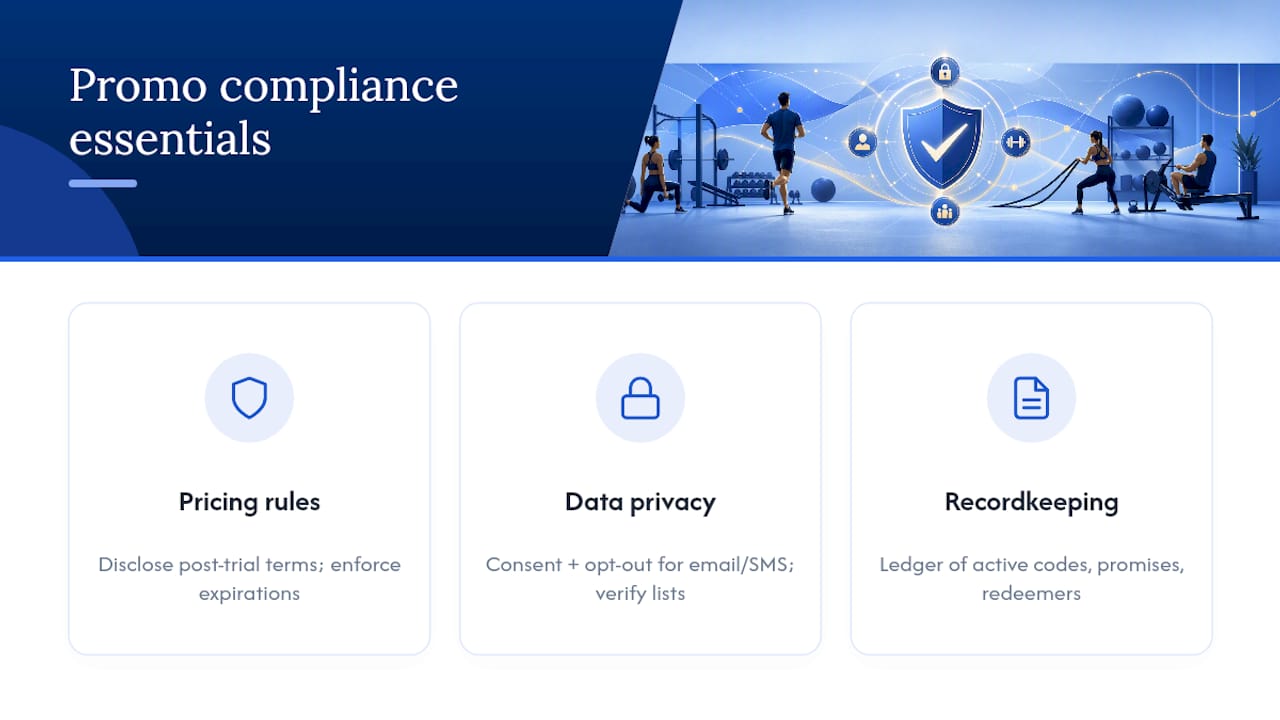
Promo codes touch consumer protection rules the moment they involve pricing, so the terms attached to a discount need to be as clear as the discount itself. If a code advertises "50% off your first month," the offer needs to state plainly what happens after that first month, since ambiguous auto-renewal terms are a common trigger for consumer complaints and chargebacks. State and federal advertising rules generally require that any discount claim be accurate and not misleading, which means a code that says "limited time" should actually have an enforced expiration date in your system, not an indefinite one left open for convenience.
Data privacy is the second piece. Promo distribution through email and SMS means you're collecting and using contact information for marketing, which puts you under the same consent and opt-out obligations as any other marketing communication. A referral or influencer code that requires collecting a partner's contact list carries its own data-handling responsibility, so confirm any list you're marketing to was gathered with proper consent before you load it into a campaign.
None of this requires a legal department for a standard membership discount, but it does mean documenting your terms clearly at the point of redemption and keeping records of when a code was active, what it promised, and who redeemed it. That's exactly what an activations ledger is for, and it doubles as your defense if a billing dispute or complaint ever surfaces.
What Most Gyms Get Wrong About Promo Codes
The conventional advice on gym promotions treats the discount as the whole strategy: pick a percentage, post it on Instagram, see what happens. That's backward. The discount is the least interesting part of the system. What actually determines whether a promo campaign helps or hurts your gym is whether you configured limits tight enough to protect margin and built tracking specific enough to know if it worked.
Most operators I'd bet skip the per-customer limit field entirely, treating it as optional when it's the single control that prevents a well-intentioned "welcome back" offer from becoming a coupon that circulates indefinitely. The second most common gap is distribution without attribution. A code posted everywhere with no channel tagging generates redemptions nobody can explain later.
Prioritize the boring parts first: scoped applicability, a hard per-customer cap, and a tracking tag baked into the code string itself. The creative offer can come second. A gym that runs three tightly controlled, well-tracked promotions a year will outperform one running constant, loosely governed discounts, even if the second gym's total redemption count looks bigger on paper.
— Vedad
Get Your Promo Code System Running in Finegym
Running promo codes through spreadsheets and manual discount entry works until you have more than one campaign live at once, and then it stops working fast. FineGym gives gym owners and franchise operators the discount fields, activation tracking, and automated distribution described throughout this guide in a single connected system, so a code you create today shows up correctly in billing, attendance, and reporting without a manual reconciliation step.
Explore the full feature set to see exactly how discount rules, notifications, and check-in data connect, or start with the free gym management tier to test a real promo code workflow before committing to a paid plan. If you'd rather walk through it live, schedule a demo through the gym management solution page and bring three things with you: your target audience for the next campaign, the discount size you're considering, and the tracking tags you want attached to each channel. That's enough for a FineGym team member to show you the exact setup screens you'd use on day one.
Key Takeaways
Promo codes for gyms work when every code carries explicit scope, hard usage limits, and a tracking tag, and when redemption data gets joined with billing data to calculate real cost per acquisition.
| Point | Details |
|---|---|
| Configure six fields minimum | Code string, discount type, applicability, date range, total limit, and per-customer limit. |
| Validate in sequence | Systems check existence, active status, date range, usage limit, uniqueness, and applicability in that order. |
| Tag every channel | Embed campaign metadata in the code or link so redemptions attribute back to email, SMS, social, or referral sources. |
| Cap concurrent promotions | Run no more than two or three offers at once to avoid promotion fatigue and margin erosion. |
| Use Finegym for setup and reporting | FineGym's discount fields, activation ledger, and marketing automation connect setup, distribution, and KPI exports in one platform. |