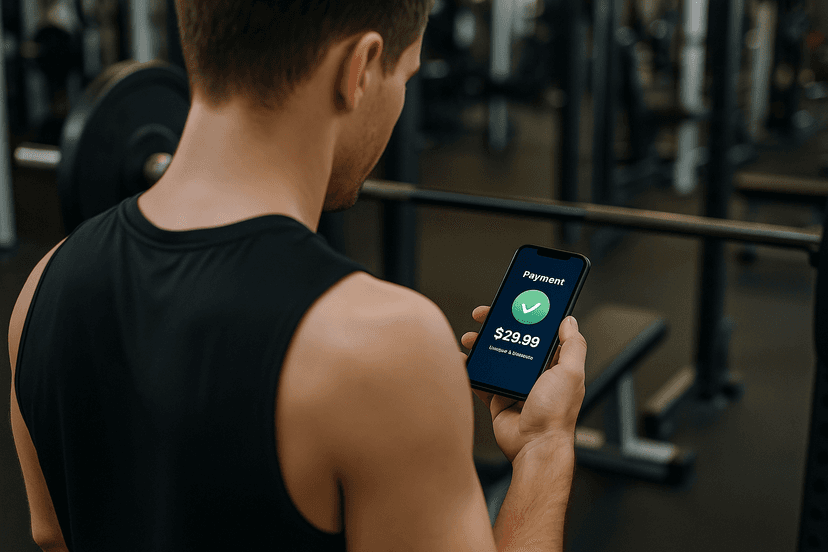

If you run a gym, SMS marketing is the highest-ROI communication channel available to you, full stop. Gym text messages get read almost immediately, and when you build the right automated flows, they cut no-shows, recover failed payments faster, and pull lapsed members back through the door. Start with three flows, in this order: class reminders with one-tap confirmation, renewal and payment nudges, and re-engagement texts for members who have gone quiet.
Those three cover the bulk of the operational pain every gym owner deals with weekly. Class reminders fix the no-show problem. Payment nudges fix the revenue leak. Re-engagement texts fix the silent churn that never shows up until the cancellation request lands on your desk.
- Class and appointment reminders with a reply-YES-to-confirm option, sent a few hours before a session
- Billing and renewal reminders sent days before a charge and immediately after a failed payment
- Re-engagement texts triggered automatically after a period without a check-in
A platform like Finegym can host all three as automated triggers tied directly to your class schedule and billing system, so the messages fire without anyone on staff lifting a finger. If you do nothing else after reading this, set up one automated class-reminder flow this week. Gym text messages report very high open rates, significantly exceeding typical email open rates (https://www.textedly.com/blog/text-marketing-for-gyms), which alone explains why this channel outperforms almost everything else in your marketing stack.
Key Takeaways
SMS marketing works for gyms because trigger-based, personalized texts convert attention into fewer no-shows, faster payment recovery, and measurable retention gains.
| Point | Details |
|---|---|
| Launch class reminders first | Automated one-tap confirmations cut no-shows by 25 to 40%. |
| Automate renewal and billing nudges | Text-based payment recovery resolves faster than email reminders. |
| Build a 30-day onboarding drip | Five-message sequences can lift 30-day retention by 20 to 30%. |
| Collect consent properly | Written opt-in and automatic STOP/HELP handling are non-negotiable under TCPA. |
| Measure attendance and opt-out rates weekly | Pivot any flow crossing a 2% monthly opt-out threshold. |
| Consider an integrated platform | Finegym hosts class, billing, and check-in triggers inside one system instead of a separate SMS tool. |
Table of Contents
- Why SMS Marketing for Gyms Outperforms Other Channels
- Concrete SMS Use Cases That Move the Needle for Gyms
- Legal Essentials: Consent, TCPA Basics, and Staying Compliant
- Writing, Timing, and Segmentation Rules That Protect Deliverability
- How to Collect Opt-Ins and Grow Your SMS List Ethically
- How to Set Up SMS for Your Gym: Integrations and Automation
- Ready-to-Use SMS Templates for Gyms
- What to Measure and Simple Benchmarks for SMS Success
- 30-Minute Checklist to Launch Your First SMS Flow
- Legal Compliance Beyond TCPA: What Else Applies
- Data Privacy and Security for Member Phone Numbers
- Cost Considerations for SMS Marketing Platforms
- A Publisher's Perspective on What Actually Works
- How Finegym Helps You Run SMS Without the Manual Work
- Sources
Why SMS Marketing for Gyms Outperforms Other Channels
The core advantage is visibility. A text message sitting on a member's lock screen gets noticed within minutes, not scrolled past in an inbox. That single fact changes how you should think about every operational problem a gym faces, from empty morning classes to overdue invoices.
Consider what a missed class actually costs you. An empty slot in a coach-led session is lost revenue and lost goodwill, since the member paid for access they didn't use. Automated class reminders with one-tap confirmation commonly cut no-shows by 25 to 40% in fitness environments, which for a mid-size studio running 20 classes a week can mean the difference between a half-full room and a waitlist.
Billing tells a similar story. Gyms using automated SMS for failed payments report faster resolution than email-based reminders, with some vendor case studies showing roughly 75% of members updating a failed card within 24 hours of a text alert. Email reminders for the same scenario routinely sit unread for days.
| Channel | Typical open rate | Typical response speed |
|---|---|---|
| SMS | ~98% | Minutes |
| 20 to 30% | Hours to days | |
| App push notification | Varies widely | Minutes, if notifications are enabled |
Pro Tip: Don't treat SMS as a replacement for email, treat it as your urgent-action channel. Use email for newsletters and program updates; reserve texts for anything with a deadline or a dollar figure attached.
SMS also drives direct revenue, not just operational efficiency. Broader consumer data shows 75% of people have completed a purchase as a result of SMS marketing in some studies, which matters when you're running a flash sale on a class pack or trying to fill a new session before launch.
- SMS reaches members who never open your emails
- Two-way texting lets members confirm or cancel in one tap
- Billing recovery happens same-day instead of over a week
Concrete SMS Use Cases That Move the Needle for Gyms
Not every message deserves the same priority. Some flows protect revenue you're already earning; others generate new revenue or rescue members who are about to quit. Here's how to think through the full list.
Class and appointment reminders. Send 2 to 4 hours before the session with a reply-YES-to-confirm option. Example: "Hey Jamie, your 6pm HIIT class with Coach Marcus starts soon. Reply YES to confirm your spot or CANCEL to release it."

Billing and renewal reminders. Send 3 days before a scheduled charge, then immediately after any failed payment. Example: "Your membership renews Friday for $89. Update your card here: [link]. Reply STOP to opt out of texts."
Re-engagement and win-back. Trigger automatically after 14 days of no check-ins. Example: "We miss you at Iron Yard Fitness! Come back this week and your next class is on us."
Onboarding drips. Send a five-message sequence across the first 30 days covering the welcome text, a schedule link, a check-in nudge, a tips message, and a satisfaction check.
Referral prompts. Send after a member's third consecutive month or a strong milestone (first 10 classes, a personal record). Example: "You've hit 10 classes this month. Know someone who'd love it here? Send them your code for a free trial class."
Event and challenge promotion. Send 5 to 7 days before a signup deadline for a specific event, tapering to a final reminder 24 hours out.
Limited-time offers. Send sparingly, capped at once or twice a month, tied to a real deadline rather than a generic discount.
| Use case | Urgency | Expected impact | Launch priority |
|---|---|---|---|
| Class reminders | High | Reduces no-shows 25 to 40% | Launch first |
| Billing/renewal nudges | High | Faster payment recovery | Launch first |
| Re-engagement/win-back | Medium | Recovers at-risk members | Launch second |
| Onboarding drips | Medium | Lifts 30-day retention 20 to 30% | Launch second |
| Referral prompts | Low | Steady, incremental growth | Launch third |
| Event/challenge promotion | Variable | Fills specific programs | As needed |
Legal Essentials: Consent, TCPA Basics, and Staying Compliant
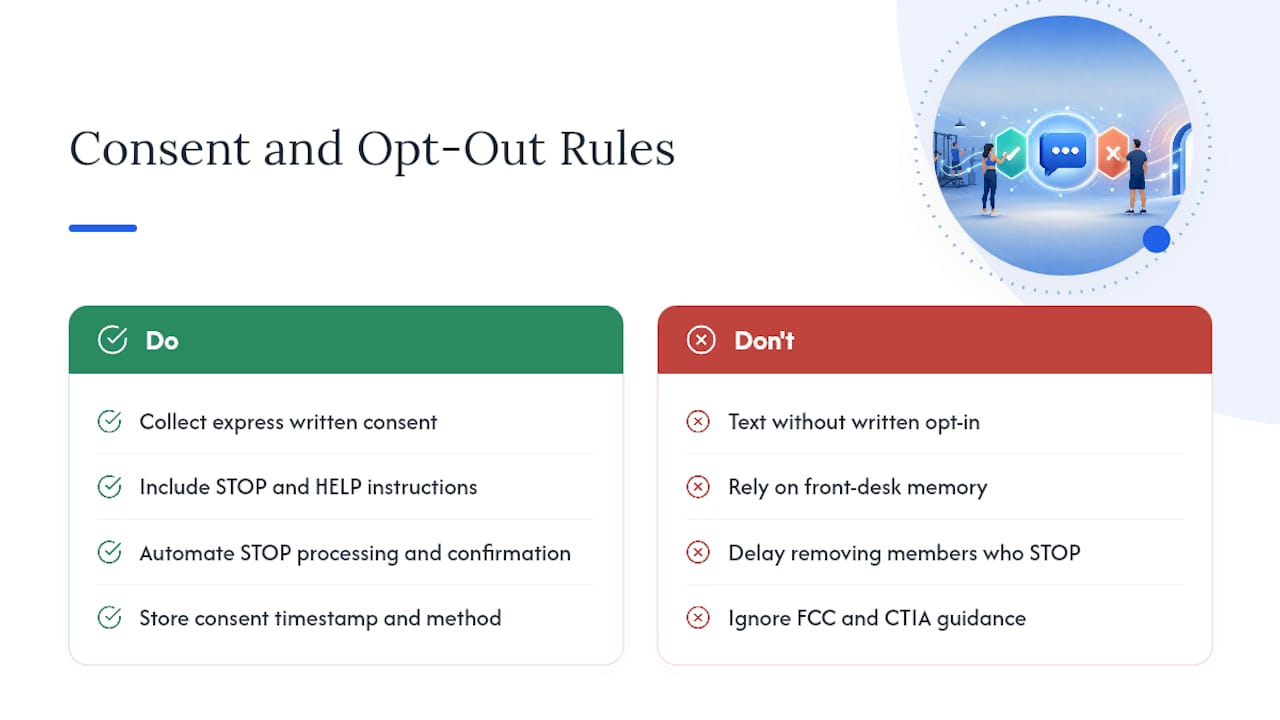
You need express written consent before texting anyone, and this isn't optional paperwork you can skip because "they're already a member." SMS marketing in the United States requires explicit, written opt-in from each member, typically collected at signup through a checkbox, a keyword text-in campaign, or a digital waiver.
A compliant platform handles opt-out language automatically. Every promotional message needs a clear STOP instruction, and your system needs to process that STOP instantly, remove the member from future sends, and confirm the opt-out without you touching a thing. HELP requests need a similar automatic response pointing members to support.
Members who text STOP must be removed from all future promotional messages immediately, and gyms that fail to honor opt-outs quickly expose themselves to real regulatory and reputational risk. Building this into your platform, not your front-desk memory, is the only reliable way to stay compliant.
Pro Tip: Use wording like this at signup: "By checking this box, I agree to receive text messages from [Gym Name] about classes, billing, and promotions. Message frequency varies. Reply STOP to opt out, HELP for help. Msg & data rates may apply." Store the timestamp and method of consent in your member record, not just a checked box on paper.
For the full legal text, the FCC's telemarketing and robocall guidance covers federal rules relevant to consent and automated messaging, and CTIA publishes industry-standard messaging best practices worth reviewing before you launch your first campaign.
Writing, Timing, and Segmentation Rules That Protect Deliverability
The single most common mistake gyms make with SMS is treating it like a billboard. Blasting the same generic offer to your entire list, repeatedly, is the fastest way to spike opt-outs. The gyms that get this right write texts the way a coach would talk to a member, direct, personal, and short.
Keep messages under 160 characters when possible, use the member's first name, and always give a clear single action. Avoid stacking multiple links or asks in one text. Send windows matter too: mornings between 8 and 10am and early evenings between 5 and 7pm tend to perform well for gym audiences, while late-night texts almost always hurt trust.
Cap promotional sends to a few per month outside of transactional messages like reminders and billing alerts, which run on their own trigger schedule and don't count against that cap.
- New members: onboarding drip only for the first 30 days, no promotions
- Active class-goers: class reminders plus occasional referral prompts
- Weekend-only attendees: re-engagement texts tuned to their actual attendance pattern, not a Monday-morning blast
- Personal training clients: session reminders and renewal nudges specific to their package, never general gym-wide offers
Do personalize with names, class times, and coach names. Don't send more than one link per message. Do honor quiet hours (no texts before 8am or after 8pm). Don't reuse the same discount copy across every campaign; members notice repetition fast.
Pro Tip: Set your sender ID to your gym's actual name, not a generic shortcode, and keep message patterns consistent (same greeting style, same sign-off) so members recognize your texts instantly and reply rates stay high.
How to Collect Opt-Ins and Grow Your SMS List Ethically
Building a list the right way protects you legally and produces better engagement, since members who actively opted in respond far more than ones swept into a list during a rushed signup. Collection needs to be visible, easy, and honest about what members are agreeing to receive.
- Front-desk checkboxes during new-member signup, with the consent language printed clearly, not buried in fine print
- Digital waivers that include an SMS opt-in field as a standard step, not an afterthought
- QR codes posted near the front desk and in locker rooms linking to a one-field opt-in form
- Keyword campaigns on gym signage ("Text JOIN to [number] for class updates and offers")
- Website booking flows that include an SMS opt-in checkbox at checkout
Incentives work well here. Offering a free day pass, a single class credit, or a small retail discount in exchange for opting in consistently boosts signup rates without feeling like a bribe.
- Collect the opt-in at the point of highest intent (signup, booking, or checkout)
- Send an immediate welcome text confirming the subscription and setting expectations
- Follow with a link to the class schedule or booking app within the first 24 hours
- Layer in the rest of your onboarding drip over the following 30 days
A sample welcome message: "Welcome to [Gym Name]! You're all set to receive class reminders and updates by text. Book your first class here: [link]. Reply STOP anytime to opt out." Keep the opt-in language visible wherever you collect the number, on the form itself, not in a linked terms page nobody reads.
How to Set Up SMS for Your Gym: Integrations and Automation
Getting your first automated flow live is mostly a checklist problem, not a technical one. Work through it in order and you'll have a working system faster than most owners expect.
- Choose a dedicated sender number (a local number or short code, depending on your message volume)
- Enable opt-in capture across every channel, front desk, waiver, website, and QR codes
- Sync your member database so phone numbers and opt-in status flag automatically inside your gym management system
- Set automation triggers tied to real behaviors, not calendar dates
- Test every flow internally with staff numbers before sending to a single real member
- Roll out to a small pilot group before activating the flow gym-wide
Trigger-based automation consistently outperforms calendar-based bulk messaging because the message actually matches what the member just did. A booking confirms a class reminder. A missed payment triggers a billing text. Fourteen days of no check-ins triggers a re-engagement message. Each of these feels personal because it responds to something the member actually did or didn't do.
A platform like Finegym can host these triggers directly inside your existing member and billing data, so a failed payment or a missed class automatically fires the right text without a manual export or a third-party sync. That integration point, tying the message engine directly to attendance and billing records, is usually the biggest technical hurdle gyms hit when they try to piece together separate tools.
Pro Tip: Before going live, run every automation through a staff-only test cycle for one full week. Confirm the STOP keyword actually removes a number from the system, not just marks it internally, before a single real member sees a message.
Train front-desk staff on the exact opt-in script and where consent gets recorded. Staff who understand the "why" behind the compliance step collect cleaner opt-ins than staff just checking a box to move the line along.
Ready-to-Use SMS Templates for Gyms
Copy these directly and swap in your own tokens. Character counts assume a single SMS segment (roughly 160 characters); longer messages split into multiple segments and cost more to send.
- Class reminder: "Hi [First Name], your [Class Name] with [Trainer Name] starts at [Time] today. Reply YES to confirm or CANCEL to release your spot."
- Failed payment: "[First Name], we couldn't process your membership payment. Update your card securely here: [link]. Reply STOP to opt out."
- Renewal nudge: "Your membership renews on [Date] for [Amount]. No action needed unless you'd like to update your plan: [link]."
- Re-engagement: "We haven't seen you at [Gym Name] in a while, [First Name]. Come back this week, your next class is on us."
- Onboarding welcome: "Welcome to [Gym Name]! Book your first class here: [link]. Text HELP anytime with questions."
- Referral request: "You just hit [Milestone], [First Name]! Share your referral code [Code] with a friend for a free trial class."
- Event promotion: "Spots are filling for our [Event Name] on [Date]. Reserve yours here: [link] before they're gone."
- Limited-time offer: "This week only: [Offer Details]. Claim it here: [link]. Offer ends [Date]."
Use tokens for first name, class time, and trainer name wherever possible, personalized texts consistently outperform generic blasts. A full 25-template pack covering every seasonal and operational scenario is available as a downloadable resource if you want a broader starting library than the eight above.
What to Measure and Simple Benchmarks for SMS Success
Track a small set of numbers rather than drowning in dashboards. Delivery rate tells you if your list is clean. Opt-out rate tells you if your content is landing wrong. Everything past that measures actual business impact.
To calculate attendance lift yourself, compare no-show rates for a class before and after launching reminders. If a class averaged 8 no-shows out of 20 bookings before reminders, and drops to 5 no-shows after, that's a 37.5% reduction, right in line with the 25 to 40% range reported across fitness businesses.
- Review delivery and opt-out rates weekly for the first month of any new flow
- Review attendance and retention lift monthly once a flow is stable
- Pivot or rewrite a campaign if opt-outs exceed 2% of sends in a single month
30-Minute Checklist to Launch Your First SMS Flow
You don't need a big rollout plan to get started. Here's the fastest path to a live class-reminder flow, from a standing start.
- Capture one test opt-in using your own phone number
- Confirm your sender number is active and verified
- Write your reminder text using the class-reminder template above
- Set the automation trigger to fire 2 to 4 hours before a booked class
- Send a test message to internal staff and confirm it arrives correctly
- Text STOP from a test number and verify the system removes it immediately
- Launch to a small pilot group (one class, one week) before enabling gym-wide
Run the pilot for a full week, check delivery and reply rates daily, then expand to your full class schedule once you're confident the trigger and opt-out handling are both working cleanly.
Legal Compliance Beyond TCPA: What Else Applies
TCPA covers the federal consent requirement, but it isn't the only rule that matters if your gym operates internationally or serves members who reside in the European Union. GDPR applies to any gym processing data for EU residents, which means additional requirements around explicit consent records, the right to be forgotten, and clear disclosure of how phone numbers are stored and used.
Most U.S.-based gyms serving a domestic membership base won't trigger GDPR obligations, but multi-location operators or gyms with international membership bases should treat consent records as auditable data, not just a checkbox. State-level texting laws also vary, some states add extra disclosure requirements on top of federal rules, so it's worth a quick review with legal counsel if you operate across state lines. This is general guidance, not legal advice, confirm your specific obligations with a qualified attorney before launching a large-scale program.
Data Privacy and Security for Member Phone Numbers
Phone numbers are personal data, and treating them casually creates both legal exposure and member distrust. Store consent records, timestamp, method, and opt-in language shown, alongside the phone number itself, not as a separate spreadsheet someone maintains manually.
Limit access to your SMS platform to staff who actually need it, and use a platform with encrypted storage and role-based permissions rather than a shared login everyone on staff uses. Never sell or share member phone numbers with third parties, and make sure your privacy policy explicitly discloses how SMS data is used and retained. A breach involving member contact data damages trust in ways that are hard to repair, members notice immediately when their information feels mishandled.
Cost Considerations for SMS Marketing Platforms
Pricing for SMS platforms usually follows one of two models: a flat monthly subscription with a message allotment, or pay-per-message pricing that scales with volume. Most gym-focused platforms fall somewhere between $20 and a few hundred dollars a month depending on list size and message volume, with per-message costs typically fractions of a cent once you're inside a plan.
Budget for overage costs too. A gym running heavy promotional campaigns or large onboarding drips can burn through a monthly allotment faster than expected, so check whether your platform charges a flat overage rate or bumps you to the next tier automatically. Platforms that bundle SMS into your existing gym management software, rather than requiring a separate standalone tool, usually work out cheaper in practice since you're not paying for two systems to sync member data manually.
A Publisher's Perspective on What Actually Works
Most of the SMS advice circulating in the fitness industry focuses on volume, more messages, more segments, more automation. That's backward. The gyms that get real results from SMS marketing for gyms is the one that starts narrow and builds slowly: one flow, tested cleanly, expanded only after it proves out.
Class reminders should always be the first flow you launch, not renewal nudges, not re-engagement, not promotions. The reason is simple: it's the flow with the clearest immediate payoff, fewer no-shows, happier coaches, better-utilized class capacity, and it teaches your team how the automation actually behaves before you layer in anything tied to billing or retention. Once that flow runs cleanly for two to three weeks, add renewal and payment nudges. Re-engagement comes third, because it requires the most nuance to get the tone right without sounding like a guilt trip.
The gyms that stumble almost always skip straight to promotional blasts because that's the flashy use case everyone talks about. It's also the fastest way to rack up opt-outs before you've built any trust with your list., and the pattern across every gym implementation I've reviewed is consistent: trust-building transactional flows first, promotional messaging second, always in that order.
How Finegym Helps You Run SMS Without the Manual Work
Finegym is built for gyms that want these SMS flows running inside their existing member and billing data, not bolted on as a separate tool you have to maintain yourself. Because class bookings, payments, and check-ins already live in the platform, a missed class or a failed payment can trigger a text automatically, no manual export, no third-party sync, no spreadsheet gymnastics.
The platform's engaging notifications feature handles class reminders with one-tap confirmation, billing alerts tied directly to your payment processor, and re-engagement triggers based on real check-in data. Opt-in capture is built into the member mobile app and signup flow, so you're not managing consent records in a separate system. Class scheduling and booking integrations connect directly to the reminder engine, which means the trigger setup described earlier in this article takes minutes, not a development sprint.
If you're running a small studio or a multi-location operation, the gym management platform includes data migration support so your existing member list and phone numbers move over cleanly. Start a demo to see how your specific class schedule and billing setup would map to automated SMS triggers.
Sources
- Textmunication — Health Club & Gym SMS/MMS
- INSIDEA — The Ultimate SMS Marketing Guide for Gyms
- EZ Texting — SMS Marketing for Gyms & Fitness Studios
- Federal Communications Commission — Telemarketing and robocalls
FAQ
Is SMS marketing legal for gyms? Yes, as long as you collect explicit written consent before sending promotional texts and honor STOP requests immediately, in line with TCPA requirements.
How often should a gym text its members? Cap promotional messages at 2 to 4 per month. Transactional messages, class reminders, billing alerts, run on their own trigger schedule and don't count against that cap.
What's the best first SMS flow for a gym to launch? Class reminders with one-tap confirmation. They have the clearest immediate payoff and the lowest risk of member fatigue.
Do gym members actually respond to SMS marketing for gyms? Yes. Gym texts see open rates near 98%, and younger members in particular respond well to promotional SMS when it's personalized and relevant.
What happens if a member texts STOP? A compliant platform removes them from all future promotional and transactional marketing texts immediately and logs the opt-out automatically.