

A corporate membership gym program is a B2B productized membership that a gym sells and bills directly to employers, built around defined tiers, roster management, access controls, and monthly reporting. It is not a subsidy that an employer hands to individual employees to spend at any gym. It is a contract your gym owns, prices, and services, and the employer becomes your customer of record.
Here's the quick checklist before you build anything else:
- Product tiers: 2–3 fixed packages (no custom pricing per deal)
- Minimums: a headcount floor, typically 15–20 employees per account
- Billing cadence: monthly invoice, net 30, tied to a reconciled roster
- Roster process: a standard intake template with additions/removals
- Access controls: QR check-in, member IDs, or a corporate promo code
- Reporting KPIs: enrolled vs. active, visits per member, retention
- Renewal terms: auto-renew with a defined notice period
A single account of this kind can deliver 15 to 50 pre-committed members with predictable monthly revenue, and operators who add these programs report meaningfully higher profitability and retention compared to relying on retail sign-ups alone. FineGym's platform is built to run this exact workflow without adding headcount.
Key Takeaways
A corporate membership gym program succeeds when packages are standardized, billing is roster-reconciled and automated, and monthly reporting removes HR's administrative burden entirely.
| Point | Details |
|---|---|
| Productize before you sell | Build 1 to 3 fixed tiers before your first sales call; avoid custom pricing per employer. |
| Price by tier and volume | Use bands like $20 to $60 basic, — access+classes, — premium per employee. |
| Bill on a roster cycle | Invoice monthly, net 30, reconciled against a signed and updated employee roster. |
| Report what HR actually wants | Track enrolled vs. active members, visits per member, and 30/60/90-day retention monthly. |
| Automate to scale | FineGym automates roster reconciliation, QR check-ins, invoicing, and renewal triggers for corporate accounts. |
Table of Contents
- Setting Up a Corporate Membership Gym Program Step by Step
- Pricing Models and Sample Pricing Tiers
- Billing, Invoicing, and Contract Essentials
- Running Enrollment and Access Control Day to Day
- KPIs and Reports Corporate Clients Expect
- Legal, Privacy, and Risk Basics to Cover Before Launch
- How Corporate Gym Memberships Compare to Other Wellness Benefits
- Where Corporate Membership Programs Usually Go Wrong
- Simplifying Corporate Programs With a Gym Management Platform
- Frequently Asked Questions
- Sources
Setting Up a Corporate Membership Gym Program Step by Step
Start narrow. Pick a target employer profile, roughly 25 to 200 employees, ideally within a short commute or walk of your location, and industries where wellness perks help with hiring (tech, healthcare, professional services). Don't build a bespoke offer for the first company that calls. Build one productized pilot and sell that same pilot to three or four employers before you touch pricing again.
- Define pilot objectives. Pick a target segment and set a goal: X signed accounts, Y enrolled employees, within 90 days.
- Build 1 to 3 standardized packages. Resist the urge to negotiate custom terms during the pilot. Consistency here is what makes reporting and billing manageable later.
- Run the sales cycle. Outreach to HR or office managers, a single sales meeting, a signed pilot agreement covering 30 to 90 days.
- Launch and measure. Track enrollment against roster size weekly, not monthly, during the pilot window.
- Hit your decision point. At day 60 or 90, decide to convert to an annual contract, adjust terms, or walk away.
Your implementation checklist should include a contract template, a roster intake form, a defined enrollment flow, an access provisioning step, a reporting cadence, and a renewal trigger date logged in your calendar. Assign clear operational handoffs too:
- Sales closes the deal and hands off a signed contract.
- Operations owns onboarding, access provisioning, and monthly reporting.
- An accounts payable contact on your side matches HR's designated point of contact on theirs.
One employer contact, one internal owner. Two-sided ambiguity here is where corporate accounts quietly fall apart.
Pricing Models and Sample Pricing Tiers
Three pricing structures dominate this market: employer-subsidized per-employee rates, prepaid bulk seat blocks, and add-on programming like on-site classes or personal training credits layered on top of a base membership. Most gyms starting out should pick one, not blend all three into a single confusing menu.
Suggested pricing bands, based on what similar direct gym partnerships typically charge:
Here's a worked example. Say you sign a 20-seat account on the Access + Classes tier at $55 per employee. That's $1,100 in monthly recurring revenue from one contract, invoiced once rather than chased through 20 individual retail transactions. Corporate accounts in this range can realistically generate $2,000 to $8,000 per month once you're running two or three of them.
A few pricing rules worth locking in from day one:
- Set a minimum headcount (15 to 20 seats) below which you won't sign a contract.
- Offer a 10% discount for annual prepay to lock in cash flow.
- Bill for reserved capacity, not just logged visits, when seats are held.
- Define upgrade and overage terms clearly (what happens when an employer wants to add 10 more employees mid-term).
Pro Tip: Protect your peak hours. Cap corporate seat access during your busiest evening slots, and use off-peak pricing incentives (free morning classes, mid-day credits) to steer corporate members toward the hours your retail members aren't using.
Billing, Invoicing, and Contract Essentials
Standard practice is monthly invoicing to the employer, net 30, reconciled against a current employee roster. Your contract needs to spell out the mechanics before either side has a dispute, not after.
Include these clauses at minimum:
- Per-employee rate and total contract value
- Minimum headcount and what happens if enrollment drops below it
- Roster update cadence (weekly or monthly, agreed in writing)
- Invoice terms and late payment consequences
- Termination and individual conversion terms if the employer cancels
- Liability, waiver, and data-sharing obligations
Set a 10-day expiry on proposals to keep your sales cycle moving, and require a signed roster template before access provisioning starts. Your invoice itself should list the employer name, billing period, headcount billed, per-seat rate, and any reserved-but-unused seats, with a short reconciliation checklist your accounts payable contact can run against their own HR records each month.
Reserved capacity and actual usage are not the same thing. If an employer holds 20 seats but only 14 employees check in, you're still owed for 20 unless the contract states otherwise. Decide your rollback and credit policy before you sign, not during the first billing dispute.
Running Enrollment and Access Control Day to Day
The enrollment workflow should run the same way every time: roster intake (a CSV or form submission) creates member records, triggers a digital waiver and welcome sequence, then provisions access. Manual, ad hoc onboarding is where most corporate programs lose time.
For access control, you have real tradeoffs to weigh:
- QR check-ins are fast to deploy and easy for employees to use from their phones.
- RFID or member ID cards work well for gyms already using turnstile hardware.
- Corporate promo codes are the simplest option but offer weaker tracking per individual.
Run a monthly roster reconciliation to catch departures and new hires before billing goes out, and automate this wherever your software allows it. On the capacity side, map corporate seats against your class schedule ahead of time. Twenty new corporate members showing up for the same 6 p.m. class will strain a room that wasn't built for it.
Pro Tip: Productize the entire enrollment sequence so HR does zero administrative work after the contract is signed. That's the single biggest thing that keeps an employer renewing.
KPIs and Reports Corporate Clients Expect
HR and benefits teams don't care about your class schedule. They care about whether the money is working. Track and report on enrolled employees against total roster size, active participants, visits per active member, attendance by class format, retention at 30/60/90 days, utilization by time slot, and a satisfaction score if you collect one.
Each metric answers a different question for the employer: enrollment shows reach, visits per member shows engagement, and retention is the closest thing to an ROI signal HR can take back to leadership.
A sample monthly report should include:
- A cover page with account summary and contract status
- Enrolled vs. active employee counts
- Top class formats and peak usage times
- A utilization heat map by day and hour
- One or two recommended actions (like a re-engagement push for inactive employees)
Automate this delivery wherever possible:
- Pull usage data from your gym management software on a fixed schedule.
- Auto-generate the report against a saved template.
- Send it to the HR contact monthly, with a short quarterly narrative summary added on top.
Early attendance data matters here too. Members who log fewer than six visits in their first month have a 72% chance of going inactive within 90 days, which makes a 30-day check-in worth building into your reporting cadence, not just your onboarding.
Legal, Privacy, and Risk Basics to Cover Before Launch
Before you sign your first contract, confirm signed waivers for every enrolled employee, written consent for sharing usage data, active insurance and liability coverage, and a clear refund and cancellation policy.
Limit what employers can see. Share aggregated usage numbers, not individual attendance or health data, unless a specific employee has consented to more granular reporting.
Have a lawyer review your standard contract language, and add a clause letting employees convert to an individual plan if the employer cancels. It protects revenue and goodwill at the same time.
A 90-Day Timeline and Resource Checklist
- Weeks 0–2: sales outreach and contract signing
- Weeks 2–4: roster intake and employee onboarding
- Month 1: pilot launch
- Months 2–3: measure results and iterate
- Month 3: decide to scale or end
You'll need a sales lead, an operations owner, a billing contact, someone handling roster automation, and a designated HR contact on the employer's side. Automating roster and reporting work cuts recurring admin hours substantially once you're running more than one account.
How Corporate Gym Memberships Compare to Other Wellness Benefits
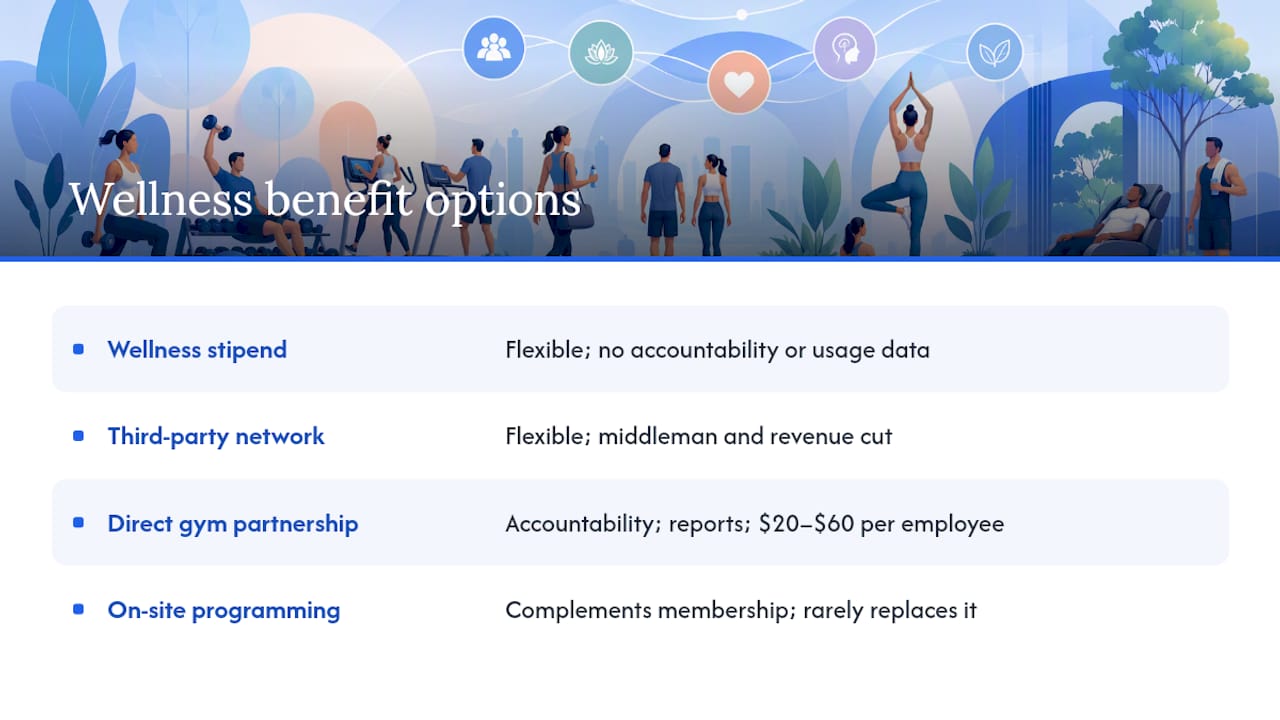
Employers choosing a wellness benefit usually weigh a corporate gym membership against a handful of alternatives: wellness stipends, third-party fitness network subscriptions, on-site programming, or nothing at all beyond a wellness stipend line item in the benefits package.
Stipends give employees flexibility but no accountability. An employee can pocket the money and never set foot in a gym, which leaves HR with no usage data and no story to tell leadership at renewal time. Third-party network subscriptions solve the flexibility problem but add a middleman between you and the employer, along with a cut of the revenue that a direct partnership avoids.
Direct partnerships with a single gym, priced $20 to $60 per employee monthly depending on volume and structure, tend to sit in a sweet spot: employers get one point of contact, one invoice, and one report, while your gym keeps full control over pricing and the member experience. On-site programming (bringing a trainer or class instructor into the workplace) can complement a membership but rarely replaces it, since employees still want access to full equipment and a real facility outside office hours.
The tradeoff for employers comes down to accountability versus flexibility. A gym-sold membership wins on accountability and reporting. A stipend wins on flexibility. Most mid-size employers land somewhere in between, often pairing a discounted gym membership with a smaller optional stipend for employees who prefer something else.
Where Corporate Membership Programs Usually Go Wrong
The biggest pitfalls repeat across almost every operator I've seen struggle with this: failing to productize the offer (custom pricing for every deal), letting the employer own logistics instead of you, weak or nonexistent onboarding for enrolled employees, and skipping monthly reporting until the employer asks where it went.
The fixes aren't complicated. Standardize your packages before your first sales call. Require a roster template, don't accept ad hoc spreadsheets. Automate reconciliation so nobody's manually cross-checking names against invoices. Offer a conversion discount to individual plans before renewal conversations start, so a canceling employer doesn't cost you every enrolled member at once.
Pro Tip: Pitch removing HR's workload, not your equipment or class schedule. Employers buy low-friction solutions, and the gym that requires zero admin from HR wins the deal over the gym with the nicer lobby.
Simplifying Corporate Programs With a Gym Management Platform
Everything above, the roster intake, the reconciliation, the monthly report, the renewal reminder, is manageable for one corporate account. It gets unmanageable at five or ten unless it's automated.
FineGym's corporate wellness program tools handle roster automation, QR check-ins, automated invoicing, and scheduled usage report generation, so the reconciliation and reporting work described in the sections above happens without a spreadsheet. Automating these five workflows, enrollment, reconciliation, reporting, renewal triggers, and upsell alerts, is what lets a gym run multiple corporate accounts without adding staff to manage them. The platform's membership management features generate the enrolled-vs-active and utilization reports HR expects monthly, and renewal sequences trigger automatically ahead of contract expiration instead of relying on someone remembering a date on a calendar.
If you're also running on-site activations or looking for programming ideas to bundle into a premium tier, resources like corporate wellness activity guides can help round out what you offer beyond floor access.
Start by exploring FineGym's full feature set or try the free tier to see how roster automation and reporting work before you commit to a paid plan.

Frequently Asked Questions
What is a corporate membership gym program exactly? It's a B2B membership package a gym sells directly to an employer, covering a group of employees under one contract, one invoice, and one set of access rules, rather than individual retail sign-ups.
How many employees do I need to sign a corporate account? Most operators set a minimum of 15 to 20 employees per contract, though pre-committed member counts on signed deals typically range from 15 to 50.
How should I bill a corporate gym client? Monthly invoicing to the employer's accounts payable contact, net 30, reconciled against a current employee roster is the standard approach.
What KPIs do employers actually want to see? Enrolled versus active employees, visits per active member, class attendance by format, and retention at 30, 60, and 90 days cover most of what HR asks for.
Do I need a lawyer to write my corporate gym contract? A short legal review of your waiver and roster language is worth the cost before you sign your first employer, given the liability and data-sharing clauses involved.
Sources
- Business Wellness Partnerships: How Gyms Win Corporate Clients
- Gym Membership as a Benefit: HR Guide and Tax Rules
- How to Add Corporate Wellness Revenue to Your Fitness Studio in 2026 | StudioStackTools
- Automate Corporate Wellness Partnership Gym — 5 Steps (2026) | US Tech Automations