

The fitness industry now has more competition than ever. New boutique studios, big-box chains, and digital workout platforms are all fighting for the same members. Even a well-run gym with excellent coaches and top-tier equipment can struggle to grow without a clear, data-backed marketing framework. Short-form video, UGC, and member stories consistently outperform polished ads in driving real engagement. This guide walks you through proven strategies, from setting the right metrics to choosing the highest-ROI channels, so you can attract more members and keep them longer.
Table of Contents
- Establish your marketing foundation: Metrics and budget
- Authenticity over polish: Use video, UGC, and member stories
- Make reputation your new homepage: Reviews and referrals
- Prioritize marketing budget: What channels work best for gyms?
- Side-by-side: Comparing top fitness marketing strategies
- Level up with all-in-one gym management solutions
- Frequently asked questions
Key Takeaways
| Point | Details |
|---|---|
| Track your metrics | Measure CPL, CAC, churn, and CLTV for clear marketing ROI and smarter decisions. |
| Choose authenticity | Use real member stories and user content to foster trust and boost engagement. |
| Build your reputation | Online reviews and referrals are now your first impressions—prioritize them for steady growth. |
| Focus marketing spend | Allocate budget to measurable, high-return channels like email and incentivized referrals. |
Establish your marketing foundation: Metrics and budget
Before you spend a single dollar on ads or content, you need to know what success looks like. That means defining four core metrics and understanding what the numbers should look like for a healthy fitness business.
- Cost per Lead (CPL): The amount you spend to generate one potential member inquiry.
- Customer Acquisition Cost (CAC): Total marketing spend divided by new members acquired.
- Monthly churn rate: The percentage of members who cancel each month.
- Customer Lifetime Value (CLTV): The total revenue a member generates before they leave.
Industry benchmarks give you a clear target. According to validated research, CPL ranges from $15 to $45, CAC sits between $150 and $350 (big-box gyms often land between $158 and $277), average monthly churn is 4.2%, and top-performing gyms keep churn below 2.5%. A healthy CLTV to CAC ratio is 3:1 or better.
| Metric | Industry average | Top performer target |
|---|---|---|
| CPL | $15 to $45 | Below $20 |
| CAC | $150 to $350 | Below $200 |
| Monthly churn | 4.2% | Below 2.5% |
| CLTV:CAC ratio | 2:1 | 3:1 or better |
Once you know your benchmarks, set your budget. Allocating 5 to 10% of revenue to marketing is the validated standard for fitness businesses. Prioritize channels you can measure, including referrals, SEO, and email, which delivers an extraordinary ROI of $42 for every $1 spent.
"The gyms that grow consistently are the ones that treat marketing like a financial discipline, not a creative experiment."
For deeper insight into tracking gym ROI and connecting spend to outcomes, a structured analytics approach pays off fast. You can also explore fitness marketing analytics to understand which data points matter most for your growth stage.
Pro Tip: Set a recurring monthly calendar reminder to review your CPL, CAC, and churn numbers. Catching a churn spike early can save you thousands in re-acquisition costs.
Once you have a measurable marketing foundation, focus on the customer experience and messaging that drive actual growth.
Authenticity over polish: Use video, UGC, and member stories
One of the most counterintuitive truths in fitness marketing is that lower-production content often outperforms expensive, polished ads. Members trust other members. A 30-second phone video of a real person hitting a personal record will generate more clicks, shares, and sign-ups than a studio-produced commercial.

User-Generated Content (UGC) refers to any content created by your members rather than your marketing team. It builds social proof organically and costs almost nothing to collect. Short-form video and UGC consistently drive higher engagement than brand-produced content across Instagram Reels, TikTok, and YouTube Shorts.
Here is how to build a steady stream of authentic content:
- Ask members to tag your gym in their workout posts and reshare the best ones.
- Feature a "Member of the Month" story on your social channels every four weeks.
- Record short video testimonials right after a member achieves a milestone, like a weight loss goal or a first pull-up.
- Create a branded hashtag and promote it at your front desk and in your welcome emails.
This approach also feeds directly into email campaigns for gyms, where member stories become compelling newsletter content that re-engages inactive members. If budget is tight, low-cost gym marketing built around UGC is one of the most efficient paths to growth.
Pro Tip: Run a quarterly "Member Story Contest" where members submit a short video or photo about their fitness journey. Offer a free month of membership as the prize. You will generate weeks of authentic content at minimal cost.
After mastering authentic content, amplify its reach by leveraging online reviews and reputation management.
Make reputation your new homepage: Reviews and referrals
Your Google Business profile and review pages now function as the first impression for most prospective members. Your gym's reputation outperforms your website as the primary decision-making tool for new sign-ups. If someone searches for a gym near them, they will read your reviews before they ever visit your website.
Building a review system does not require a big budget. It requires consistency and timing. Here is a simple four-step process:
- Identify key touchpoints: After a new member's first class, after a personal training milestone, and after a successful check-in streak (like 30 days in a row).
- Send a personalized request: Use the member's first name and reference their specific achievement. Generic requests get ignored.
- Make it frictionless: Include a direct link to your Google review page in the message. Fewer clicks means more reviews.
- Respond to every review: Thank positive reviewers and address negative ones professionally. This signals to prospects that you are attentive and accountable.
Referral programs work on the same principle of trust. A member who refers a friend is essentially vouching for your gym. Formalize this by offering a clear incentive, such as a free month or a branded gym bag, for every successful referral. Track it systematically using your member growth workflow so no referral goes unrecognized.
Pro Tip: Personalize your review request messages by mentioning a specific class or coach the member interacted with. Personalized requests generate significantly higher response rates than generic follow-ups.
With a system for reviews and referrals in place, it is time to optimize your marketing budget for the best results.
Prioritize marketing budget: What channels work best for gyms?
Not all marketing channels deliver equal results for fitness businesses. Knowing where to put your dollars, especially when budgets are limited, is one of the most practical decisions you can make. Prioritizing measurable channels like email, referrals, and SEO consistently outperforms broad paid advertising for gyms at most growth stages.
| Channel | Typical cost | Estimated ROI | Best for |
|---|---|---|---|
| Email marketing | Low | $42:$1 | Retention and re-engagement |
| Referral program | Low to medium | High (varies) | Organic acquisition |
| SEO and local search | Medium | High long-term | New member discovery |
| Paid social ads | Medium to high | Moderate | Brand awareness and promos |
| Short-form video | Low | High engagement | Trust building and reach |
For small studios just starting out, focus on email and referrals first. Both are low-cost and highly trackable. Growing gyms should layer in SEO and local search optimization to capture members actively searching for fitness options nearby. Established gyms with larger budgets can add paid social campaigns to amplify reach during key seasons like January and September.
Explore budget marketing strategies for practical channel-by-channel guidance. For automation across these channels, marketing automation for gyms can dramatically reduce the manual work involved. And if you want to extend your reach to members on the go, fitness business mobile apps are increasingly central to retention strategies.
Now, let's look at these strategies side-by-side for clarity in choosing your next steps.
Side-by-side: Comparing top fitness marketing strategies
Choosing the right mix of marketing tactics depends on your gym's size, goals, and available resources. This comparison gives you a clear view of each strategy's strengths and limitations.
| Strategy | Pros | Cons | Best fit |
|---|---|---|---|
| Short-form video | High reach, low cost, builds trust | Requires consistency and creativity | All gym sizes |
| UGC and member stories | Authentic, free content, strong social proof | Relies on member participation | Studios and boutique gyms |
| Online reviews | Drives first impressions, free to generate | Negative reviews need active management | All gym sizes |
| Email marketing | Highest ROI, fully trackable, scalable | Requires a quality contact list | Growing and established gyms |
| Referral programs | Low cost, high trust, organic growth | Needs formal tracking and incentives | All gym sizes |
| SEO and local search | Long-term visibility, compounding returns | Slow to show results, needs expertise | Established gyms |
Short-form video and UGC are the best immediate tactics for gyms that want to build trust without a large budget. Email and referrals are the most reliable long-term drivers of both acquisition and retention. SEO is a longer play but pays off significantly for gyms in competitive local markets.
For immediate wins, start with reviews and UGC. For sustained growth, invest in email automation and local SEO. Review your website design tips to make sure your site converts the traffic these strategies generate.
Level up with all-in-one gym management solutions
Knowing the right strategies is only half the equation. Executing them consistently, across email, referrals, reviews, and member engagement, requires tools that work together rather than separate systems cobbled together from different platforms.
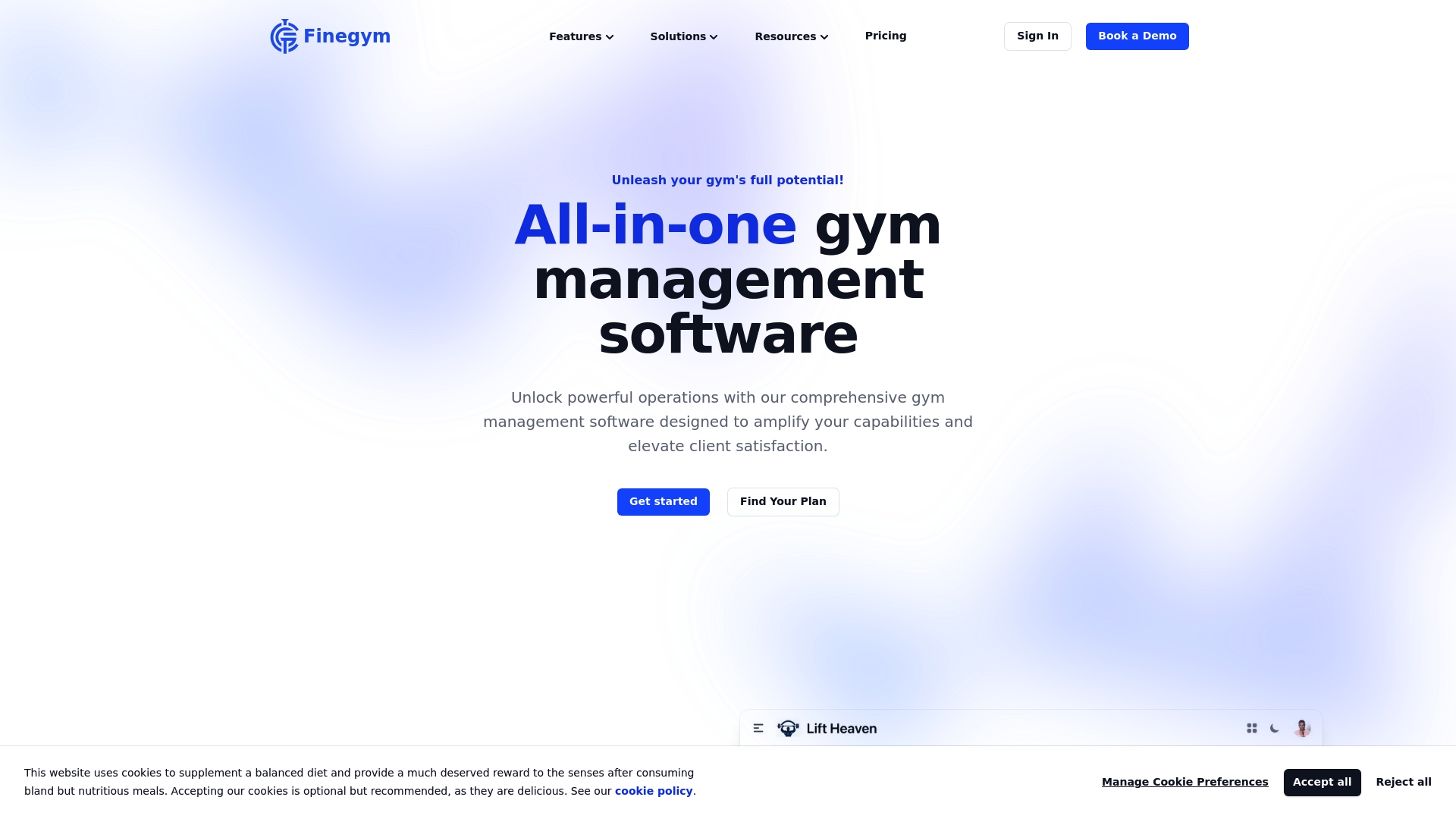
FineGym's complete gym software brings marketing automation, member management, and engagement tools into a single platform. From automated email campaigns triggered by member milestones to referral tracking and review request workflows, everything is connected. The all-in-one gym platform also includes a member mobile app, QR code check-ins, and class scheduling, so your team spends less time on admin and more time delivering results. If you are ready to put these marketing strategies on autopilot, the gym scheduling app and built-in communication tools give you a strong starting point.
Frequently asked questions
What is a good marketing budget for a fitness business?
Aim to allocate 5 to 10% of your gym's revenue to marketing, investing in results-driven channels like email and referrals that offer measurable returns.
Which marketing channel gives the highest ROI for gyms?
Email marketing typically provides the highest ROI, returning $42 for every $1 spent, making it the most cost-efficient channel for both acquisition and retention.
How do I increase member retention with marketing?
Use personalized email campaigns, gather regular reviews, and share genuine member stories and UGC to build loyalty and keep members engaged between visits.
What are key metrics to track gym marketing success?
Track CPL, CAC, churn rate, and member lifetime value monthly to measure marketing impact, identify inefficiencies, and make informed budget decisions.