

A gym franchise system is not simply renting a brand name and hanging a logo on the wall. It is a fully structured operating model that includes territory rights, proprietary software, standardized procedures, training programs, and ongoing support. Many gym owners and operators assume the primary value is in brand recognition and marketing materials. The real value, however, runs much deeper. This article breaks down how franchise systems actually work, how they generate revenue, what the financial benchmarks look like, and what separates operators who thrive from those who struggle. Whether you are evaluating your first franchise or considering scaling an existing gym into a franchise model, this guide gives you the complete picture.
Table of Contents
- Core mechanics of a gym franchise system
- How gym franchise systems make money
- Investment required and realistic benchmarks
- Critical requirements, risks, and realities
- Why success with gym franchise systems is more about execution than the brand
- Streamline gym operations with the right technology partner
- Frequently asked questions
Key Takeaways
| Point | Details |
|---|---|
| Systemized operations | Franchise systems provide standardized processes, support, and proprietary software to ensure consistency. |
| Recurring revenue focus | Memberships drive 70 to 80 percent of gym franchise income, with automation reducing labor costs. |
| Investment and benchmarks | Expect upfront investment from $400,000 to over $3 million with realistic timelines for break-even. |
| Execution is critical | Hands-on ownership, local market fit, and effective software adoption are key to franchise success. |
Core mechanics of a gym franchise system
When you buy into a gym franchise, you are not just acquiring a name. You are buying access to a proven operating framework. The Anytime Fitness model illustrates this well: core mechanics include territory protection, site selection assistance, pre-opening training, proprietary software, a standardized operations manual, and ongoing field support. Each element plays a specific role in protecting your investment and setting a floor for operational quality.
Territory protection is one of the most valuable components. It legally prevents the franchisor from opening a competing unit within your defined geographic boundary, which directly supports your membership potential and long-term profitability. Without it, you risk cannibalizing your own customer base as the brand scales.
Here is a quick comparison of how major franchise systems structure their offerings:
| Franchise | Territory protection | Proprietary software | Pre-opening training | Ongoing field support |
|---|---|---|---|---|
| Anytime Fitness | Yes | Yes | Yes (80+ hours) | Yes |
| Snap Fitness | Yes | Yes | Yes | Yes |
| World Gym | Yes | Partial | Yes | Yes |
Software requirements are increasingly central to how franchises operate. Most major franchisors mandate a central member management platform, point-of-sale system, and automated billing tool. This ensures data consistency across locations and gives the franchisor visibility into performance. For operators already familiar with implementing gym management software, the transition into a franchise system feels natural. For those new to integrated platforms, there is a learning curve worth preparing for.
Pre-opening training typically ranges from 40 to over 80 hours, covering everything from sales scripts to equipment maintenance. Franchisors also provide ongoing consulting, often through dedicated field representatives who visit locations quarterly or on demand.
"A franchise is not a brand. It is an operating system. The logo is just the interface." This distinction matters enormously when evaluating whether a franchise is the right path for your business goals.
Pro Tip: Before signing any franchise agreement, ask the franchisor for a list of five to ten existing franchisees you can contact directly. Ask them specifically about the quality of ongoing support, not just the onboarding experience. That is where the real picture emerges.
For operators managing multi-location gyms efficiency is a consistent challenge, and a well-structured franchise system can either solve or compound that problem depending on how well the software and support infrastructure are built.
How gym franchise systems make money
With the mechanics established, it is essential to understand how revenue works within these systems. The economics of a gym franchise are built on one dominant engine: recurring membership dues.
Recurring memberships dominate at 70 to 80 percent of total revenue, with personal training and retail as meaningful but secondary add-ons. For a mature Anytime Fitness location, average annual revenue reaches approximately $515,000, with memberships accounting for roughly 72 percent of that figure. Snap Fitness targets 300 to 500 active members per location as a benchmark for financial stability.
Here is how revenue typically breaks down across franchise models:
| Revenue stream | Share of total revenue | Notes |
|---|---|---|
| Membership dues | 70 to 80% | Recurring, predictable |
| Personal training | 10 to 15% | High margin, variable |
| Retail and supplements | 5 to 10% | Location dependent |
| Class packages | 5 to 10% | Studio models higher |
Automation plays a critical role in keeping costs low while revenue grows. The 24/7 key fob access model, used by Anytime Fitness and Snap Fitness, allows locations to operate with minimal staff during off-peak hours. This directly improves EBITDA (earnings before interest, taxes, depreciation, and amortization) by reducing labor as a percentage of revenue.
Key profit drivers in a gym franchise include:
- High membership retention rates above 70 percent annually
- Low variable costs once the facility is fully equipped
- Automated billing that reduces payment failures and churn
- Upsell pathways through personal training packages and premium tiers
Cost centers to watch closely include rent (often 15 to 25 percent of revenue), equipment maintenance, and royalty fees paid to the franchisor, which typically range from 5 to 8 percent of gross revenue.
Modern cloud technology, as covered in 2026 gym tech trends, is reshaping how franchises capture and retain recurring revenue. Automated payment retries, digital check-ins, and app-based engagement tools all reduce administrative overhead while improving the member experience. Operators who adopt these tools early consistently outperform those relying on manual processes. For a deeper look at how large gym management practices scale these revenue streams, the structural parallels to franchise operations are instructive.
Investment required and realistic benchmarks
Knowing how franchise systems make money, the next step is analyzing what it takes financially to get started and what benchmarks signal success. The numbers vary significantly by brand and market, but empirical benchmarks provide a reliable starting framework.
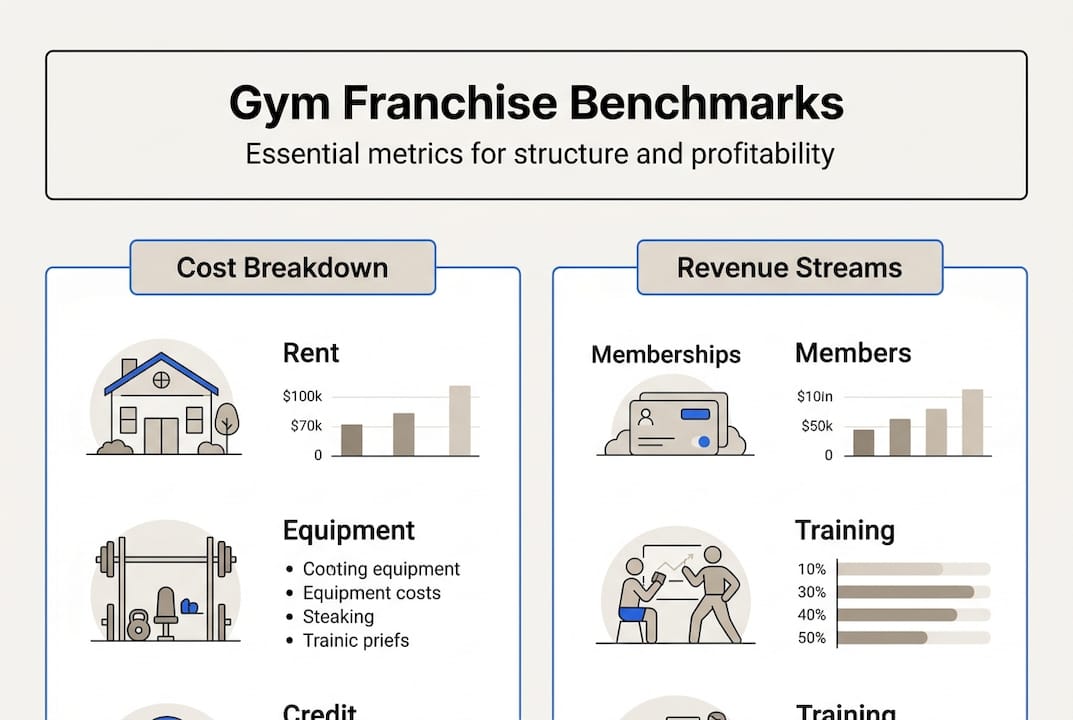
According to the 2025 Gym Industry Benchmark Report, initial investment ranges from $400,000 to $3.5 million, average unit volume (AUV) falls between $365,000 and $1.7 million, EBITDA margins sit at 15 to 35 percent, break-even typically occurs at 12 to 24 months, and payback periods range from 2 to 5 or more years.
The primary investment categories you need to budget for are:
- Franchise fee: Typically $20,000 to $50,000, paid upfront as a one-time licensing cost
- Fit-out and construction: Often the largest cost, ranging from $150,000 to over $1 million depending on location and model
- Equipment: Cardio machines, free weights, and functional training gear typically run $50,000 to $300,000
- Technology and software: Setup fees, hardware, and first-year subscriptions can add $10,000 to $30,000
- Working capital: Reserves to cover operating losses during the ramp-up phase, generally 6 to 12 months of expenses
AUV is the most useful metric for comparing performance across franchise systems. An AUV of $500,000 with a 25 percent EBITDA margin generates $125,000 in annual operating profit before debt service. That figure, compared against your total investment, gives you a realistic payback timeline.
Pro Tip: Always request the Franchise Disclosure Document (FDD) Item 19 before making any financial projections. Item 19 contains audited financial performance data from existing franchisees. Many prospective buyers skip this step and rely on franchisor projections instead, which is a costly mistake.
For a broader look at what separates financially successful operators from those who underperform, reviewing franchise success factors across leading fitness companies reveals consistent patterns in how top performers manage costs and grow revenue.
Critical requirements, risks, and realities
After covering the numbers, it is vital to address the often-overlooked realities and risks of running a gym franchise. The financial benchmarks above assume competent, engaged operators. That assumption is not always met.
Most franchisors explicitly prefer owner-operators over absentee investors. Franchisors prefer operators; absentee models consistently underperform, real estate challenges remain a post-COVID risk, and the distinction between opened and unopened franchises matters significantly, as illustrated by cases like D1 Training.
Ongoing operational requirements that franchisees often underestimate include:
- Active local marketing: National brand campaigns do not replace local outreach and community building
- Member recruitment: Especially critical in the first 12 months when the membership base is thin
- Real estate management: Lease renewals, rent escalations, and location changes create long-term financial exposure
- Staff retention: High turnover in fitness roles is common and directly impacts member experience
- Compliance with franchisor standards: Regular audits and required updates to equipment or software add ongoing costs
"The franchisees who perform best treat the system as a starting point, not a finish line. They use the playbook, then they improve on it based on what their local market actually needs."
Multi-unit scaling introduces additional complexity. Managing two or three locations requires systems for multi-unit gym management that go well beyond what a single-location operator needs. Demographic misalignment is another underappreciated risk. A brand that performs well in suburban markets may struggle in dense urban environments where price sensitivity and competition are higher.
Lease risk deserves specific attention. Post-pandemic commercial real estate has created both opportunities and traps. Some markets offer favorable lease terms, while others carry inflated rents that compress margins even at strong membership volumes. Always model your unit economics against multiple rent scenarios before committing.
Why success with gym franchise systems is more about execution than the brand
Here is what most guides and brands do not tell you: the franchise system is a framework, not a guarantee. We have seen operators with premium brand affiliations struggle while independent gym owners with strong local roots outperform them consistently.
What actually separates successful franchisees is execution quality, owner engagement, and the willingness to adapt. Operators who treat the system as a rigid script tend to plateau. Those who treat it as a toolkit, using the brand, software, and support as inputs rather than outputs, find ways to improve retention, reduce churn, and build community loyalty that no franchisor can manufacture for them.
Adopting smart gym software is one of the clearest differentiators we observe. Franchisees who leverage digital engagement tools, automated communications, and data-driven retention strategies consistently outperform static operators regardless of brand size or market position.
The uncomfortable reality is that no franchise system is hands-off or bulletproof. Local market fit, your team's culture, and your personal involvement in the first two years matter more than the logo on the door. Pursue a franchise because you want a validated operating model to build on, not because you expect the brand to do the work for you.
Streamline gym operations with the right technology partner
Running a gym franchise means managing a constant flow of operational demands: member billing, class scheduling, staff coordination, and engagement campaigns. Cobbling together separate tools for each task creates gaps that cost you time and members.
FineGym is built specifically for gym operators and franchise networks who need an integrated platform that handles all of it in one place. From automated billing and QR code check-ins to member engagement and multi-location reporting, FineGym reduces admin burden so you can focus on growing your membership base. Whether you are running a single studio or scaling a franchise network, explore our complete gym management software to see how it fits your operation. You can also review the full list of all-in-one gym features to match capabilities to your specific needs.
Frequently asked questions
What is included in a standard gym franchise system?
A standard gym franchise system includes territory protection, site selection and training, proprietary software, standardized operations manuals, and ongoing franchisor support. These elements work together to create a replicable operating model across locations.
What is the average investment to open a gym franchise?
The average investment ranges from $400,000 to $3.5 million, depending on the gym model, market, and build-out requirements. Budget for working capital beyond the initial setup costs.
How long does it take to break even with a gym franchise?
Most gym franchises reach break-even in 12 to 24 months, with full payback periods ranging from 2 to 5 years depending on membership ramp-up speed and local market conditions.
Do franchisors prefer owner-operators or investors?
Most franchisors prefer hands-on owner-operators because absentee investor models consistently produce weaker performance outcomes and higher failure rates across the industry.