
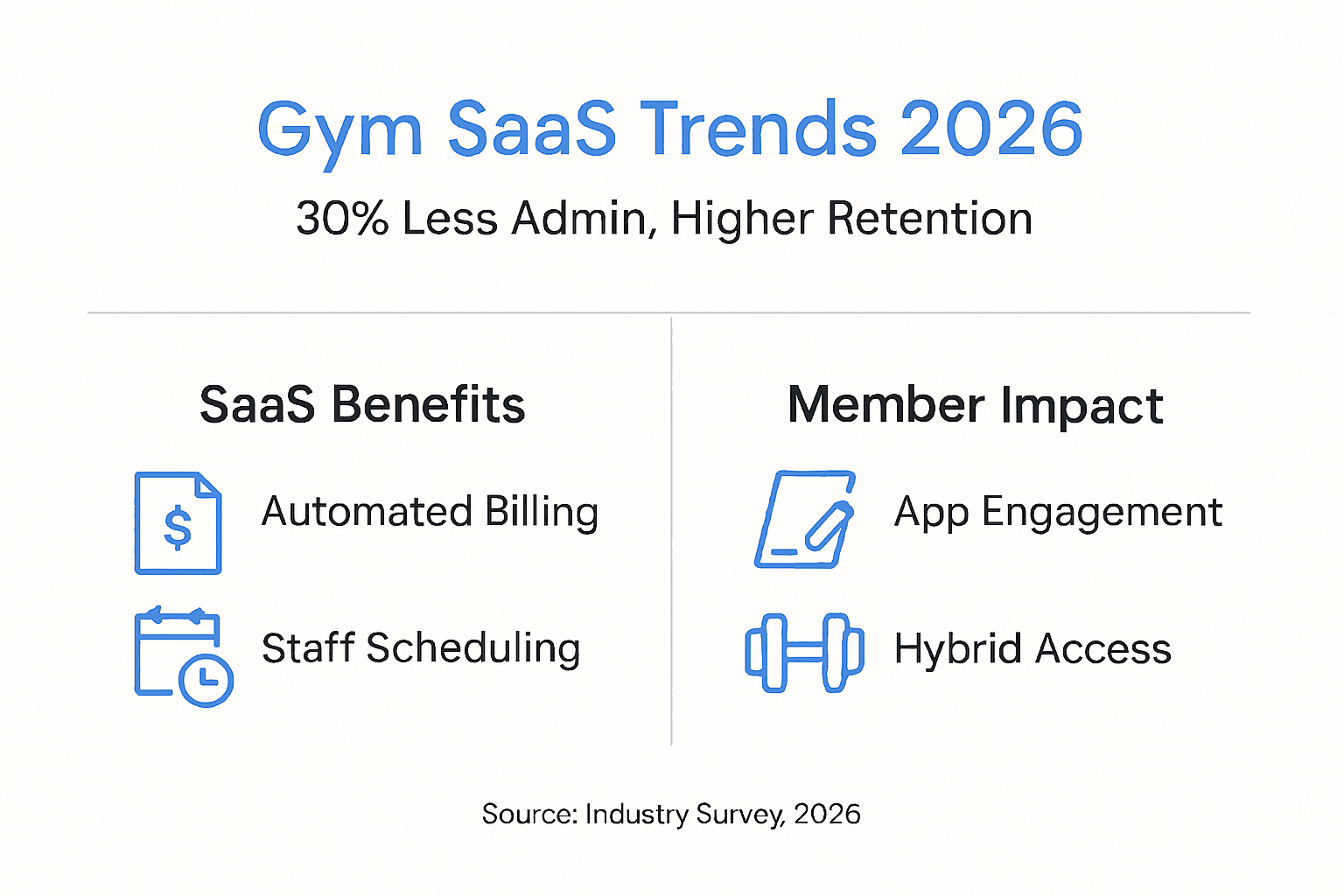
Running a gym in 2026 means juggling member onboarding, class schedules, billing cycles, and staff coordination daily. 79% of gym operators now report a 30% reduction in administrative workload thanks to SaaS platforms automating these tasks. This guide reveals the top gym management trends transforming operations and member engagement, plus practical steps to implement them in your facility.
Table of Contents
- Introduction To 2026 Gym Management Landscape
- Role Of Saas Platforms In Revolutionizing Gym Operations
- Data-Driven Member Engagement And Personalization
- Hybrid Fitness Business Models: Adapting To Member Preferences
- Innovations In Staff And Multi-Location Management
- Common Misconceptions And Pitfalls To Avoid
- Implementing Trends For Operational Success
- Conclusion And Future Outlook For Gym Management
- Discover Finegym's All-In-One Gym Management Software
Key takeaways
| Point | Details |
|---|---|
| SaaS automation cuts admin work by 30% | Integrated platforms handle billing, scheduling, and member communication automatically |
| Data-driven engagement boosts retention 20% | Personalized messaging and analytics deliver targeted member experiences |
| Hybrid models reach 35% adoption | Combining in-person and virtual services meets evolving member preferences |
| Staff scheduling improves 40% | Centralized software accelerates scheduling and reduces payroll errors by 35% |
| Right-sized software maximizes ROI | Matching platform tier to gym size outperforms defaulting to premium options |
Introduction to 2026 gym management landscape
The fitness industry continues robust growth through 2026, but member expectations have shifted dramatically. Today's gym-goers demand personalized training programs, flexible class schedules, and seamless hybrid experiences that blend physical and virtual workouts. Fitness industry growth trends through 2026 show increasing demand for personalization and hybrid models that traditional management approaches struggle to deliver.
Operational complexity has escalated alongside these expectations. Gym owners juggle:
- Manual billing processes prone to late payments and revenue gaps
- Fragmented scheduling systems that increase no-shows
- Disconnected member communication tools limiting engagement
- Staff management challenges across multiple locations
- Data silos preventing actionable insights
These challenges threaten both member retention and operational efficiency. Gyms that fail to adapt risk losing members to competitors offering smoother, more personalized experiences. Integrated technology solutions have become essential rather than optional for surviving this competitive landscape.
Role of SaaS platforms in revolutionizing gym operations
SaaS automation platforms transform how gyms handle daily tasks. The 79% of operators reporting 30% workload reduction aren't exaggerating. These systems eliminate manual data entry, automate routine communications, and synchronize operations across departments.
Consider billing alone. Automated billing and payment processing reduces late payments by 25% while improving revenue predictability. Members receive automatic payment reminders, invoices generate without staff intervention, and failed transactions trigger smart retry sequences. This consistency eliminates the awkward conversations about overdue accounts.
Statistic spotlight: Scheduling automation reduces no-shows by 40% through integrated reminders and easy rescheduling options.
Key operational improvements include:
- Automated class booking with waitlist management
- QR code check-ins that update attendance instantly
- Bulk messaging for promotions, policy updates, and class changes
- Integrated member profiles tracking preferences and history
- Dashboard analytics revealing usage patterns and revenue trends
These fitness technology trends free your team to focus on member relationships rather than administrative tasks. Staff spend more time on the gym floor providing value and less time entering data or chasing payments.
Data-driven member engagement and personalization
Generic email blasts to your entire membership list no longer drive results. Modern gyms leverage data analytics to segment members by behavior, preferences, and engagement levels. Personalized communication delivers 15-20% higher member retention compared to broad messaging approaches.
Data-driven strategies transform member interactions:
- Automated birthday messages with special class credits
- Re-engagement campaigns targeting members with declining attendance
- Personalized class recommendations based on past bookings
- Milestone celebrations when members hit workout streaks
- Referral incentives sent to your most active advocates
Mobile apps strengthen this connection by creating 24/7 touchpoints. Members book classes, track progress, and engage with your community outside facility hours. This constant presence builds loyalty that survives temporary schedule disruptions or competitive pressure.
Pro Tip: Track member attendance patterns monthly and automate outreach when someone misses their typical workout frequency. A simple "We miss you" message with a free guest pass often prevents cancellations.
Marketing campaign effectiveness improves dramatically with micro-targeting. Instead of promoting yoga to everyone, you message members who attended yoga previously but haven't booked recently. Conversion rates on these targeted campaigns outperform manual contact by 25% because effective member management matches offers to demonstrated interests.
Automated gym notifications handle routine updates while freeing staff for high-value conversations. Members receive immediate booking confirmations, class change alerts, and payment receipts without staff touching the process.
Hybrid fitness business models: adapting to member preferences
The pandemic permanently shifted member expectations around fitness access. 35% of gyms adopted hybrid models by 2026, combining in-person facilities with virtual class options and on-demand content. This flexibility attracts members who travel frequently, have unpredictable schedules, or simply prefer home workouts some days.
Hybrid model adoption rates by facility type:
| Facility Type | Hybrid Adoption Rate | Primary Virtual Offering |
|---|---|---|
| Boutique Studios | 42% | Live-streamed specialty classes |
| Traditional Gyms | 31% | On-demand workout library |
| CrossFit Boxes | 38% | Virtual coaching sessions |
| Multi-location Chains | 45% | Integrated app with all options |
Integrating virtual offerings creates technical and operational challenges. You need platforms that handle both physical class bookings and virtual access permissions seamlessly. Fitness technology trends show successful hybrid gyms use unified systems where members view all options in one interface.
Online class booking systems must accommodate capacity limits for physical spaces while supporting unlimited virtual attendees. The same instructor teaching a 20-person studio class might have 50 people joining remotely. Your software needs to track both populations separately while billing appropriately.
Hybrid models boost retention because members maintain engagement even when circumstances prevent facility visits. Business travelers stay connected through virtual classes. New parents work out at home during nap times. This flexibility reduces cancellation risk during life transitions that traditionally end memberships.
Innovations in staff and multi-location management
Staffing complexity grows exponentially with facility count. Multi-location gym management requires coordinating schedules, payroll, performance tracking, and compliance across sites while maintaining consistent member experiences.
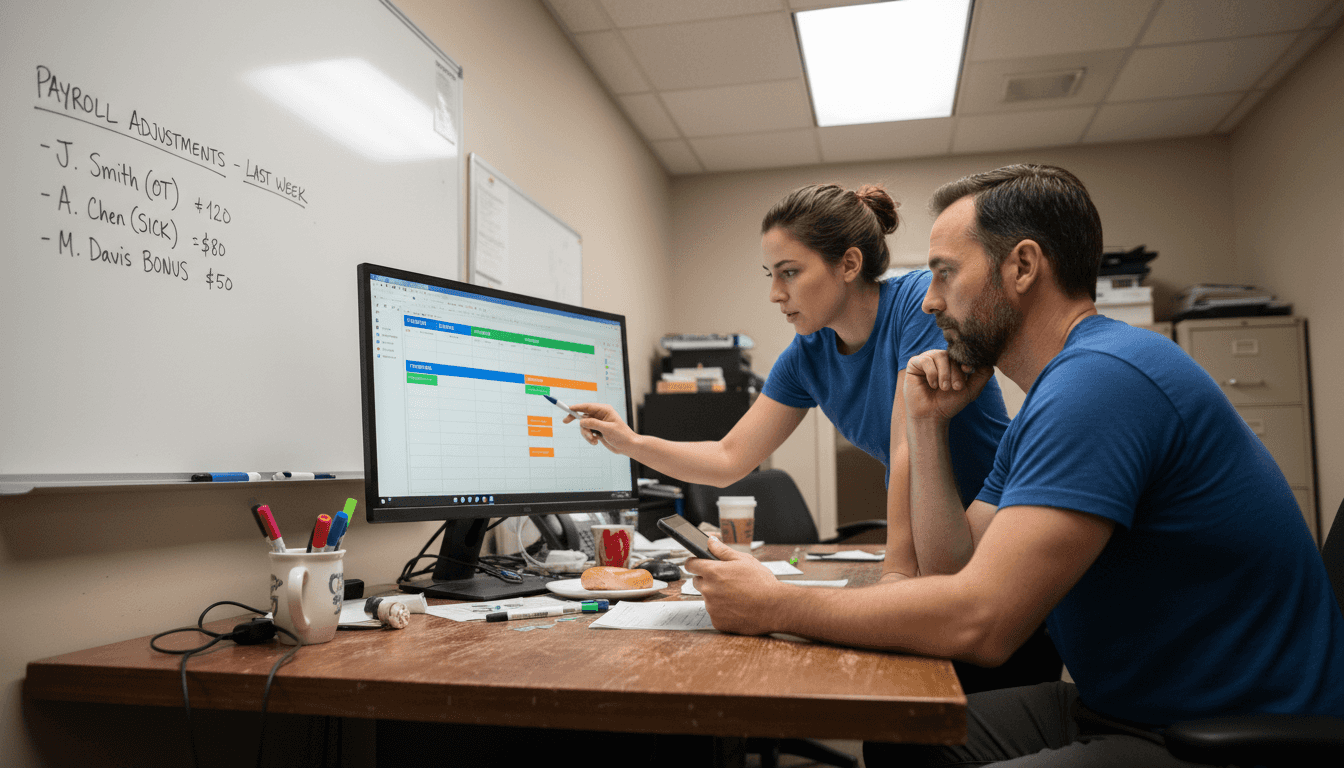
Staff scheduling improves 40% and payroll errors reduce 35% when gyms implement integrated software. These platforms centralize instructor availability, certification tracking, and shift assignments in one system. Managers see gaps immediately and can shift staff between locations based on demand.
Manual vs. automated staff management comparison:
| Task | Manual Process Time | Automated Process Time | Time Saved |
|---|---|---|---|
| Weekly schedule creation | 4 hours | 45 minutes | 81% |
| Payroll calculation | 3 hours | 30 minutes | 83% |
| Certification tracking | 2 hours/month | 15 minutes/month | 88% |
| Shift coverage coordination | 1 hour/incident | 10 minutes/incident | 83% |
Payroll accuracy improves because hours automatically sync from check-in systems to payroll modules. No more manual timesheets with disputed hours or forgotten overtime calculations. Gym staff management software handles complex scenarios like split shifts across locations or varying pay rates for different class types.
Pro Tip: Use performance dashboards that track instructor metrics like class attendance averages, member feedback scores, and retention rates for their regular attendees. Data-driven coaching conversations improve staff development and member satisfaction simultaneously.
Franchise operators particularly benefit from centralized systems providing visibility across territories. Corporate teams monitor performance metrics, enforce brand standards, and identify best practices to share network-wide. Individual franchisees maintain local control while benefiting from enterprise-level tools and insights.
Common misconceptions and pitfalls to avoid
Gym owners often make expensive mistakes when adopting new management technology. Understanding these misconceptions saves time and money:
- Higher-tier software guarantees better results. ROI depends on matching software tier to gym size rather than defaulting to premium options. Small studios overpaying for enterprise features waste budget on unused capabilities.
- Manual communication builds stronger relationships. Personalized automated messaging actually outperforms manual contact by 25% in engagement rates because consistency and timing matter more than the human touch on routine messages.
- Price is the most important selection factor. Ease of setup, data migration support, and responsive customer service often deliver more value than the lowest monthly fee. Implementation failures cost far more than price differences.
- Staff will figure out new software naturally. Neglecting structured training slows adoption and undermines potential benefits. Dedicated onboarding and ongoing support are essential.
- Data security is the vendor's responsibility alone. Gyms must implement access controls, train staff on privacy practices, and maintain compliance with regulations. Ignoring data privacy risks regulatory penalties and member trust.
The complete guide to gym management software details selection criteria beyond feature checklists, including vendor stability, integration capabilities, and scalability for future growth.
Implementing trends for operational success
Translating trends into results requires systematic implementation. Follow this roadmap:
- Audit current operations. Identify your biggest time drains and member friction points. Track how staff spend their hours weekly. Survey members about their experience gaps.
- Define success metrics. Establish baseline measurements for admin time, member retention rates, billing accuracy, and staff satisfaction before implementing changes.
- Select appropriate SaaS platform. Match software selection best practices to your facility size, budget, and priority needs. Request demos focused on your specific pain points.
- Plan phased rollout. Start with billing automation and member check-ins before tackling complex integrations. Quick wins build momentum and staff confidence.
- Implement data-driven engagement. Use analytics to segment members and launch targeted campaigns. Apply member engagement strategies that match messaging to behavior patterns.
- Integrate hybrid offerings. Add virtual class options that complement your in-person strengths rather than competing with them. Train instructors on engaging remote participants.
- Train staff thoroughly. Invest in comprehensive onboarding and create quick reference guides. Designate software champions on each shift to support peers.
- Monitor and optimize. Review dashboard metrics monthly. Solicit staff and member feedback quarterly. Adjust workflows based on usage patterns.
Pro Tip: Document your current processes before implementing new software. This baseline helps you measure improvement accurately and identifies workflows that need redesign rather than just automation.
Successful implementation balances technology capabilities with human change management. The best software fails without staff buy-in and member adoption.
Conclusion and future outlook for gym management
Adopting integrated SaaS solutions delivers measurable efficiency gains and retention improvements throughout 2026. Gyms implementing comprehensive platforms report 30% workload reductions, 20% retention increases, and significantly improved staff satisfaction. These aren't aspirational goals but documented results from facilities prioritizing operational excellence.
Emerging technologies promise even deeper transformation beyond 2026. Artificial intelligence will power predictive retention modeling that identifies at-risk members weeks before they consider canceling. Wearable device integration will enable truly personalized programming based on recovery metrics and performance trends. Virtual reality could create immersive group fitness experiences rivaling in-person energy.
The competitive advantage belongs to gyms that stay agile as member expectations evolve. Technology adoption isn't about chasing trends but building operational foundations that support consistent, personalized member experiences at scale. Start with core automation that frees your team from administrative tasks, then layer in engagement tools and hybrid offerings as capacity allows.
Your members notice when operations run smoothly. They appreciate instant booking confirmations, seamless billing, and communications that feel personally relevant. These details accumulate into loyalty that survives competitive pressure and market changes.
Discover FineGym's all-in-one gym management software
Ready to implement the 2026 gym management trends transforming the industry? FineGym offers scalable SaaS platforms tailored for facilities ranging from boutique studios to multi-location franchises. Our complete gym management software automates billing, scheduling, member communications, and staff coordination in one integrated system.
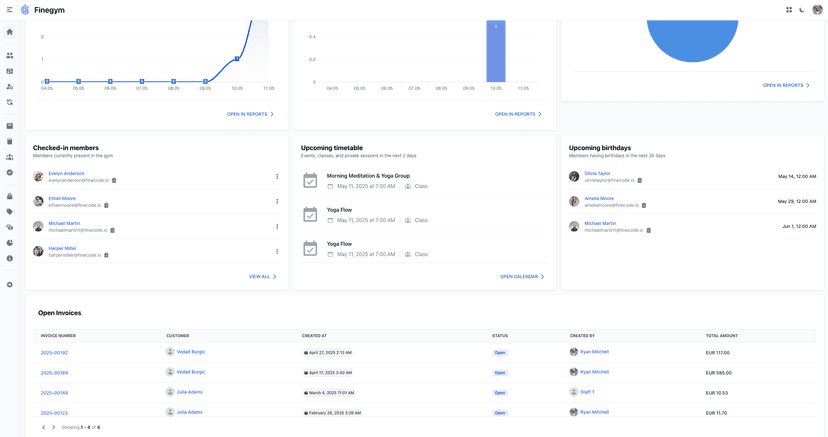
FineGym's platform supports hybrid fitness models with unified booking for physical and virtual classes. Automated notifications keep members engaged while freeing your staff for high-value interactions. Multi-location operators benefit from centralized dashboards providing real-time visibility across territories. Easy setup and responsive customer support ensure smooth adoption without disrupting daily operations. Explore our all-in-one gym software features and discover how the right platform transforms operational efficiency and member satisfaction. Learn more in our comprehensive gym management software guide.
Frequently asked questions
What are the top trends in gym management for 2026?
SaaS automation reducing administrative workload by 30%, data-driven member engagement boosting retention by 20%, hybrid fitness models combining physical and virtual services reaching 35% adoption, and integrated staff management improving scheduling by 40% lead the transformation. These innovations address operational efficiency and evolving member expectations simultaneously.
How does SaaS automation reduce gym administrative work?
Automated billing eliminates manual invoicing and reduces late payments by 25%. Scheduling systems handle bookings, reminders, and waitlists without staff intervention. Integrated check-ins update attendance instantly. Bulk messaging automates routine communications, freeing staff to focus on member relationships and service quality.
Why do hybrid fitness models improve member retention?
Hybrid models offering both in-person and virtual options provide flexibility that keeps members engaged during travel, schedule changes, or life transitions that traditionally end memberships. Members maintain workout consistency regardless of circumstances, reducing cancellation risk and extending lifetime value.
What should gyms prioritize when selecting management software?
Match platform tier to your facility size and specific needs rather than defaulting to premium options. Prioritize ease of setup, data migration support, and responsive customer service over feature quantity. Verify the system handles your priority pain points like billing accuracy, scheduling efficiency, or multi-location coordination.
How can small gyms benefit from data-driven member engagement?
Even small facilities gain from segmenting members by attendance patterns and preferences. Automated re-engagement campaigns targeting declining attendance prevent cancellations. Personalized class recommendations based on booking history increase participation. Birthday messages and milestone celebrations build loyalty without requiring manual tracking.
What metrics indicate successful gym management software implementation?
Track administrative time savings, member retention rate changes, billing accuracy improvements, staff satisfaction scores, and member engagement metrics like class booking rates and app usage. Compare these measurements to pre-implementation baselines quarterly to validate ROI and identify optimization opportunities.