

Opening a second location is often seen as a milestone for ambitious gym owners, but the challenges of managing multiple facilities quickly become clear. The rise of modern fitness culture has transformed multi-location gyms into more than a string of buildings—they are now centers of health promotion and commercial individuality shaped by complex operations. This article breaks down the core principles behind true multi-location gym success, clears up common misconceptions, and guides you toward integrated systems that keep your business running smoothly wherever you grow.
Table of Contents
- Defining Multi-Location Gyms And Misconceptions
- Types Of Multi-Location Gym Models
- Key Operational Features And Integration
- Technology's Role In Managing Multiple Sites
- Common Pitfalls And How To Avoid Them
Key Takeaways
| Point | Details |
|---|---|
| Operational Integration is Key | Successful multi-location gyms rely on unified systems for member management, billing, and operations across all sites. |
| Choose the Right Model | Selecting between franchise, corporate chain, or managed partnership models hinges on your capital, management capabilities, and growth goals. |
| Proper Technology Implementation | Utilizing integrated technology can enhance operational efficiency, customer engagement, and data-driven decision-making. |
| Consistent Standards Across Locations | Establishing and maintaining operational consistency helps build trust and a reliable member experience across multiple gym locations. |
Defining Multi-Location Gyms and Misconceptions
A multi-location gym is a fitness business operating two or more physical facilities under unified ownership or management. These gyms share branding, member benefits, and operational systems across locations.
Multi-location gyms have evolved significantly over time. Modern fitness facilities increasingly focus on health promotion and commercial individualism, reflecting how gyms transitioned from niche subcultural spaces to mainstream health centers. This cultural shift shapes how multi-location franchises approach operations and member experience today.
Common Misconceptions About Multi-Location Gyms
Many gym owners and managers hold beliefs that don't match reality:
-
Misconception: Opening more locations automatically generates more profit. Reality: Each location requires separate staffing, utilities, and equipment investment.
-
Misconception: Members automatically use all locations equally. Reality: Usage patterns vary significantly by location and local market conditions.
-
Misconception: Managing multiple gyms is just managing one gym times two. Reality: Complexity grows exponentially—not linearly—with additional locations.
-
Misconception: Centralized billing and member data are nice additions. Reality: Unified systems are operational necessities for franchise efficiency.
Multi-location success depends on unified operations, not just multiple buildings. Without integrated management systems, fragmented processes will drain resources faster than growth generates them.
What Actually Defines Multi-Location Gym Success
Successful multi-location gyms share distinct characteristics that go beyond simply having multiple addresses:
Unified member experience across all locations creates consistency that members expect and appreciate. A member paying dues should access the same services, equipment quality, and class schedules regardless of which facility they visit.
Centralized financial management consolidates billing, payroll, and accounting. This prevents the costly mistakes that come from isolated bookkeeping at each location.
Streamlined operations use consistent protocols for class scheduling, staff training, and member check-ins. Operational chaos multiplies when each location invents its own procedures.
Data integration connects member profiles, attendance records, and engagement metrics across all facilities. When data remains siloed by location, franchise owners lose visibility into true member behavior and retention patterns.
The distinction between a true multi-location gym and multiple separate gyms that happen to share a name comes down to operational integration. Without it, you're managing isolated businesses competing for your attention.
Pro tip: Before expanding to a second location, audit your current systems—billing, scheduling, member communication, and staff management. Identify which processes you can centralize; these will be your operational foundation for scaling efficiently.
Types of Multi-Location Gym Models
Gym franchises operate under different structural models, each with distinct operational and financial implications. Understanding these models helps you choose the approach that fits your business goals and resources.
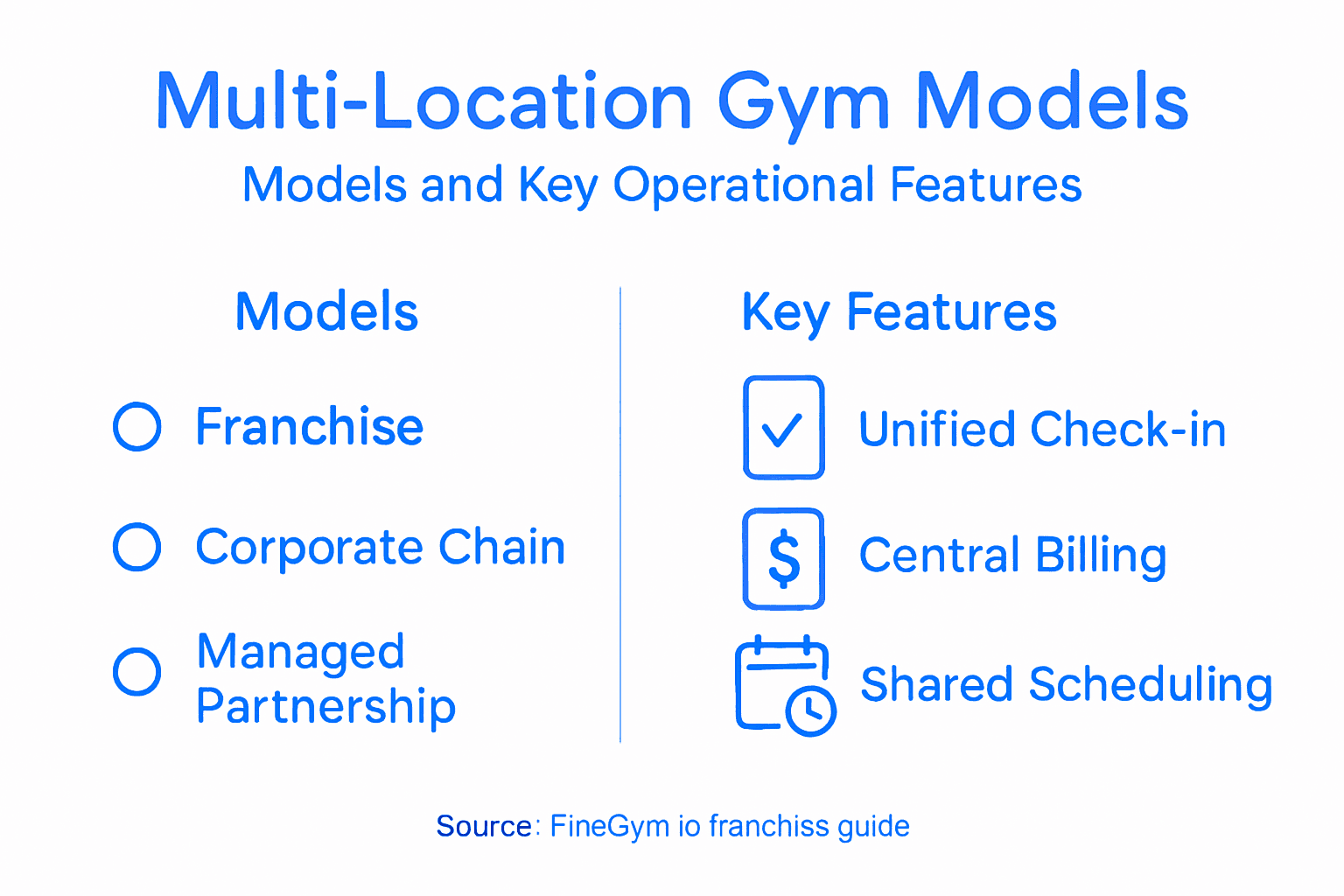
The Franchise Model
The franchise model is the most common multi-location gym structure. A franchisor owns the brand, systems, and intellectual property, while franchisees operate individual locations using standardized procedures.
Franchisees benefit from established branding and proven operational systems. They pay upfront franchise fees plus ongoing royalties, typically 5-8% of revenue. In return, they receive training, marketing support, and access to centralized systems.
The franchisor maintains quality control across locations through standardized protocols. Member data, billing, and scheduling systems remain connected, ensuring a consistent experience regardless of which facility a member visits.
Key advantages include:
- Lower startup costs for franchisees compared to building from scratch
- Rapid geographic expansion without the franchisor carrying all capital risk
- Proven business model reduces operational uncertainty
- National brand recognition accelerates member acquisition
Franchise models succeed when the franchisor provides genuine operational support, not just licensing agreements with minimal involvement.
The Corporate Chain Model
In the corporate chain model, a single company owns and operates all locations directly. This creates complete operational control but requires significant capital investment and management infrastructure.

Corporate chains maintain 100% ownership, eliminating franchise royalty payments. Every location uses identical systems, making scaling easier operationally. However, the company absorbs all financial risk, overhead, and staffing complexity.
This model works best for well-capitalized gym operators with strong management teams. Large fitness corporations typically use this approach.
The Managed Partnership Model
A managed partnership sits between full franchise and corporate ownership. A parent company provides systems, training, and capital while local operators maintain operational autonomy within agreed parameters.
Partners share revenue rather than paying fixed royalties. This aligns incentives more closely than traditional franchise arrangements.
Here's a quick comparison of multi-location gym models and their operational strengths:
| Model Type | Ownership Structure | Control Level | Initial Investment |
|---|---|---|---|
| Franchise | Franchisee with franchisor | Moderate | Lower, franchise fees |
| Corporate Chain | Single company owns all | High | Significant, company-driven |
| Managed Partnership | Parent with local partners | Balanced | Shared with partners |
This summary can help clarify the core differences among popular models.
Choosing the Right Model for Your Business
Your choice depends on capital availability, management capacity, and growth speed goals. Fitness subscription models and pricing strategies directly influence which model you can sustain profitably.
Franchise models accelerate growth with less capital but require strong brand systems. Corporate models demand more investment but offer complete control. Managed partnerships balance both considerations.
Regardless of model, success requires unified member management, billing integration, and consistent operational protocols across all locations.
Pro tip: Before selecting a model, map out your capital resources, management team capacity, and 5-year growth targets. These three factors will reveal which model aligns with your actual operational capabilities.
Key Operational Features and Integration
Multi-location gym success hinges on unified systems that connect all facilities seamlessly. Without integration, each location operates in isolation, creating inconsistencies that frustrate members and drain management time.
Unified Member Management Across Locations
A centralized member database is the foundation of multi-location operations. Every member profile, attendance record, and payment history exists in one system accessible across all gyms.
Members expect to check into any location without re-entering data. When Sarah signs up at the downtown gym, she can immediately visit the suburban location using the same credentials. Her class history, personal records, and billing status follow her everywhere.
This unified approach eliminates duplicate accounts, conflicting records, and member frustration. It also reveals true usage patterns—you see which members use multiple locations versus staying loyal to one facility.
To better understand integration, here’s an overview of key unified systems and their business benefits:
| System Area | Unified Function | Impact on Operations |
|---|---|---|
| Member Management | Centralized profiles | Improved cross-location access |
| Billing | Single payment processor | Accurate financial tracking |
| Scheduling | Synchronized class times | Efficient staff and resource use |
| Communication | Automated updates | Enhanced member engagement |
These integrated features are essential for scaling and maintaining consistency.
Integrated Billing and Financial Systems
Centralized billing prevents costly mistakes and improves cash flow visibility. All revenue flows through one accounting system, making financial reporting accurate and timely.
Key financial features include:
- Automated billing across all locations with consistent payment processing
- Unified revenue reporting that shows profit by location or membership type
- Consolidated expense tracking for staffing, utilities, and equipment
- Real-time financial dashboards for quick decision-making
Without unified billing, franchises lose visibility into profitability and struggle to identify which locations drain resources.
Synchronized Scheduling and Class Management
Consistent class schedules across locations create predictability for members and efficiency for staff. When classes run at different times or with different instructors, member experience fragments.
Integrated scheduling allows:
- Identical class times across locations when appropriate
- Staff assigned to multiple facilities without double-booking
- Centralized instructor certification and background tracking
- Capacity management that prevents overcrowding or underutilization
Automated Communications and Member Engagement
Multi-location gyms need integrated business tools for consistent member communications. When a member schedules a class at location A, their reminder should arrive automatically, regardless of which facility they visit.
Automated systems handle:
- Birthday and anniversary messages that reinforce member relationships
- Class reminders and cancellation notifications
- Promotional offers relevant to member behavior patterns
- Retention alerts when attendance drops
Data-Driven Decision Making
Integration creates visibility that single-location gyms never achieve. You see cross-location trends: which classes fill fastest, where member retention lags, which programs drive revenue.
This data drives smarter decisions about class scheduling, staff allocation, and marketing investment. You allocate resources where they generate results, not where you guess they might help.
Pro tip: When selecting a management system, prioritize integration capabilities over individual feature counts. A platform that connects member management, billing, and scheduling seamlessly will save more time than a tool with fancy bells and whistles that operate in silos.
Technology's Role in Managing Multiple Sites
Managing multiple gym locations without technology is like trying to coordinate five separate businesses simultaneously. Technology transforms scattered operations into a cohesive network that runs efficiently across all facilities.
Why Technology Matters for Multi-Location Gyms
Digital transformation enables centralized membership management, automated billing, and real-time attendance tracking across all locations. Without integrated systems, you lose visibility into what's happening at each facility.
Consider the alternative: phone calls to verify member status, manual billing reconciliation across spreadsheets, and scheduling conflicts that require constant firefighting. That's operational chaos, not a business.
Proper technology stacks create competitive advantage. You respond faster to member needs, allocate staff more intelligently, and make decisions based on data rather than intuition.
Core Technology Functions
Effective multi-location gym systems handle these critical operations:
- Centralized member profiles accessible instantly from any location
- Automated billing that processes payments consistently across all sites
- Attendance tracking showing real-time occupancy and usage patterns
- Staff scheduling that prevents double-booking and optimizes coverage
- Data analytics revealing which locations and programs drive revenue
- Communication automation sending targeted messages to specific member segments
How Technology Improves Operational Productivity
Speed matters. When a member calls asking about class schedules, your staff should answer immediately from any location's computer. When a billing issue arises, resolution takes minutes, not days of back-and-forth emails.
Technology eliminates repetitive administrative work. Billing runs automatically. Attendance updates in real time. Staffing conflicts surface before they become scheduling disasters.
This frees your team to focus on member experience rather than paperwork. Trainers work with members instead of managing spreadsheets. Managers analyze trends instead of hunting for data.
Enhancing Customer Engagement and Retention
Integrated systems enable personalized engagement at scale. You identify when a member's attendance drops and send retention offers before they quit. You recognize high-value members and give them VIP treatment.
Automated communications feel personal because they're based on individual behavior data. A member who consistently attends morning classes gets morning reminders. A member showing declining attendance gets a personal check-in message.
Technology doesn't replace human relationships—it enables staff to have more meaningful interactions by handling repetitive tasks automatically.
Competitive Advantage in Multi-Location Markets
Gyms that leverage technology respond faster to market changes. If one location experiences declining evening class attendance, data surfaces this immediately. You adjust scheduling and test new offerings without guessing.
Competitors still managing on spreadsheets can't react that quickly. You've already implemented solutions while they're still arguing about what the problem is.
Pro tip: Don't treat technology as a nice-to-have expense. Calculate the hours your team currently spends on manual billing, scheduling, and member communication. Multiply by hourly labor costs. That's your real cost of operating without integrated systems—often exceeding software investment within months.
Common Pitfalls and How to Avoid Them
Expanding to multiple locations amplifies mistakes. A billing error at one gym becomes a billing crisis across all sites. A scheduling conflict multiplies across multiple teams. Understanding common pitfalls helps you sidestep costly failures.
Pitfall 1: Inconsistent Operational Standards
Many franchises treat each location like a separate business. The downtown gym offers unlimited guest passes while the suburban location restricts them. Classes start five minutes late at one facility but run on time at another. Member experience becomes unpredictable.
Consistency builds trust. Members expect the same service quality, class lengths, and member benefits regardless of location.
How to avoid it:
- Document every operational procedure in writing
- Train all staff using identical curricula
- Conduct monthly audits comparing locations against standards
- Address deviations immediately
Pitfall 2: Siloed Locations Operating Independently
When each gym manager acts like they're running their own business, information doesn't flow between locations. The downtown manager discovers a profitable class format, but the suburban manager never finds out. Best practices stay local instead of scaling across all sites.
Isolated operations waste your competitive advantage and create unnecessary duplication.
Pitfall 3: Poor Technology Implementation
Buying software without planning integration creates chaos. You implement billing at location one, scheduling at location two, and member communications at location three. Nothing talks to anything else.
The result? Staff entering the same member data multiple times. Billing running separately at each facility. Attendance tracking that doesn't connect to member profiles.
How to avoid it:
- Select integrated platforms that handle member management, billing, and scheduling together
- Plan data migration carefully before implementation
- Train staff thoroughly before launch
- Monitor data accuracy in the first 90 days
Poor technology implementation creates more work, not less. Choose systems designed for multi-location operations from the start.
Pitfall 4: Insufficient Staff Training
New staff learning on the job creates inconsistency. One trainer teaches form differently than another. Customer service quality varies based on who answers the phone.
Investment in comprehensive training pays dividends. Staff feel confident, members receive consistent care, and your reputation strengthens.
Pitfall 5: Ignoring Member Feedback Across Locations
Members at location A ask for morning yoga. You dismiss it as a local preference and never mention it to location B's management. That location could have filled those classes, but you never tested it.
Aggregated feedback from all locations reveals genuine demand patterns. One location's feedback might solve another location's problem.
Pitfall 6: Underestimating Management Overhead
Many owners think managing five gyms is like managing one gym times five. It's actually exponentially more complex. Coordination issues multiply. Decision-making becomes harder.
You need strong management systems and clear communication protocols. Without them, operational chaos grows faster than revenue.
Pro tip: Before opening your second location, implement systems at your first location and run them flawlessly for six months. Fix every problem, document every process, and train your team thoroughly. Only then expand. A solid operational foundation at location one prevents ten problems at location two.
Streamline Your Multi-Location Gym Operations with FineGym.io
Managing multiple gym locations is not just about having more facilities. It requires unified member management, synchronized billing, and seamless scheduling to avoid the common pitfalls of operational chaos and inconsistent experiences detailed in this article. If you are struggling with siloed locations, fragmented data, or escalating management overhead, FineGym.io offers an all-in-one SaaS platform designed specifically for multi-location fitness businesses like yours. Our solution integrates member management, automated billing, staff scheduling, and personalized member engagement tools to help you achieve the operational efficiency you need.
Take control of your franchise growth by adopting FineGym.io’s streamlined platform today. Visit FineGym.io to explore how our unified systems can deliver consistent member experiences, accurate financial reporting, and data-driven insights across all your locations. Don’t let disjointed processes hold your business back. Discover more about our fitness subscription models and pricing strategies and how integrated solutions support multi-location success. Start your journey towards simplified and scalable gym management now.
Frequently Asked Questions
What defines a multi-location gym?
A multi-location gym operates two or more fitness facilities under unified ownership or management, sharing branding, member benefits, and operational systems across locations.
What are the main misconceptions about multi-location gyms?
Common misconceptions include the belief that opening more locations guarantees more profit, members will use all locations equally, and managing multiple locations is simply managing one gym multiple times.
How can unified operations improve the member experience across different locations?
Unified operations ensure a consistent member experience, including access to the same services, equipment quality, and class schedules, regardless of which location they visit.
What technology features are essential for managing multiple gym locations effectively?
Key technology features include centralized member management, automated billing, synchronized scheduling, and integrated communication systems to enhance operational efficiency and member engagement.