
One gym ran AI-powered lead generation, chatbots, and sales coaching. The result? A 172% increase in leads and a 41% conversion rate, while the competing gym down the street stuck with manual processes and hit just 20%. That gap is not a fluke. It reflects a fundamental shift in how fitness businesses compete, retain members, and grow revenue. This article breaks down what AI actually delivers for gym owners and managers, how to implement it without the usual headaches, and what pitfalls to avoid before you invest a single dollar.
Table of Contents
- What does AI mean for fitness management?
- AI applications that drive operational excellence
- Personalizing member experiences with AI
- Predictive analytics: Turning data into member retention
- Pitfalls and challenges of adopting AI in gyms
- Best practices to successfully implement AI in your fitness business
- Unlock the power of AI with the right gym management solution
- Frequently asked questions
Key Takeaways
| Point | Details |
|---|---|
| AI transforms gym operations | Adopting AI leads to higher leads, lower costs, and greater revenue for fitness businesses. |
| Personalization boosts retention | AI-driven personalization increases member retention by anticipating needs and reducing churn. |
| Predictive analytics prevent dropout | Behavior analysis powered by AI enables proactive interventions before members leave. |
| Adoption needs strategy | Success with AI depends on data quality, realistic goals, and continuous staff training. |
What does AI mean for fitness management?
AI in the gym context is not just fancy automation. Traditional software follows rules you set. AI learns from data, adapts over time, and makes decisions or recommendations without you manually programming every scenario. That distinction matters because it changes what is possible.
For fitness businesses, AI currently powers several high-impact areas:
- Lead scoring and follow-up: AI ranks prospects by conversion likelihood and triggers personalized outreach automatically.
- Member retention modeling: Systems flag at-risk members before they cancel, enabling proactive intervention.
- Personalized workout and nutrition recommendations: Think of AI personal trainers that adapt programming based on individual progress data.
- Dynamic pricing: AI adjusts membership offers based on demand, seasonality, and member behavior.
- Predictive maintenance: Equipment failure is flagged before it disrupts operations.
AI personalization boosts retention by 25% and reduces churn through proactive interventions, which means the technology is not just a back-office efficiency tool. It directly affects whether members stay or leave.
"The gyms winning in 2026 are not the ones with the most equipment. They are the ones that know their members better than their members know themselves."
Understanding the evolution of gym software helps put this in context. We have moved from paper sign-in sheets to cloud-based management platforms to AI-driven decision engines. Each leap changed what a lean team could accomplish.
AI applications that drive operational excellence
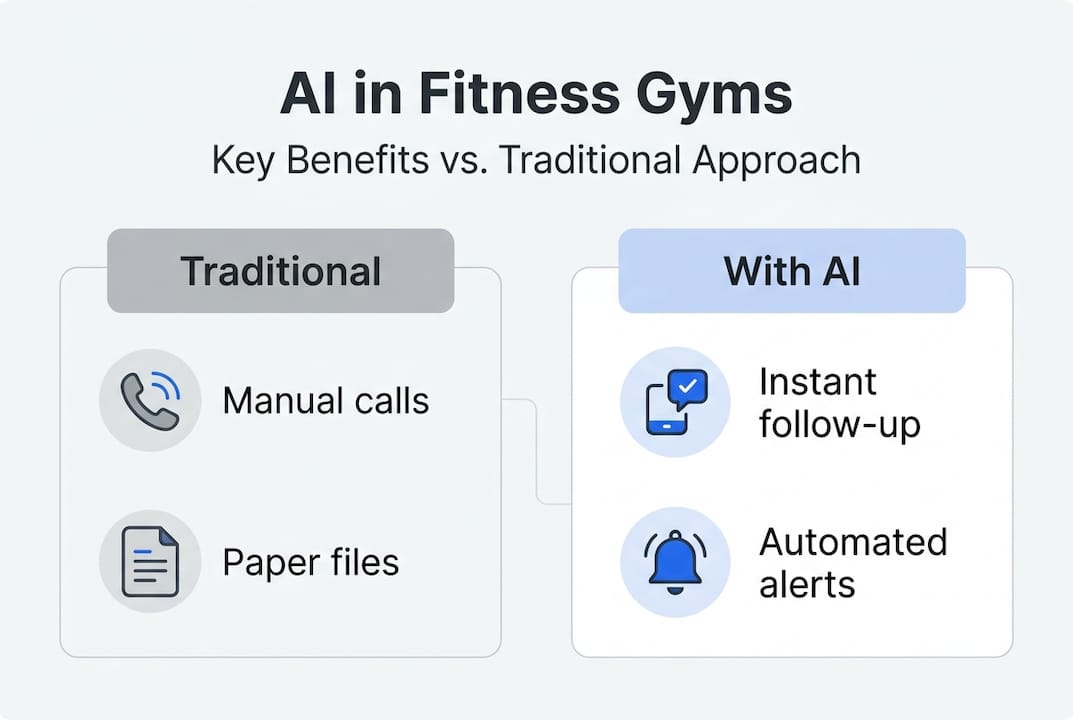
Knowing what AI can do is one thing. Seeing how it stacks up against traditional gym management makes the case undeniable.
| Area | Traditional approach | AI-driven approach |
|---|---|---|
| Lead follow-up | Manual calls, delayed responses | Instant chatbot + scored outreach |
| Class scheduling | Fixed templates, manual adjustments | Demand-based dynamic scheduling |
| Member retention | Reactive (after cancellation) | Predictive (30-90 days before churn) |
| Marketing spend | Broad campaigns, high cost per lead | Targeted ads, lower cost per lead |
| Reporting | Monthly manual reports | Real-time dashboards with AI insights |
The numbers behind this comparison are striking. Gyms using AI for lead management, targeted ads, and sales coaching saw a 47% drop in cost per lead alongside a 38% revenue increase. Those are not marginal gains. They represent a structural advantage.
Here are the key automation features worth prioritizing:
- Smart scheduling: AI analyzes class attendance patterns and adjusts time slots to maximize utilization and reduce empty spots.
- Automated sales pipelines: Leads are captured, scored, and nurtured without manual input from your front desk team.
- Real-time reporting dashboards: Business intelligence for gyms gives managers instant visibility into revenue, attendance, and churn risk.
- Automated member communications: Birthday messages, missed-class check-ins, and renewal reminders go out without anyone lifting a finger.
- Staff performance tracking: AI surfaces which staff members drive the highest retention and conversion rates.
Exploring gym automation tools before committing to a full platform helps you identify which workflows are costing you the most time right now.
Pro Tip: Do not try to automate everything at once. Pick the single most time-consuming manual task your team handles each week and automate that first. Early wins build staff confidence and make the next rollout easier. Reviewing guidance on implementing gym management software will help you sequence this correctly.
Personalizing member experiences with AI
Operational efficiency gets you lean. Personalization gets you loyal members. These are two different outcomes, and AI delivers both.
Here is what AI-powered personalization looks like in practice:
- Sending a member a modified workout plan when their attendance drops below their usual frequency
- Offering a discounted class pack to a member whose contract is 60 days from expiry
- Recommending a nutrition add-on based on a member's stated fitness goals
- Triggering a personal trainer consultation offer after a member logs a plateau in progress
The retention data is clear. AI personalization boosts retention by 25% compared to gyms relying on generic communication. That number compounds. A 25% retention improvement across 500 members means significantly fewer cancellations per month, which directly protects recurring revenue.

| Metric | Non-AI gym | AI-enabled gym |
|---|---|---|
| Average member retention rate | 65-70% | 80-90% |
| Churn detection lead time | After cancellation | 30-90 days prior |
| Personalized touchpoints per member | 1-2 per month | 5-10 per month |
| Conversion rate on renewal offers | ~15% | 30-40% |
Dynamic pricing is another underused lever. AI can identify when demand for peak-hour classes is high and adjust pricing accordingly, or offer discounted off-peak memberships to price-sensitive segments. This is not about squeezing members. It is about matching value to willingness to pay, which increases overall revenue without adding capacity.
Statistic callout: Gyms using AI-driven member lifecycle segmentation report up to a 25% improvement in retention, with predictive models identifying at-risk members up to three months before they cancel.
Pairing AI with engagement strategies for member retention creates a feedback loop. The more members engage, the more data AI has to personalize their experience. Integrating wearable fitness technology into this loop adds real-time biometric signals that make recommendations even more precise.
Predictive analytics: Turning data into member retention
Predictive analytics is the engine behind AI's retention power. It sounds technical, but the concept is straightforward: collect behavioral signals, identify patterns that precede cancellation, and intervene before it happens.
Here is how a basic predictive model works in a gym setting:
- Collect data: Attendance frequency, class bookings, app logins, payment history, and wearable sync data are all inputs.
- Identify churn signals: Members who drop from 4 visits per week to 1, stop booking group classes, or skip two consecutive payments are flagging risk.
- Train the model: Machine learning algorithms learn which combinations of signals most reliably predict cancellation.
- Trigger interventions: When a member crosses a risk threshold, the system automatically sends a targeted message, offer, or staff alert.
- Measure and refine: Track which interventions work and feed results back into the model to improve accuracy over time.
ML models predicting churn can achieve up to 85% accuracy three months in advance when trained on quality behavioral data. That lead time is the difference between saving a member and processing their cancellation.
Integrating wearables and IoT devices into this data flow adds a real-time dimension. A member whose heart rate variability data suggests overtraining might benefit from a recovery class recommendation before they burn out and quit entirely.
Pro Tip: Before launching a full predictive analytics program, identify your single highest-risk member segment, such as members in months 3 to 6 who have reduced their visit frequency. Run a 90-day pilot targeting only that group. This keeps the scope manageable and gives you clean data to evaluate results. Pairing this with dynamic gym pricing strategies can make your retention offers more financially compelling for at-risk members.
For context on preventing gym member dropout, the research consistently shows that early intervention outperforms any win-back campaign after a member has already left.
Pitfalls and challenges of adopting AI in gyms
AI adoption is not a guaranteed win. The reality is that 80 to 95% of AI pilots fail in fitness management contexts, most often due to poor data quality, unrealistic expectations, or inadequate staff training. Understanding why helps you avoid the same traps.
Common pitfalls include:
- Dirty data: AI is only as good as the data it learns from. Incomplete member profiles, inconsistent attendance records, and siloed systems produce unreliable outputs.
- Over-reliance on AI: Automating member communications without human oversight can feel cold and impersonal, damaging the relationships you are trying to protect.
- Privacy risks: Collecting behavioral and biometric data creates compliance obligations. Members need to know what you collect and why.
- Accuracy gaps for diverse users: AI models trained on narrow datasets may perform poorly for members with atypical fitness profiles, ages, or goals.
- Overpromising outcomes: Vendors sometimes sell AI as a silver bullet. Expect incremental gains, not overnight transformation.
"Technology should amplify human connection in fitness, not replace it. The best AI implementations free up staff to have more meaningful conversations, not fewer."
Addressing facility management challenges before layering AI on top is critical. If your core operations are disorganized, AI will amplify that chaos rather than fix it.
The data privacy and accuracy challenges in AI fitness adoption are real and must be planned for, not discovered mid-rollout.
Best practices to successfully implement AI in your fitness business
Success with AI is not about buying the most sophisticated tool. It is about matching the right technology to clear goals, with the right people supporting it.
Follow these steps to give your AI implementation the best chance of delivering results:
- Assess your data readiness: Before selecting any AI tool, audit your existing member data. Is it complete, consistent, and centralized? Gaps here will undermine any AI initiative.
- Define specific goals: "Use AI to improve retention" is too vague. "Reduce month-3 to month-6 churn by 15% in 90 days" gives you a measurable target.
- Start with a pilot: Choose one use case, one member segment, and one clear metric. Keep the scope tight so you can evaluate results cleanly.
- Train your staff: AI adoption requires training at every level. Front desk staff, personal trainers, and managers all need to understand what the system does and why it makes certain recommendations.
- Communicate with members: Be transparent about what data you collect and how it benefits them. Members who understand the value are far more likely to engage.
- Scale gradually: Once your pilot shows positive results, expand to adjacent use cases. Avoid the temptation to automate everything simultaneously.
- Review and iterate: Set a monthly review cadence to assess whether AI outputs are improving the metrics you defined in step two.
Pro Tip: Run a data audit before you evaluate any AI vendor. Map out what member data you currently collect, where it lives, and how clean it is. This single step will save you months of troubleshooting after implementation. Reviewing AI system rollout strategies gives you a proven framework for sequencing each phase.
The formula is straightforward: right technology plus right people plus clear outcomes equals sustainable AI success.
Unlock the power of AI with the right gym management solution
Everything covered in this article points to one truth: AI delivers results only when it runs on a solid operational foundation. The platform you choose determines how much of this potential you can actually capture.
FineGym.io is built for exactly this moment. As an AI-ready gym management software platform, it integrates member management, automated billing, class scheduling, marketing automation, and real-time analytics in one place. That means your AI tools have clean, centralized data to work with from day one. Explore the full range of gym software features to see how FineGym supports smarter member engagement, automated retention campaigns, and the operational clarity your team needs to act on AI insights confidently.
Frequently asked questions
How does AI help gyms increase member retention?
AI uses behavioral data to personalize engagement and trigger proactive interventions before members consider canceling, boosting retention by up to 25% compared to gyms using generic communication.
What are the main risks or challenges in adopting AI for fitness management?
The primary challenges include data privacy obligations, high pilot failure rates of 80 to 95%, accuracy gaps for diverse member profiles, and the need for thorough staff training before deployment.
Which gym operations can AI automate most effectively?
AI performs best in lead generation, member communications, class scheduling, and retention campaigns, with one gym seeing a 172% increase in leads after deploying AI across these areas.
How can gyms start implementing AI cost-effectively?
Start with a single pilot targeting one at-risk member segment, use your existing data foundation, and measure one clear metric before expanding to additional use cases.