

There is no federal sales tax on gym memberships, so taxability comes down entirely to state and local law. Many U.S. states tax health club or fitness memberships in at least some circumstances, and the rest exempt them, partially tax them, or tax only specific add-on services. Your first move should be checking your state's revenue department guidance and confirming whether you have nexus that triggers a filing obligation.
TL;DR:
- Most states tax gym memberships through existing recreational or amusement statutes, with many applying tax based on how they define "recreation."
- Taxability depends on factors such as location, nexus triggers, and whether charges are itemized, with some states exempt or partially tax fitness fees.
- Accurate tax collection requires setting correct rates by facility location, itemizing charges, and maintaining detailed records for at least four to seven years.
- Different states like New York, California, Florida, and Texas have varied rules; for example, New York exempts some dues at the state level but local taxes may still apply.
- Automating billing via gym management software that supports itemization and location-aware rates reduces errors and simplifies compliance.
Table of Contents
- Sales Tax on Gym Memberships: A State-by-State Snapshot
- How to Determine Whether Your Membership Fees Are Taxable
- Representative State Rules: New York, California, Florida, Texas
- Collecting and Remitting: Billing, Invoicing, and Rate Selection
- Recordkeeping and Audit Readiness
- Member Tax Deductibility vs. Sales Tax: Two Different Questions
- How Gym Management Software Helps Automate Sales Tax Compliance
- Practical Priorities for Gym Owners Managing Sales Tax
- How Finegym Simplifies Sales Tax Collection for Gym Owners
- Sources
Sales Tax on Gym Memberships: A State-by-State Snapshot
State treatment of gym dues splits into three rough categories: fully taxable, fully exempt, and partially taxable depending on what the fee covers. States that tax memberships often classify them under broader categories rather than writing fitness-specific rules from scratch.
Common classifications that pull gym fees into taxable territory include:
- Amusement or recreation charges — some states lump health clubs in with recreational activities generally.
- Admission fees — access to a facility can be taxed the same way as a ticketed event.
- Bundled service charges — when instruction, equipment rental, or retail sales ride along with membership access, the whole invoice can become taxable if it is not broken apart.
TaxJar's industry analysis of fitness membership taxability confirms this pattern: states that choose to tax gyms usually do it through existing amusement, admission, or recreational-services statutes rather than a dedicated fitness tax code. That matters for owners because it means the taxability question often hinges on how your state defines "recreation," not on anything specific to fitness. Start by pulling your state Department of Revenue's guidance document. Most publish a plain-language bulletin or FAQ specifically addressing health clubs, gyms, or athletic facilities.
How to Determine Whether Your Membership Fees Are Taxable
Figuring out whether you owe sales tax on gym memberships takes a structured walkthrough, not a guess based on what a competitor across town does. Every gym's situation depends on its state, its city, and exactly what it sells.
- Establish tax situs. Tax situs is simply the location that governs which state and local rates apply, and for a gym that is almost always your facility's physical address, not your billing address or headquarters.
- Check your nexus triggers. Physical presence (a location, equipment, or staff) creates nexus automatically. Selling digital training programs or merchandise to out-of-state customers can create economic nexus too, which means you might owe tax in a state where you have no gym at all.
- Classify every charge type separately. Facility access, group class instruction, one-on-one personal training, and retail goods (shakes, apparel, gear) frequently fall under different tax rules within the same state.
- Itemize mixed transactions. If a single invoice bundles a taxable retail item with a nontaxable access fee, break it into line items so each portion is taxed correctly.
- Register for a sales tax permit if you meet the threshold. Once nexus applies, most states require registration and periodic filing, even in months with zero taxable sales.
Pro Tip: Set up separate product or service codes in your billing system for access fees, personal training, and retail before you ever have to think about tax rates. Retrofitting an itemization scheme after three years of lumped invoices is far more painful than building it in from day one.
Representative State Rules: New York, California, Florida, Texas
State guidance varies enough that a rule working perfectly in one market can be flatly wrong in another 200 miles away.
- New York exempts certain health club membership dues at the state level, but New York City layers on its own local sales tax on membership fees and facility use charges, detailed in Tax Bulletin ST-329. A gym in Buffalo and a gym in Manhattan can face entirely different tax outcomes for the identical membership structure.
- California guidance from the CDTFA treats membership fees granting facility access as potentially non-taxable, but retail sales and certain service charges tied to that membership often remain taxable. Itemization is what separates the two.
- Florida applies a broader lens in many jurisdictions, treating admissions and physical fitness charges as taxable more often than not, which puts the burden on owners to confirm local exceptions.
- Texas draws typical distinctions between general access and specific exempt categories, with common carve-outs for nonprofit or municipal facilities that a for-profit gym cannot claim.
One classification detail trips up more owners than any rate table: whether your business legally qualifies as an "athletic club" versus a general commercial gym can change your entire tax treatment in states like New York, since the statutory definitions hinge on that label.
Collecting and Remitting: Billing, Invoicing, and Rate Selection
Once you know a charge is taxable, the mechanics of collecting it correctly matter as much as the classification itself. Get the rate wrong and you either shortchange the state or overcharge your members.
- Pull the combined rate from your facility's address, not your business mailing address, since state, county, and city rates stack based on where the service is delivered.
- Itemize every invoice so taxable charges (retail, certain instructional fees) sit separately from nontaxable access dues.
- Confirm your billing platform recalculates tax by location for recurring charges, especially if you operate multiple sites with different local rates.
- Track your filing frequency. States assign monthly, quarterly, or annual schedules based on sales volume, and missing a zero-sales filing is a common, avoidable penalty.
Recurring billing systems that don't update rates automatically are a quiet liability. Rates change more often than most owners assume, and a stale rate table generates errors on every single cycle until someone notices.
Recordkeeping and Audit Readiness
Auditors look for one thing above all else: whether your records let them trace a dollar of revenue back to a tax category without guesswork.
- Keep separate ledgers for taxable sales, nontaxable services, and retail goods rather than one blended revenue account.
- Retain invoices, your sales tax permit, physician letters supporting any medical exemption claims, and filing receipts. Most states expect four to seven years of records available on request.
- Watch for the audit red flags examiners flag most often: blended invoices, missing itemization, and inconsistent treatment of the same charge type across different months.
The Association of Fitness Studios recommends filing on schedule even during zero-sales periods and keeping nontaxable receipts documented separately from the start, since retrofitting records during an active audit is far harder than building the habit early.
Pro Tip: Store every invoice with its line-item tax treatment attached, not just the total charged. If a member disputes a charge or a state auditor asks for backup two years later, you want the itemization sitting right there in the record, not reconstructed from memory.

Member Tax Deductibility vs. Sales Tax: Two Different Questions
Sales tax on gym memberships and a member's ability to deduct dues on a federal return are unrelated issues, and mixing them up creates confusion at the front desk. IRS Publication 502 and written determination WD 2010-0175 make clear that general gym dues are not deductible as medical expenses on federal returns, except in narrow cases where a physician prescribes exercise for a specific diagnosed condition and the member documents it strictly.
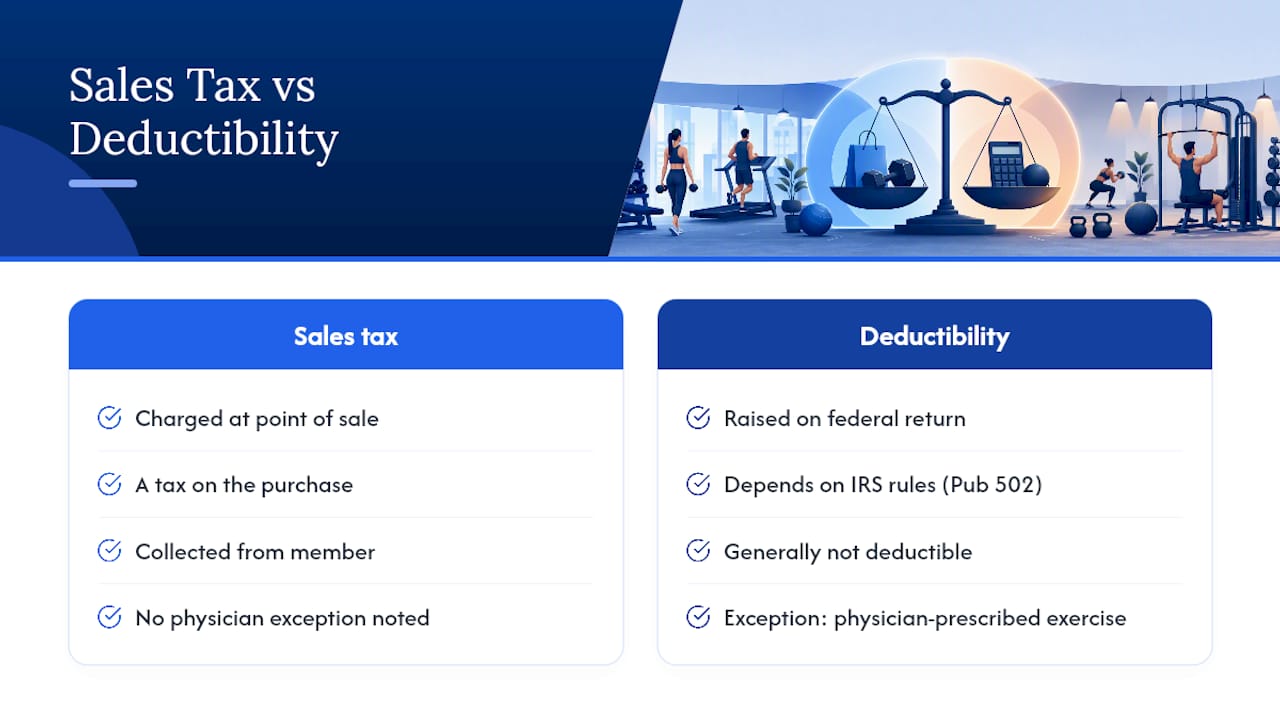
Members will sometimes ask whether HSA or FSA funds cover their membership. The honest answer is "rarely, and only with specific documentation," and it's not your job to give tax advice. Point members toward a tax professional, and if someone claims a medical exemption, ask for the physician's letter and keep a copy on file alongside their membership record.
How Gym Management Software Helps Automate Sales Tax Compliance
Manually tracking classification, rate changes, and itemization across every membership tier is where most compliance mistakes start. Finegym's invoicing and payment features are built to handle exactly this kind of operational load for gyms, CrossFit boxes, and multi-location clubs.
- Itemized invoicing separates access fees, personal training, and retail so taxable and nontaxable charges never blend into one line.
- Recurring billing calculates tax by facility location, which matters the moment you run more than one site with different combined rates.
- Reporting tools pull filing-ready summaries instead of forcing someone to reconstruct months of transactions by hand.
- Stored invoice history gives you the itemized paper trail an auditor actually wants to see, without digging through a spreadsheet from three years ago.
Practical Priorities for Gym Owners Managing Sales Tax
Classify and itemize before you touch pricing. Automate the calculation so no one's manually applying rates from memory. And the moment you sell across state lines or open a second location, bring in a tax professional. Guessing is what triggers audits.
— Vedad
How Finegym Simplifies Sales Tax Collection for Gym Owners
Finegym gives gym owners the itemized invoicing and location-aware recurring billing that sales tax compliance actually requires, without hand-building spreadsheets every billing cycle.

Where a generic payment processor treats every charge the same, Finegym's gym management platform separates membership access, personal training, and retail sales automatically, then keeps the invoice history an auditor would ask for. Payment processing and reporting run through the same system, so your filing data reflects actual itemized transactions rather than a lump revenue number you have to unpack later. If you're running billing manually or through a tool that can't itemize by location, it's worth testing the difference. Finegym offers a free plan so you can set up itemized billing and see how automated recurring payments handle multi-location tax rates before committing to anything.
This article is general information, not a substitute for advice from a qualified financial advisor. Consult a qualified financial professional about your own circumstances before acting on anything here.
Sources
- Tax
- California Department of Tax and Fee Administration (CDTFA)
- How does sales tax work on fitness memberships? - TaxJar
- IRS written determination 2010-0175 (gym membership medical deduction guidance)