
Most gym owners stick with monthly billing, assuming it guarantees steady cash flow and member retention. In reality, relying on outdated cycles can leave your studio vulnerable to missed payments, administrative headaches, and lost revenue. Understanding billing cycle fundamentals empowers you to adapt your payment model, reduce cancellations, and capture more income each year. This guide reveals key concepts and debunks industry myths so you can build a system that supports growth and keeps members satisfied.
Table of Contents
- Gym Billing Cycles: Key Concepts And Misconceptions
- Recurring, Prepaid, And Flexible Billing Models
- Automated Billing: How Saas Platforms Simplify Payments
- Financial Implications And Common Pitfalls To Avoid
- Member Agreements, Legal Compliance, And Responsibilities
Key Takeaways
| Point | Details |
|---|---|
| Understand Billing Cycles | Choose billing cycles that align with member preferences and your cash flow needs to optimize revenue and retention. |
| Leverage Different Billing Models | Utilize recurring, prepaid, and flexible billing models to cater to various member segments and enhance member satisfaction. |
| Invest in Automated Billing | Implement automated billing systems to increase accuracy, reduce administrative burden, and improve cash flow predictability. |
| Ensure Legal Compliance | Maintain clear membership agreements that outline billing, cancellation policies, and member rights to protect both your business and your members. |
Gym Billing Cycles: Key Concepts and Misconceptions
A billing cycle is the recurring period when you charge members and issue invoices—weekly, monthly, quarterly, or annually. This timing shapes your cash flow, revenue recognition, and member expectations. Getting this right separates gyms that struggle with cash flow from those that grow predictably.
Many gym owners operate on autopilot with monthly billing simply because it's the industry default. But that assumption costs money. Weekly billing cycles can increase revenue by capturing additional billing weeks each year, giving you more predictable income streams and better operational flexibility.
Common Misconceptions About Billing Cycles
Here's where most gym owners get it wrong:
-
Monthly is always best: Industry tradition doesn't equal optimal strategy. Weekly, biweekly, and quarterly options serve different member segments and financial goals.
-
Longer cycles mean better cash flow: Counterintuitive, but annual billing locks up cash upfront while monthly flexibility lets you capture more payment cycles annually.
-
Billing cycles don't affect retention: Members notice billing friction. Aligned cycle timing and transparent communication reduce cancellations significantly.
-
All members should have the same cycle: Different membership tiers and price points benefit from different billing frequencies.
Your billing cycle isn't just an accounting detail—it's a member experience and revenue strategy combined.
How Billing Cycles Impact Your Business
A billing cycle defines when customers are billed and how revenue gets recognized, making it central to predictable business performance. The cycle you choose affects everything below:
-
Cash flow timing: Weekly cycles bring money in faster; monthly cycles require better forecasting.
-
Member perception: Frequent small charges feel different than one large annual bill—psychology matters.
-
Operational complexity: More billing frequencies mean more variations in payment processing and member communication.
-
Revenue optimization: Additional billing opportunities compound into meaningful annual increases.
Owners often treat billing cycles as set-it-and-forget-it decisions. That's the mistake. Strategic cycle planning aligns member preferences with your cash needs and growth objectives. When you understand the fitness business billing process, you can match cycles to specific membership packages and financial goals.
Pro tip: Test a weekly or biweekly tier alongside your standard monthly option to capture revenue-conscious members and discover which cycle frequency drives higher lifetime value in your market.
Recurring, Prepaid, and Flexible Billing Models
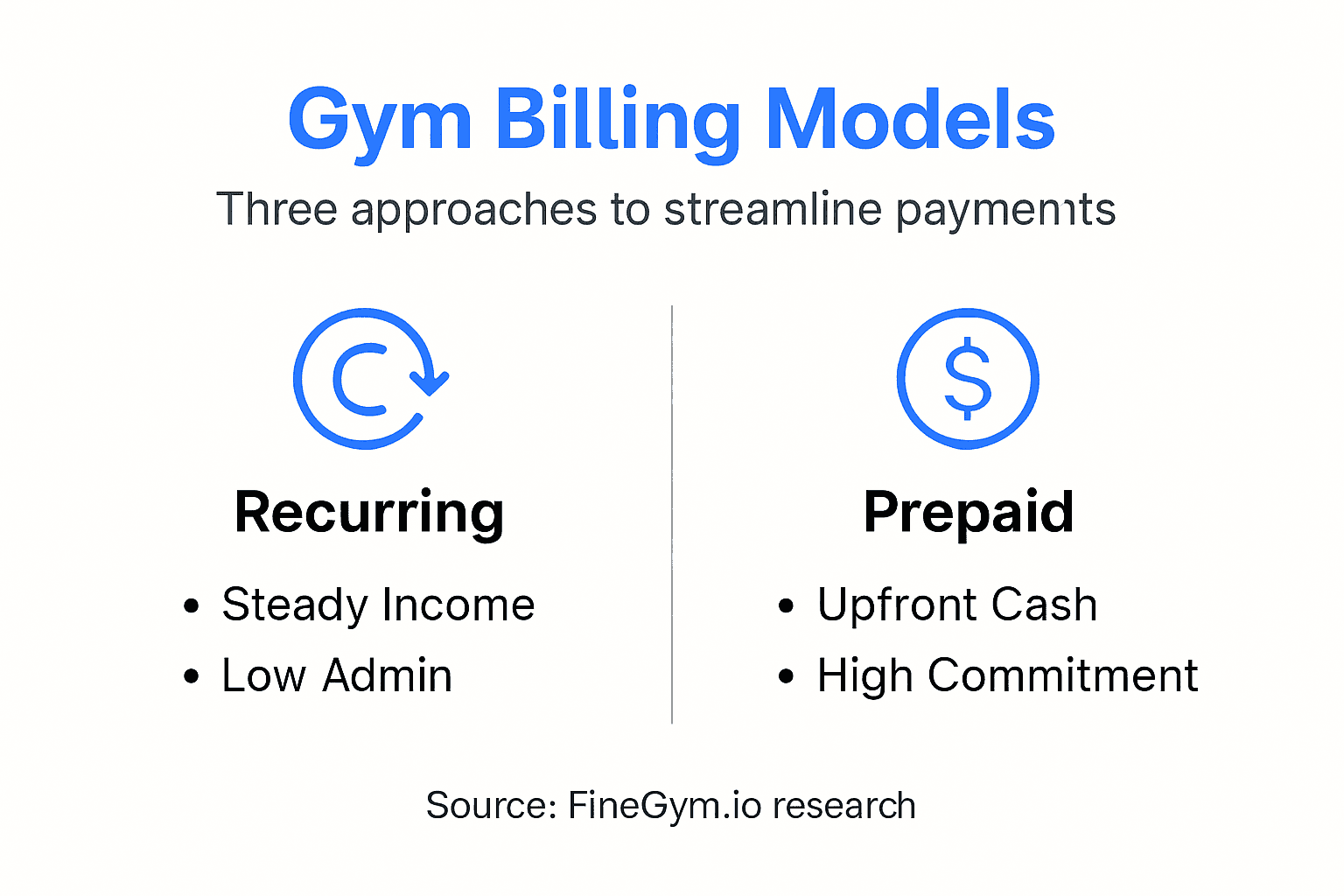
Three billing approaches dominate the fitness industry, each with distinct advantages and member appeal. Understanding when to use each model transforms how members experience your gym and how predictably your revenue flows.
Here's how the main gym billing models differ in purpose and appeal:
| Billing Model | Revenue Flow | Member Commitment | Operational Demand |
|---|---|---|---|
| Recurring | Steady, predictable monthly income | Moderate; members renew automatically | Low; automation handles most tasks |
| Prepaid | Large upfront cash infusion | High; longer membership terms required | Moderate; manages upfront payments and refunds |
| Flexible | Variable, adapts to member needs | Varies; members can pause or change plans | High; requires robust system to track changes |
Recurring Billing: The Steady Foundation
Recurring billing charges members on a fixed schedule—typically monthly—and is the most common model. Members authorize automatic payments, creating predictable revenue and reducing collection friction. This model works best for gyms seeking stable cash flow and low administrative overhead.

The recurring model's strength lies in simplicity. Members know exactly when they'll be charged, and your accounting becomes straightforward. However, it requires strong payment processing infrastructure to handle failed transactions and member disputes.
Key benefits of recurring billing:
-
Predictable revenue: You forecast cash flow with confidence months ahead.
-
Low friction: Automatic charges mean fewer manual payment requests.
-
Member habit: Regular small charges feel less painful than lump sums.
-
Reduced churn: Members must actively cancel rather than passively leaving.
Prepaid Billing: Upfront Revenue and Commitment
Prepaid memberships require members to pay in advance—quarterly, semi-annually, or annually. You receive cash immediately, which boosts working capital and signals member commitment. Prepaid models provide upfront revenue while reducing collection risk, making them valuable for cash-constrained operations.
Prepaid plans appeal to serious members willing to lock in longer commitments. They also reduce payment failures since charges happen upfront. The tradeoff: members sometimes feel trapped and may churn harder mid-cycle if unsatisfied.
When prepaid works best:
-
Growing gyms needing immediate capital injection
-
Premium tiers attracting committed long-term members
-
Seasonal businesses requiring cash before off-peak periods
Flexible Billing: Retention Through Choice
Flexible billing models accommodate membership freezes, upgrades, downgrades, and pause options without cancellation. Flexible structures increase member satisfaction by allowing individuals to adapt memberships to their circumstances. A member facing hardship can freeze rather than cancel, preserving lifetime value.
Flexibility isn't free. It requires sophisticated billing systems capable of handling mid-cycle adjustments without errors. But the retention gains justify the complexity. Members stay longer when they feel your gym adapts to their needs.
Flexible options to offer:
-
Membership freezes (pause 1-3 months per year)
-
Tier changes without penalties
-
Class package adjustments
-
Month-to-month override plans
The best billing model balances your cash needs with member preferences—and members increasingly expect flexibility.
Combining Models for Maximum Impact
Winning gyms don't pick one model. They layer all three. Offer monthly recurring for price-sensitive members, annual prepaid discounts for committed ones, and flexible pause options for everyone. This approach optimizes membership design for different member segments and maximizes both retention and revenue.
Automation is critical here. Manual tracking of mixed billing models causes errors that damage trust. Billing systems must track payment schedules, handle freezes, process upgrades, and generate accurate reports without human intervention.
Pro tip: Offer prepaid annual plans at 15-20% discounts while keeping flexible month-to-month options available—this captures committed members' upfront cash while retaining price-sensitive members who stay longer when they control their billing.
Automated Billing: How SaaS Platforms Simplify Payments
Manual billing is a time sink that breeds errors, frustrates members, and leaves money on the table. Automated billing systems eliminate this friction by handling invoices, payment collection, and compliance without human intervention. For gym owners juggling operations, staff management, and growth, automation transforms billing from a headache into a competitive advantage.
What Automated Billing Actually Does
Automated billing systems integrate payment gateways, CRM, and accounting tools to generate and process invoices on preset schedules. The system charges members automatically, sends payment reminders, handles failed transactions, and generates financial reports—all without manual touchpoints.
Here's what disappears when you automate:
-
Manual invoice creation and sending
-
Chasing members for late payments
-
Reconciling payment records across platforms
-
Re-entering billing data into accounting software
-
Calculating prorated charges for mid-cycle changes
Instead, these tasks happen silently in the background while you focus on member experience and business growth.
The Real Benefits Beyond Convenience
Error reduction is the first win. A SaaS platform processes thousands of transactions with zero arithmetic mistakes. One human error in billing damages member trust permanently. Automation eliminates that risk.
Cash flow predictability follows close behind. You know exactly when revenue arrives because charges process on schedule automatically. This certainty lets you plan payroll, equipment purchases, and facility maintenance with confidence.
Member satisfaction improves when billing feels frictionless. Members appreciate automatic renewal reminders, flexible payment methods, and transparent charge explanations. When problems arise, your system flags them before members notice.
Automation also enables flexibility without complexity. Membership freezes, tier upgrades, and plan changes process automatically without manual recalculation. Sophisticated billing platforms handle these adjustments seamlessly, preserving accuracy across thousands of membership variations.
Security and Compliance Built In
Managing payment security yourself is risky and expensive. SaaS platforms handle PCI DSS compliance automatically, encrypting sensitive data and protecting against fraud. You avoid the liability nightmare of storing credit card information.
Automatic platforms also generate audit trails for regulatory purposes and handle tax reporting without extra work. You stay compliant without hiring a compliance officer.
Integration With Your Existing Systems
Proper automation doesn't exist in isolation. Your billing system must feed data to accounting software, member management platforms, and reporting dashboards. Real SaaS solutions integrate these tools seamlessly, eliminating duplicate data entry and reconciliation headaches.
Automation transforms billing from a operational burden into a growth engine that runs itself.
Pro tip: Start with automated recurring charges for your largest member segment, then gradually add flexible options like freezes and upgrades—this gives you early wins while building system sophistication over time.
Financial Implications and Common Pitfalls to Avoid
Billing errors don't just annoy members—they hemorrhage revenue and destroy trust. A single missed payment notification costs you that month's dues. Multiple errors compound into serious cash flow gaps. Understanding the financial damage of poor billing practices helps you prioritize getting this right.
The Hidden Cost of Billing Mistakes
Poor billing practices lead to lost revenue from missed or late payments and wasted administrative time resolving errors. When a member's payment fails and you don't catch it for weeks, that's lost income. When you manually track overdue accounts on spreadsheets, that's time you could spend acquiring new members.
The real damage extends beyond direct losses. Members hate billing confusion. One unclear charge or disputed transaction breeds resentment that lingers long after resolution. A frustrated member cancels faster than a satisfied one renews.
Common financial hits from poor billing:
-
Revenue leakage: Missed payments and late collections shrink monthly income.
-
Administrative overhead: Manual billing processes consume staff hours better spent on retention and growth.
-
Churn acceleration: Billing friction triggers cancellations at significantly higher rates.
-
Compliance penalties: Payment processing errors can trigger fines and chargebacks.
Specific Pitfalls That Drain Gyms
Juggling multiple payment methods without proper tracking is a recipe for disaster. Members pay by card, bank transfer, or cash. Without centralized tracking, payments slip through cracks and duplicate charges happen. This creates confusion and refund nightmares.
Membership changes handled incorrectly create another bleeding point. A member downgrades their tier but gets charged at the old rate. Or someone freezes their account and still gets billed. These errors compound across dozens or hundreds of members monthly.
Common pitfalls to avoid:
-
Inconsistent billing dates: Charges spread across the month instead of clustering, making forecasting impossible.
-
Manual payment tracking: Spreadsheets and emails create duplicate work and inevitable oversights.
-
No failed payment recovery: When a card declines, you don't automatically retry—you just lose the revenue.
-
Poor communication: Members don't receive renewal reminders, so they're surprised by charges and dispute them.
-
Untracked overdue accounts: Late payments sit unaddressed instead of being systematically followed up.
The Financial Argument for Automation
Automation prevents these pitfalls by design. One system handles all payments consistently. Failed charges trigger automatic retries. Membership changes process correctly every time. Communication happens automatically on schedule.
The financial payoff is substantial. A gym recovering just 5-10 missed payments monthly through better tracking adds $600-1,200 in annual revenue. Reducing administrative time by half frees a staff member for higher-value work like member retention and sales.
Billing mistakes are expensive—but they're also preventable through systematic processes and the right technology.
Building Your Defense
Start by auditing your current billing losses. How many payments fail monthly? How much time does manual billing consume? How many billing disputes arise? These numbers justify investment in better systems.
Then implement controls. Automate what you can. Review overdue accounts weekly. Communicate payment details clearly to members upfront. Track metrics so you spot problems early.
Pro tip: Run a one-month audit of your current billing: count failed payments, manual processing hours, and member disputes—then show that data to justify switching to automated billing, since the ROI becomes impossible to ignore.
Member Agreements, Legal Compliance, and Responsibilities
A clear membership agreement is your legal shield and your member's roadmap. It spells out billing terms, cancellation policies, liability limits, and member responsibilities. Without one, you face disputes, chargebacks, and potential legal exposure. With one, billing becomes a matter of documented consent rather than guesswork.
Why Member Agreements Matter
Your membership agreement is a binding contract that protects both parties. It specifies exactly when and how members get charged, what happens if they want to cancel, and what they're legally responsible for. Members know what they're agreeing to upfront, eliminating surprise-billing disputes later.
The agreement also establishes your gym's right to enforce terms. If a member disputes a charge months after cancelling, you have documented proof of their consent. If someone gets injured and tries to sue, liability waivers in your agreement limit your exposure significantly.
Core elements of a solid agreement:
-
Billing terms: Frequency, amount, payment method, and date
-
Cancellation policy: Notice period required, final billing date, refund terms
-
Liability waiver: Members acknowledge fitness risks and release your gym from certain claims
-
Membership freeze policy: How long members can pause, any fees involved
-
Dispute resolution: How billing disagreements get handled
Legal Compliance Across Jurisdictions
Compliance requirements vary by country and state. Some jurisdictions require explicit consent before charging recurring payments. Others mandate specific refund timeframes or cancellation notice periods. Operating without understanding your local rules exposes you to fines and forced refunds.
Understanding data privacy regulations and member liability waivers is critical for protecting both your business and member data. Payment processor compliance also matters—credit card networks have their own billing agreement rules you must follow.
Key compliance areas:
This table highlights compliance essentials for gym billing and agreements:
| Compliance Area | What It Protects | Typical Requirement |
|---|---|---|
| Recurring Billing Consent | Member rights | Written or digital authorization before charging |
| Cancellation Rights | Fair billing disputes | Clear process; minimum notice period |
| Refund Policies | Financial transparency | Published timeframes for unused services |
| Privacy Protection | Member personal data | Data encrypted, handled by certified services |
| Transparent Terms | Trust and legal defense | Plain language in all agreements |
-
Recurring billing consent: Written authorization before charging members automatically
-
Cancellation rights: Clear, accessible instructions for members to cancel
-
Refund policies: Timeframes and conditions for refunding unused membership periods
-
Privacy protection: How member data gets collected, stored, and used
-
Transparency: Clear, honest disclosure of all terms in plain language
Your Responsibilities as a Gym Owner
You're responsible for three core things: enforcing your agreement consistently, protecting member data, and following payment regulations.
First, enforce your policy uniformly. If your agreement says 30-day cancellation notice, require it from every member—no exceptions. Inconsistent enforcement weakens your legal position and signals unfairness to members.
Second, protect member payment data. Never store credit card numbers yourself. Use PCI-compliant payment processors that handle security for you. A data breach isn't just embarrassing—it's legally devastating.
Third, honor your cancellation terms. If someone cancels, stop billing them immediately. Continued charges after cancellation are the leading cause of chargeback claims against gyms.
A strong membership agreement prevents disputes before they start and protects you if they do.
Building Your Agreement
Don't wing this. Work with a lawyer familiar with fitness business law in your jurisdiction. They'll ensure your agreement reflects local requirements and protects your interests. The cost of legal review—typically $300-800—is trivial compared to fighting a lawsuit or regulatory fine.
Your agreement should be written in clear, plain language, not legal jargon. Members should understand exactly what they're agreeing to without needing a law degree.
Pro tip: Have members sign and date your membership agreement in person or digitally (with timestamps) before taking their first payment—this creates undeniable proof of informed consent if disputes arise later.
Master Your Gym's Billing Cycles for Sustainable Growth
Managing billings with precision is essential to avoid cash flow gaps and member churn. This article highlights how choosing the right billing cycle and automating processes directly influences your gym's revenue stability and member satisfaction. If you struggle with manual billing errors, inconsistent payment tracking, or the complexity of offering flexible plans, these pain points threaten your growth potential.
FineGym.io solves these challenges by providing an integrated SaaS platform that automates recurring, prepaid, and flexible billing models. Our system reduces administrative overhead, ensures timely payments, and lets you tailor billing cycles to your membership tiers seamlessly. Experience streamlined operations that keep members happy and your cash flow predictable. Discover how to optimize your gym's financial management with powerful automation at FineGym.io.

Ready to eliminate billing headaches and accelerate your gym's growth? Explore how FineGym.io can simplify your billing cycles today. Get started now and transform your gym with automated payment processing, member management, and seamless integrations all in one solution.
Frequently Asked Questions
What is a billing cycle in a gym?
A billing cycle is the recurring period when gyms charge their members and issue invoices. This can be weekly, monthly, quarterly, or annually, and it significantly impacts cash flow and revenue recognition.
How do different billing cycles affect gym revenue?
Different billing cycles, such as weekly and monthly, can optimize revenue streams. Weekly billing can capture additional payment opportunities, leading to more predictable income and improved operational flexibility compared to standard monthly billing.
What are the main billing models used in gyms?
The three main billing models are recurring billing, prepaid billing, and flexible billing. Recurring billing provides steady monthly income, prepaid billing boosts initial cash flow with upfront payments, and flexible billing accommodates changes like membership freezes and upgrades.
Why should gyms consider automated billing systems?
Automated billing systems streamline payment processing, reduce errors, and improve member satisfaction. They handle invoices, payment collections, and compliance without manual input, allowing gym owners to focus on business growth and member experience.