
Yes, ACH is the right default for recurring gym membership billing in the United States. It costs less than card processing, avoids the expired-card churn that quietly drains revenue every quarter, and runs on a payment network Nacha reports processed 31.5 billion payments worth $80.1 trillion in 2023. A platform like Finegym can wire the authorization, retries, and reconciliation together so you're not managing it by hand, which is vital when implementing effective gym SEO services to grow and retain memberships.
TL;DR:
- ACH costs significantly less per transaction than card processing, typically between $0.20 and $1.50, which can save gyms thousands annually.
- The standard settlement time for ACH payments is three to five business days, but Same Day ACH is increasingly available for faster confirmation at a higher fee.
- Proper authorization language must specify the debit amount, frequency, your business name, and cancellation terms to prevent disputes and unauthorized debits.
- Integration with gym management software simplifies reconciliation and automates retry, notification, and dispute handling processes to minimize manual work.
- Managing returns and disputes requires quick, reason-specific responses and solid documentation; unauthorized claims are easiest to resolve with signed authorization and receipt records.
Table of Contents
- Why ACH Matches the Recurring Membership Model
- How ACH Recurring Billing Actually Works
- Step-by-Step: Launching ACH at Your Gym
- Managing Returns, Disputes, and Member Complaints
- Connecting ACH to Your Gym Management Software
- Choosing Your Fee Model and Pricing Policy
- How Finegym Operationalizes ACH for Gym Owners
- Set Up ACH Billing Without the Manual Work
- Sources
- FAQ
Why ACH Matches the Recurring Membership Model
A gym membership is a subscription, and ACH was built for subscriptions. The network's scale, 31.5 billion payments and $80.1 trillion in value in 2023 alone, tells you this isn't a niche rail reserved for utility companies. It's the backbone of American recurring billing.
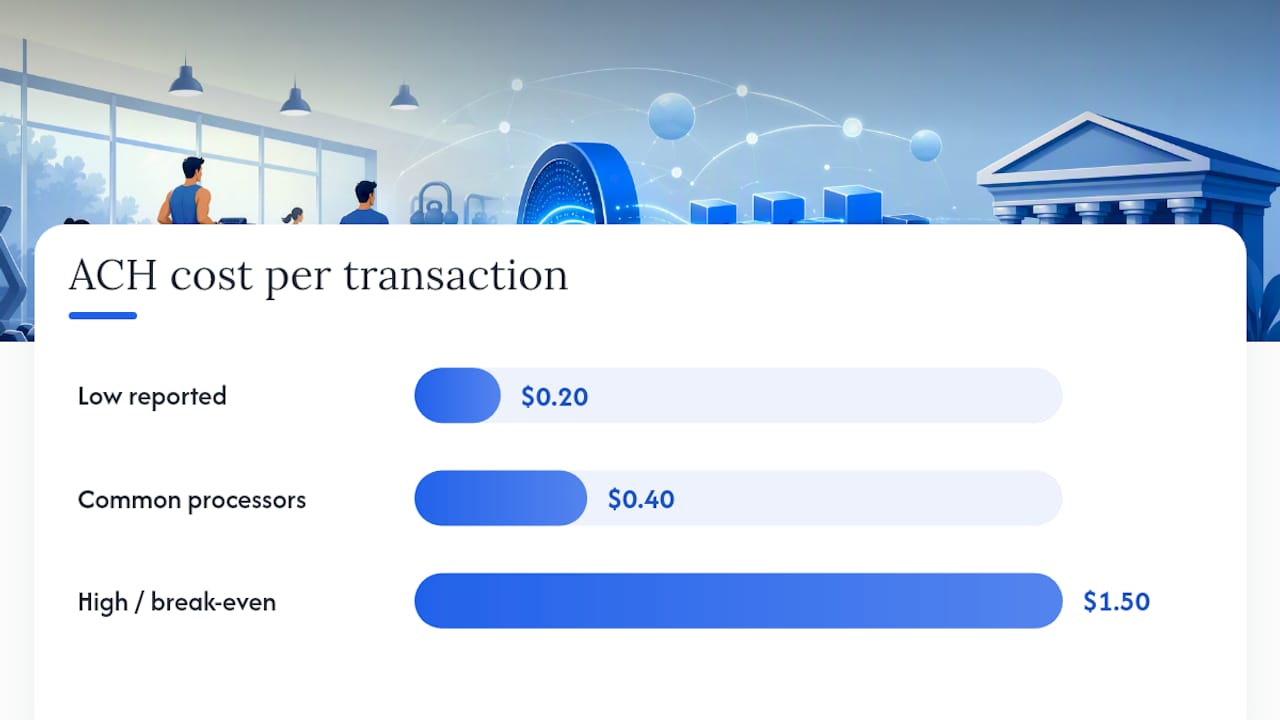
The cost math is where most owners get convinced. Card processing typically runs 2.5% to 3.5% per transaction, while ACH transactions cost roughly $0.20 to $1.50 flat, regardless of the membership price. ACH at even the high end of $1.50 breaks even; at $0.30 to $0.50, which is common with many processors, you keep an extra dollar per member every month. Multiply that across 400 members and you're looking at real annual savings, not rounding error.
Beyond the fee comparison, ACH sidesteps three operational headaches:
- No expired cards interrupting billing cycles every time a member's plastic renews.
- Fewer chargebacks, since ACH disputes route through a return process rather than a card network dispute.
- More predictable monthly revenue, because bank account numbers don't expire the way card numbers do.
How ACH Recurring Billing Actually Works
ACH billing runs on authorization first, everything else second. Before you debit a member's account, you need their explicit consent covering the amount, frequency, and your business name as it will appear on their bank statement. Vague or inconsistent authorization language is the leading cause of unauthorized-debit claims, which is the ACH equivalent of a chargeback and the thing you're trying hardest to avoid.
Settlement timing matters for cash flow planning. Standard ACH typically takes three to five business days to settle, meaning a debit initiated Monday might not post as final until Thursday or Friday. Same Day ACH exists for cases where you need faster confirmation, and Nacha reports adoption of the faster option has been climbing, though it usually carries a higher per-transaction fee.
The lifecycle looks like this:
- Setup: Member provides bank details and signs authorization.
- Debit attempt: Your processor initiates the transaction on the scheduled date.
- Settlement window: Funds move through the bank network over the following days.
- Outcome: Either the payment settles successfully, or it returns with a reason code you need to act on.
Step-by-Step: Launching ACH at Your Gym
Rolling out ACH works best as a sequence, not a scramble. Skipping the authorization step to save a week of setup time is how gyms end up fielding disputed-debit calls in month two.
- Pick your processor or bank partner first. Confirm they support ACH specifically for recurring subscription billing, not just one-time transfers, and ask directly about return-handling tools.
- Set your billing cadence. Most gyms bill monthly on a fixed date (the 1st or 15th are common), which simplifies dunning schedules and member expectations.
- Write clear authorization language. Include the exact debit amount or how it's calculated, the frequency, your business descriptor as it appears on bank statements, and how a member cancels.
- Capture bank details securely. Instant bank linking through a verified aggregator reduces errors compared with manual account and routing number entry, and cuts down on abandoned sign-ups.
- Verify the account before the first debit. Micro-deposit verification or instant verification both work; instant is faster and lowers drop-off.
- Send a confirmation receipt immediately after signup, restating the authorization terms in writing.
- Build your dunning sequence: a pre-bill notice two to three days before the debit, a same-day confirmation once it processes, an immediate failure alert if it doesn't, and a retry attempt scheduled two to three business days later.
- Set escalation rules for what happens after two failed retries, whether that's a manual staff call, a temporary access pause, or an automated switch to a backup payment method.
Pro Tip: Put your authorization language in three places, the signup form, the membership contract, and the confirmation receipt, using identical wording each time. Consistency across all three is what actually holds up if a member disputes a debit later.
Managing Returns, Disputes, and Member Complaints
Returns happen even with a clean setup, and treating them as a single category is a mistake. NSF (non-sufficient funds) returns deserve a different response than an invalid account number, which deserves a different response than a member claiming the debit was unauthorized.
For NSF returns, a short retry window of two to three business days often clears the issue without any staff involvement. Invalid account returns need a member outreach immediately, since retrying the same bad account number just repeats the failure. Unauthorized-debit claims are the most serious category, and this is exactly where your documentation earns its keep: a signed or electronic authorization, a timestamped confirmation receipt, and a clear cancellation record can resolve a dispute in minutes instead of days.
- Log every return with its reason code, not just "payment failed."
- Contact the member the same day a return posts, before it becomes a second missed cycle.
- Reserve access suspension for after a defined retry sequence has run its course, never as a first response.
Pro Tip: Reason-based retry logic, different schedules for NSF versus invalid account versus revoked authorization, cuts unnecessary member friction and keeps your front desk out of collections mode.
Connecting ACH to Your Gym Management Software
A payment method living outside your membership management system creates reconciliation work nobody enjoys. When a member's profile, payment method, and billing history sit in one record, matching a return to the right account takes seconds instead of a spreadsheet hunt.
The integration points worth requiring from any gym platform:
- Signup forms that capture bank details and authorization language in the same flow, not two separate steps.
- Self-service portals where members update their own bank information without calling the front desk.
- Freeze and refund triggers that adjust billing automatically when a membership pauses.
- Webhook-based notifications that alert staff the moment a debit fails, not after next week's reconciliation.
Security matters just as much as convenience here. Look for tokenization so raw bank account numbers never sit exposed in your database, staff permissions scoped to only what each role needs, and an audit log tracking who accessed payment records and when.
Choosing Your Fee Model and Pricing Policy
Most gyms land on one of three approaches: absorb the ACH fee as a cost of doing business, pass a small discount to members who use ACH, or run dual pricing where card users pay a slightly higher listed rate.
Given that ACH typically runs $0.20 to $1.50 flat versus 2.5% to 3.5% for cards, absorbing the ACH fee is usually painless even for budget-conscious studios. Dual pricing, showing an ACH or cash price alongside a higher card price that bakes in the processing fee, can eliminate your card costs entirely, but it requires clear, visible disclosure to stay compliant with U.S. merchant rules.
- Default new signups to ACH as the standard payment method.
- Offer card as an optional, clearly labeled alternative.
- Disclose any price difference between payment methods before checkout, not after.
How Finegym Operationalizes ACH for Gym Owners
Most of the friction in ACH billing isn't the payment rail itself. It's stitching together authorization capture, retry logic, and member records across separate tools. Finegym is built as a single platform where member management, scheduling, billing, and communications share one data layer, so a returned debit automatically ties back to the right member profile instead of living in a disconnected processor dashboard.
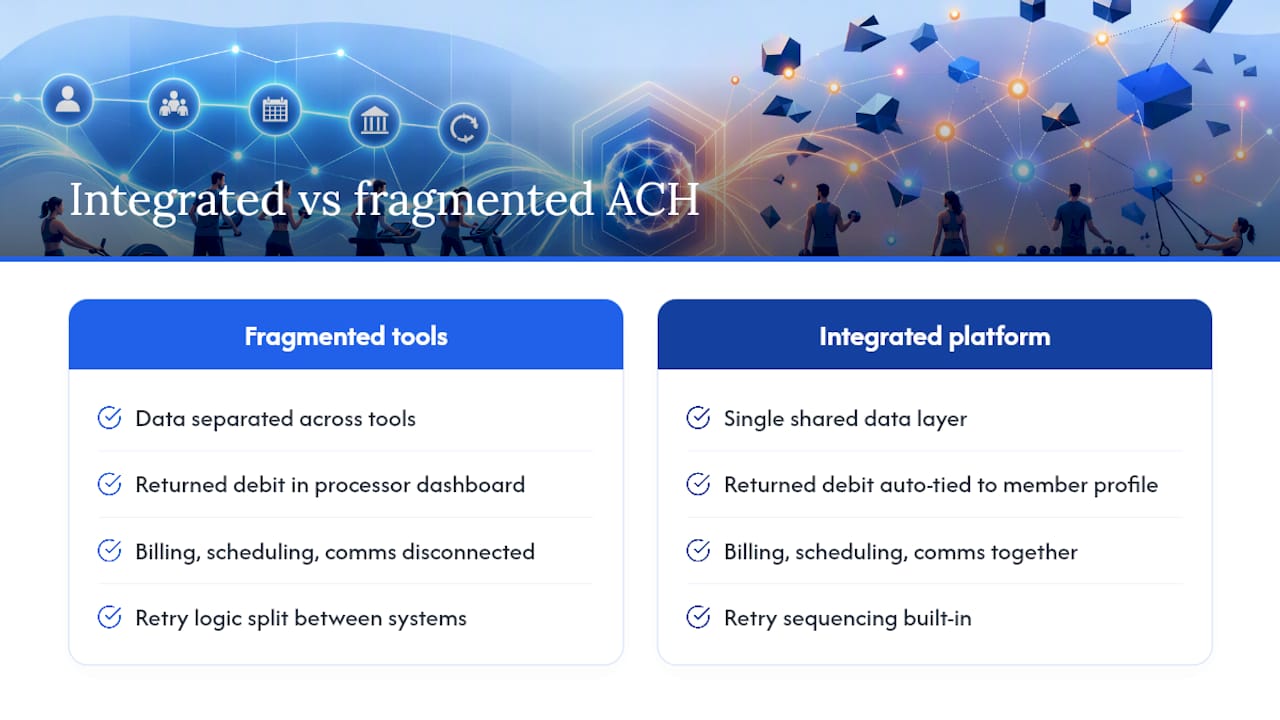
The platform's automated billing and payment processing tools are designed specifically around fitness business billing cycles, including the pre-bill notices and retry sequencing this guide walks through. That's the practical value of an integrated system: fewer manual handoffs between your front desk, your processor, and your accounting software.
The gyms that get the most out of ACH are rarely the ones with the most sophisticated processor. They're the ones whose authorization language, retry rules, and member records already live in one place before the first debit ever runs.
— Vedad
Set Up ACH Billing Without the Manual Work
This gym management platform gets your ACH billing running without you stitching together a processor, a spreadsheet for retries, and a separate system for member records. It handles authorization capture at signup, automated pre-bill notices, and reason-based retries in one place, so a failed debit doesn't turn into a lost member over a missed follow-up call.
If you're running a CrossFit box, a multi-location club, or a single studio, the gym management solution ties your membership records, scheduling, and billing into one dashboard instead of three disconnected tools. Small studios evaluating ACH before committing to a full platform can also start with the free gym management software to see how automated billing fits their current workflow. Book a walkthrough to see your billing cycle mapped out before you switch a single member over.
Sources
- ACH Network records strong growth in 2023; Same Day ACH surpasses 3 billion payments since inception
- ACH payments for gyms and fitness centers - Rotessa
FAQ
Is ACH Cheaper Than Credit Card Processing for Gyms?
Usually, yes. ACH typically costs $0.20 to $1.50 per flat transaction compared with 2.5% to 3.5% for card processing, which favors ACH on most membership price points.
How Long Does an ACH Payment Take to Settle?
Standard ACH transactions typically settle within three to five business days, while Same Day ACH offers faster confirmation for an added fee.
What Should ACH Authorization Language Include?
It needs the exact debit amount or how it's calculated, the billing frequency, your business descriptor as it appears on statements, and a clear cancellation process to prevent unauthorized-debit disputes.
Can Finegym Handle ACH Billing for My Gym?
Yes, Finegym's automated billing tools manage authorization capture, pre-bill notices, and retry scheduling within the same platform as your member records.
What Happens If an ACH Payment Returns?
The response depends on the reason code: NSF returns usually clear with a short retry, invalid account numbers need immediate member outreach, and unauthorized-debit claims require your signed authorization and receipt records to resolve.