
Gyms using automated recurring payments can boost member retention by up to 20%, transforming how fitness businesses handle billing and cash flow. Manual billing creates unnecessary headaches, administrative burden, and member churn that hurts your bottom line. This article explains what recurring payments are, the measurable benefits they deliver, common myths holding gym owners back, and how to implement them successfully in your facility.
Table of Contents
- Understanding Recurring Payments in Gyms
- Benefits of Recurring Payments for Gyms
- Common Misconceptions About Recurring Payments
- Comparison of Recurring Payment Models for Gyms
- Security and Compliance Considerations
- Implementing Recurring Payments in Your Gym
- Conclusion: Maximizing Gym Success with Recurring Payments
- Streamline Your Gym Billing with Finegym Software
- Frequently Asked Questions
Key Takeaways
| Point | Details |
|---|---|
| Automated recurring payments reduce manual billing errors | Eliminating manual processes cuts workload by over 75% and improves accuracy. |
| Member retention increases up to 20% with recurring billing | Convenient automated payments reduce friction and keep members engaged longer. |
| Common myths about cost and complexity are unfounded | Modern platforms integrate quickly with flexible pricing for gyms of all sizes. |
| PCI DSS compliance is mandatory for secure payment processing | Security standards protect member data and prevent costly breaches. |
| Step-by-step implementation ensures smooth member adoption | Clear communication and proper setup drive successful recurring payment programs. |
Understanding Recurring Payments in Gyms
Recurring payments are automated scheduled billing systems that charge gym members at regular intervals for their memberships. These systems work by securely storing payment information and processing charges automatically according to your billing schedule.
Most gyms implement recurring payments via credit/debit cards or ACH with PCI DSS compliance to protect member data. The automation runs in the background through payment processing for fitness businesses, requiring minimal staff intervention once properly configured.
Here's what makes recurring payments work for gyms:
- Monthly, quarterly, or annual billing frequencies match membership terms
- Automatic charge processing eliminates manual invoice creation and payment collection
- Integrated systems sync with member management platforms for seamless operations
- PCI DSS compliance ensures secure handling of sensitive payment data
- Authorization protocols protect both gym and member interests
The result is a reliable billing experience that members appreciate and gym owners depend on. Staff spend less time chasing payments and more time creating value for members.
Benefits of Recurring Payments for Gyms
The 15-20% increase in member retention and up to 30% better cash flow predictability fundamentally changes how gyms operate financially. These aren't just minor improvements; they represent substantial competitive advantages in a tight market.
Automated recurring billing delivers measurable improvements across multiple areas:
- Member retention jumps 15-20% because convenient automatic payments reduce cancellation friction
- Cash flow predictability improves by 30%, enabling better financial planning and investment decisions
- Manual billing workload drops over 75%, freeing staff to focus on member experience
- Payment collection rates increase as automated reminders prevent missed charges
- Administrative costs decrease significantly with fewer billing disputes and manual corrections
The benefits of recurring payments extend beyond simple convenience. Members stay longer when payment happens seamlessly without requiring action each month. Your gym gains financial stability through predictable revenue streams.
Pro Tip: Set up automatic payment failure notifications to quickly address declined cards before members become inactive. This simple step can recover 60-70% of failed payments within 48 hours.
Streamlining gym billing cycles creates a foundation for sustainable growth. When you're not constantly managing payment issues, you can invest time in programs that attract and retain members.

Common Misconceptions About Recurring Payments
Many gym owners hesitate to implement recurring payments based on outdated assumptions about cost, complexity, and member preferences. These misconceptions prevent gyms from capturing significant operational and financial benefits.
Let's address the most common myths directly:
- Myth: Recurring payment systems are expensive and complicated to set up
- Fact: Modern SaaS platforms offer flexible pricing with integration times averaging under one week
- Myth: Members prefer manual payment methods and resist automated billing
- Fact: Automated recurring billing actually increases retention by removing payment hassle
- Myth: Integration will disrupt daily operations for months
- Fact: Integration with gym management software completes quickly with minimal workflow interruption
The reality is that most gym billing setup processes are straightforward when you choose the right platform. You don't need technical expertise or massive budgets to implement professional recurring payment systems.
Pro Tip: Start with a pilot program for new members before migrating existing members to recurring payments. This approach builds confidence in your processes and allows you to refine communication strategies.
Members appreciate the convenience of automatic payments once they understand the benefits. Clear communication during onboarding prevents confusion and builds trust in your billing practices.
Comparison of Recurring Payment Models for Gyms
Different recurring payment models serve different gym business strategies and member demographics. Understanding which model aligns with your goals helps optimize both revenue and member satisfaction.
| Payment Model | How It Works | Best For | Key Advantages | Potential Drawbacks |
|---|---|---|---|---|
| Fixed Subscription | Same charge each billing cycle | Boutique gyms, studios | Predictable revenue, simple member communication | Less flexibility for variable usage patterns |
| Usage-Based | Charges based on attendance or classes | Large multi-service centers | Aligns cost with value received | Revenue less predictable, requires robust tracking |
| Tiered Memberships | Different pricing levels with varied benefits | Full-service gyms | Supports upselling, accommodates diverse member needs | More complex to manage and communicate |
| Hybrid Model | Combines base subscription with usage fees | Specialty training facilities | Balances predictability with flexibility | Requires sophisticated billing systems |
Fixed subscription models dominate the gym industry because they deliver revenue stability and straightforward member expectations. Usage-based models work well when members value flexibility and facilities have capacity to track attendance accurately.
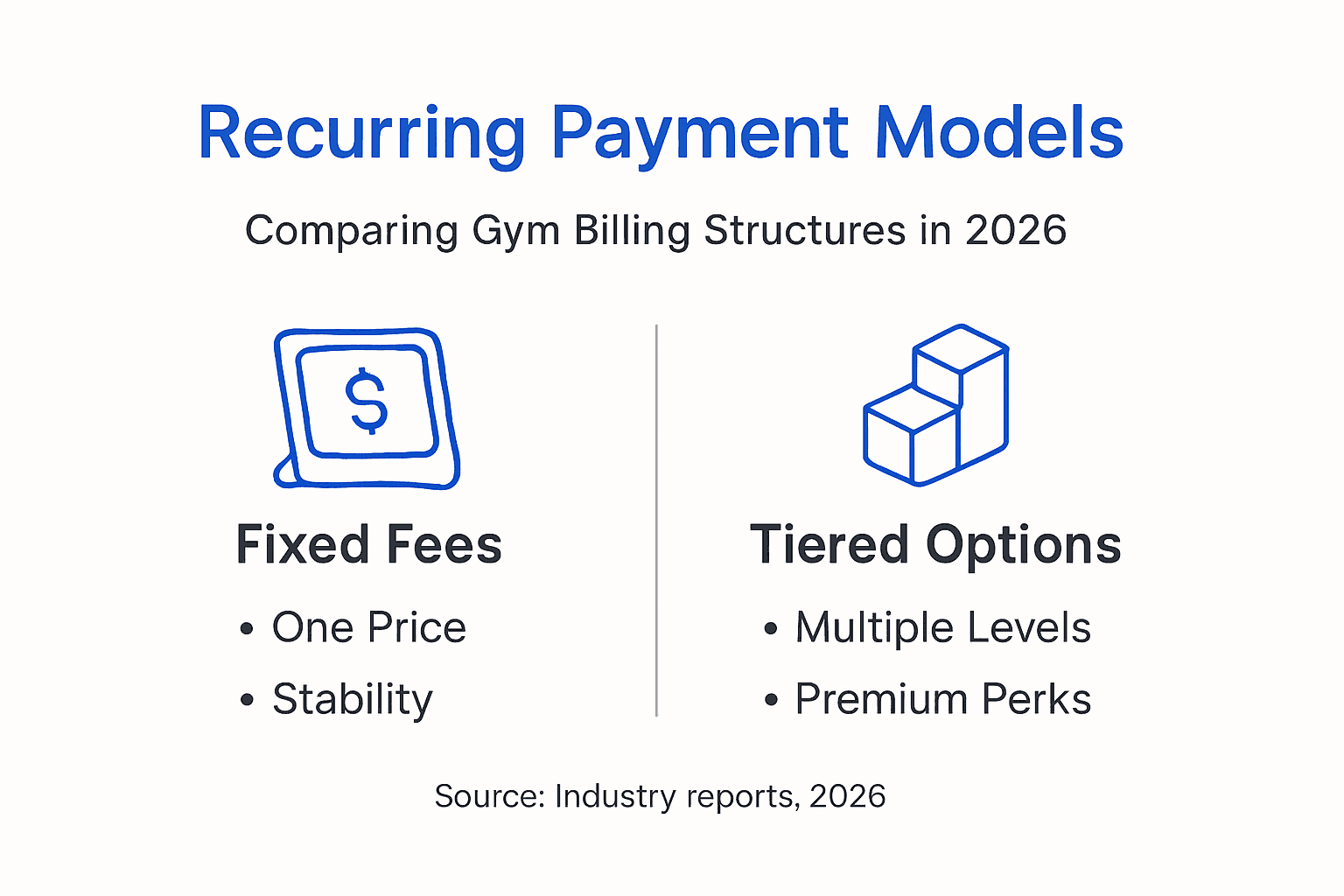
Tiered memberships create opportunities for segmentation and premium service offerings. Gym membership management systems make it easy to handle multiple pricing tiers without administrative overhead.
Your choice should reflect your facility type, target member demographics, and growth strategy. Most gyms find success with fixed subscriptions supplemented by optional add-on services.
Security and Compliance Considerations
Secure payment processing isn't optional; it's mandatory for protecting member data and avoiding costly breaches that damage reputation and finances. PCI DSS compliance is mandatory for secure handling of payment data in recurring billing, establishing minimum security standards all gyms must meet.
Implementing proper security measures protects both your business and your members:
- Tokenization replaces sensitive card data with secure tokens for storage and processing
- Encrypted transmission protocols protect payment information during transaction processing
- Written member authorization documents establish legal consent before recurring charges begin
- Regular security audits identify vulnerabilities before they become breach points
- Compliant payment gateways handle PCI DSS security standards on your behalf
Choosing software with built-in legal compliance for fitness software removes the burden of managing technical security requirements internally. Your payment processor should handle encryption, tokenization, and compliance monitoring automatically.
Member trust depends on demonstrating that you take data security seriously. Displaying security certifications and explaining your protection measures during signup builds confidence in your recurring payment program.
Implementing Recurring Payments in Your Gym
Successful implementation follows a systematic approach that minimizes disruption while ensuring proper setup and member acceptance. These steps guide you from selection through full deployment.
-
Select a compliant payment gateway: Choose a PCI DSS-certified processor that integrates with your membership management software and supports your preferred payment methods.
-
Obtain member authorization: Create clear recurring billing agreements that explain charges, frequencies, and cancellation procedures before collecting payment information.
-
Integrate with your management platform: Connect your payment system to your gym payment processing software and conduct thorough testing with small transaction amounts.
-
Communicate transparently: Explain the new payment process to members, emphasizing convenience benefits and security measures protecting their information.
-
Monitor and optimize: Track payment success rates, member feedback, and system performance to identify improvement opportunities.
The step-by-step gym billing setup process typically completes within one week when you have the right tools and clear communication plan. Don't rush the testing phase; thorough validation prevents expensive mistakes.
Pro Tip: Offer multiple payment methods including credit cards, debit cards, and ACH transfers to accommodate member preferences and reduce payment failures.
Integration with comprehensive gym management software solutions ensures that billing, member profiles, and attendance tracking work together seamlessly. This connectivity eliminates data entry errors and provides complete visibility into member accounts.
Conclusion: Maximizing Gym Success with Recurring Payments
Recurring payments transform gym operations by automating billing, reducing errors, and creating predictable cash flow that supports sustainable growth. The convenience factor directly impacts member retention, keeping members engaged longer and reducing costly churn.
Gyms that implement recurring payments gain competitive advantages through improved financial stability and operational efficiency. Your staff focuses on member experience rather than payment collection, and members enjoy seamless billing without monthly payment hassles.
The implementation process is straightforward with modern platforms that handle technical complexity and compliance requirements. Start by selecting compliant payment processing, obtaining proper member authorization, and communicating transparently about the benefits.
Adopting recurring billing today future-proofs your gym business for continued growth in an increasingly competitive fitness market. The combination of enhanced retention, predictable revenue, and reduced administrative burden creates a foundation for long-term success.
Streamline Your Gym Billing with Finegym Software
Ready to implement the recurring payment strategies outlined in this article? Finegym offers secure, PCI-compliant payment processing fully integrated into comprehensive gym management software designed specifically for fitness businesses.
Our platform makes it simple to set up automated billing and payment processing that reduces manual work and boosts member retention. You get all-in-one functionality covering scheduling, member management, communications, and billing in a single system.
Discover how Finegym's gym payment processing features simplify billing operations and improve cash flow management. Focus on growing your gym while we handle the technical complexity of secure, compliant payment processing.
Frequently Asked Questions
How long does it take to implement recurring payments in a gym?
Most gyms complete implementation within one week when using integrated gym management platforms. The process includes selecting a payment gateway, configuring settings, testing transactions, and communicating with members. Actual setup time depends on your existing systems and member base size.
Are recurring payment systems secure for gym members?
Yes, when properly implemented with PCI DSS-compliant processors that use tokenization and encryption. These security measures protect sensitive payment data from breaches and unauthorized access. Choose payment platforms that maintain current security certifications and conduct regular audits.
What happens if a member's recurring payment fails?
Modern systems automatically retry failed payments and send notifications to both staff and members. You can configure retry schedules and dunning management to recover most failed payments within 48 hours. Clear policies about failed payment procedures should be included in member agreements.
Do recurring payments work for all gym membership types?
Recurring payments adapt to various membership structures including monthly, quarterly, and annual plans. Tiered memberships, family plans, and corporate accounts all work with automated billing systems. Flexible platforms allow customization for different membership categories and pricing models.
How much do recurring payment systems cost for gyms?
Pricing varies based on transaction volume, payment methods, and platform features. Most providers charge between 2.5-3.5% per transaction plus small fixed fees. Integrated gym management platforms often include payment processing in their monthly subscription, potentially reducing overall costs compared to standalone payment processors.
Can members easily cancel recurring payments?
Yes, members can request cancellation according to your membership agreement terms. Transparent cancellation policies and clear communication prevent disputes and maintain positive member relationships. Automated systems should allow you to pause or cancel recurring billing immediately when members request changes.