

Managing several gym locations across North America often means sorting facts from fiction when it comes to fitness operations. Many franchise operators face persistent myths that cloud decisions and hold back growth. Debunking these misconceptions is key to building a connected fitness ecosystem where member engagement thrives and operational headaches are minimized. This article helps franchise owners understand what sets multi-location gyms apart and reveals strategic ways to achieve consistency and efficiency.
Table of Contents
- Defining Multi-Location Gyms And Common Myths
- Core Features Of Multi-Location Operations
- Membership Models Across Multiple Sites
- Management And Technology Challenges
- Comparing Single-Site And Multi-Site Gyms
Key Takeaways
| Point | Details |
|---|---|
| Multi-Location Gym Structure | Multi-location gyms operate as interconnected systems, sharing brand identity and member benefits across multiple locations. |
| Centralized Management | Successful operations rely on robust centralized management systems to maintain consistency and streamline processes across sites. |
| Flexible Membership Models | Innovative membership structures offer members enhanced flexibility, allowing access across multiple locations with varied pricing options. |
| Technological Integration | Advanced technology is essential for data synchronization, operational efficiency, and delivering a cohesive member experience across all facilities. |
Defining Multi-Location Gyms and Common Myths
A multi-location gym is a fitness business that operates multiple physical facilities across different geographic areas, offering standardized services, membership options, and brand experiences. These establishments extend beyond traditional single-site fitness centers by creating interconnected networks of gyms that share consistent operational standards, management systems, and member benefits.
Understanding multi-location gyms requires dispelling common misconceptions about their structure and functionality. Many entrepreneurs mistakenly believe these businesses are simply duplicated facilities, when in reality, they represent complex, strategically managed ecosystems that require sophisticated coordination and technology integration.
Key characteristics of multi-location gyms include:
- Centralized management systems
- Consistent brand identity across locations
- Unified membership and access protocols
- Standardized equipment and training programs
- Integrated technology platforms for scheduling and member tracking
Contrary to popular belief, multi-location gyms are not just about geographic expansion. They represent sophisticated business models designed to provide seamless fitness experiences while maintaining operational efficiency. These organizations leverage technology and strategic planning to create interconnected fitness ecosystems that adapt to member needs.
Pro tip: Invest in robust management software that can synchronize operations across multiple gym locations to ensure consistent member experiences and streamline administrative tasks.
Core Features of Multi-Location Operations
Multi-location gym operations require sophisticated management strategies that go beyond traditional single-site fitness center approaches. Centralized management becomes the cornerstone of successfully running multiple gym facilities, enabling consistent performance and member experiences across different geographic locations. Multi-Location Gym Management demands a comprehensive approach to operational integration.
The core features that distinguish successful multi-location gym operations include:
- Unified Technology Infrastructure
- Integrated membership management systems
- Centralized billing and payment platforms
- Real-time data synchronization across locations
- Standardized Operational Protocols
- Consistent training programs
- Uniform equipment maintenance standards
- Identical customer service guidelines
- Scalable Business Processes
- Flexible membership transfer options
- Cross-location access privileges
- Centralized marketing and branding strategies
Successful multi-location gyms recognize that technological integration is crucial for maintaining operational excellence. Advanced software platforms enable gym operators to track member usage, manage resources, and ensure consistent service quality across all facilities. This approach transforms individual gym locations from standalone businesses into a cohesive, interconnected network.
Effective multi-location operations require more than just replicating a business model. They demand strategic planning, robust technological infrastructure, and a commitment to maintaining a uniform brand experience that resonates with members regardless of which specific location they visit.

Here's a quick reference showing how core multi-location gym features impact business outcomes:
| Core Feature | Business Impact | Member Value |
|---|---|---|
| Integrated tech platforms | Streamlined operations | Effortless scheduling |
| Centralized management | Cost control across locations | Consistent experience |
| Unified memberships | Simplified billing | Flexible access |
| Standardized branding | Strong market presence | Familiar environment |
Pro tip: Implement a comprehensive management system that allows real-time data sharing and centralized control across all gym locations to maximize operational efficiency and member satisfaction.
Membership Models Across Multiple Sites
Multi-location gyms have revolutionized traditional fitness membership structures, offering unprecedented flexibility and value for members. Unified membership models have emerged as a critical strategy for fitness businesses seeking to provide seamless experiences across different locations. Fitness Subscription Models represent a sophisticated approach to member engagement and retention.
Key membership models for multi-location gyms typically include:
- Comprehensive Multi-Site Memberships
- Unlimited access across all gym locations
- Single monthly or annual subscription
- No additional fees for location transfers
- Tiered Access Memberships
- Basic membership with limited location access
- Premium membership with full network access
- Customizable options based on member needs
- Flexible Hybrid Memberships
- Combination of in-person and digital fitness options
- Virtual class access alongside physical location benefits
- Personalized workout tracking across platforms
The most successful multi-location gym networks design membership models that prioritize member convenience and flexibility. By allowing seamless transitions between locations, gyms can attract members who travel frequently or have diverse fitness routines. These adaptive membership structures transform traditional gym experiences into dynamic, personalized fitness journeys.
Technological integration plays a crucial role in supporting these complex membership models. Advanced management systems enable real-time tracking of member privileges, ensuring smooth access and billing across multiple locations while maintaining consistent service quality.
Pro tip: Design membership tiers that offer incremental value, allowing members to upgrade or customize their experience based on their individual fitness goals and lifestyle needs.
Management and Technology Challenges
Multi-location gym operations present complex technological integration challenges that require sophisticated management strategies. The convergence of multiple facilities demands robust technological solutions that can seamlessly connect disparate systems while maintaining data integrity and operational efficiency. Multi-Location Gym Management reveals critical technological considerations for expanding fitness businesses.
Key technological challenges for multi-location gym management include:
- Data Synchronization
- Real-time member information updates
- Consistent billing and payment tracking
- Uniform membership status across locations
- Operational Complexity
- Centralized staff scheduling
- Equipment maintenance tracking
- Standardized reporting mechanisms
- Security and Compliance
- Protected member data management
- Consistent privacy protocol implementation
- Cross-location authentication systems
Successful multi-location gym networks must develop integrated technological ecosystems that can handle the intricate demands of managing multiple facilities. These systems require advanced software platforms capable of maintaining seamless communication between different locations while preserving individual site autonomy.
Technological infrastructure represents more than just a backend necessity. It becomes the central nervous system that enables multi-location gyms to deliver consistent, high-quality experiences across different geographic areas. Advanced management platforms transform potential operational challenges into opportunities for streamlined, efficient fitness business models.
Pro tip: Invest in scalable management technology that offers modular integration capabilities, allowing your system to grow and adapt alongside your multi-location gym network.
Comparing Single-Site and Multi-Site Gyms
The landscape of fitness businesses has dramatically transformed, with multi-site gym models challenging traditional single-location fitness centers. Large Gym Facility Management reveals the critical distinctions between these operational approaches, highlighting the evolving nature of fitness industry infrastructure.
Key differences between single-site and multi-site gym models include:
- Operational Scope
- Single-site: Limited geographic reach
- Multi-site: Expansive network coverage
- Geographic flexibility for members
- Resource Management
- Single-site: Localized equipment and staffing
- Multi-site: Centralized resource allocation
- Economies of scale in purchasing
- Member Experience
- Single-site: Consistent but location-specific
- Multi-site: Standardized across all locations
- Enhanced membership value proposition
Single-site gyms operate with a narrow focus, typically serving a specific local community or neighborhood. In contrast, multi-site gyms create interconnected fitness ecosystems that provide members with unprecedented flexibility, access, and consistent quality across different geographic locations.
The strategic advantages of multi-site gym models extend beyond mere expansion. They represent a sophisticated approach to fitness business management, leveraging technology and centralized systems to deliver more comprehensive, adaptable member experiences that single-location facilities cannot match.
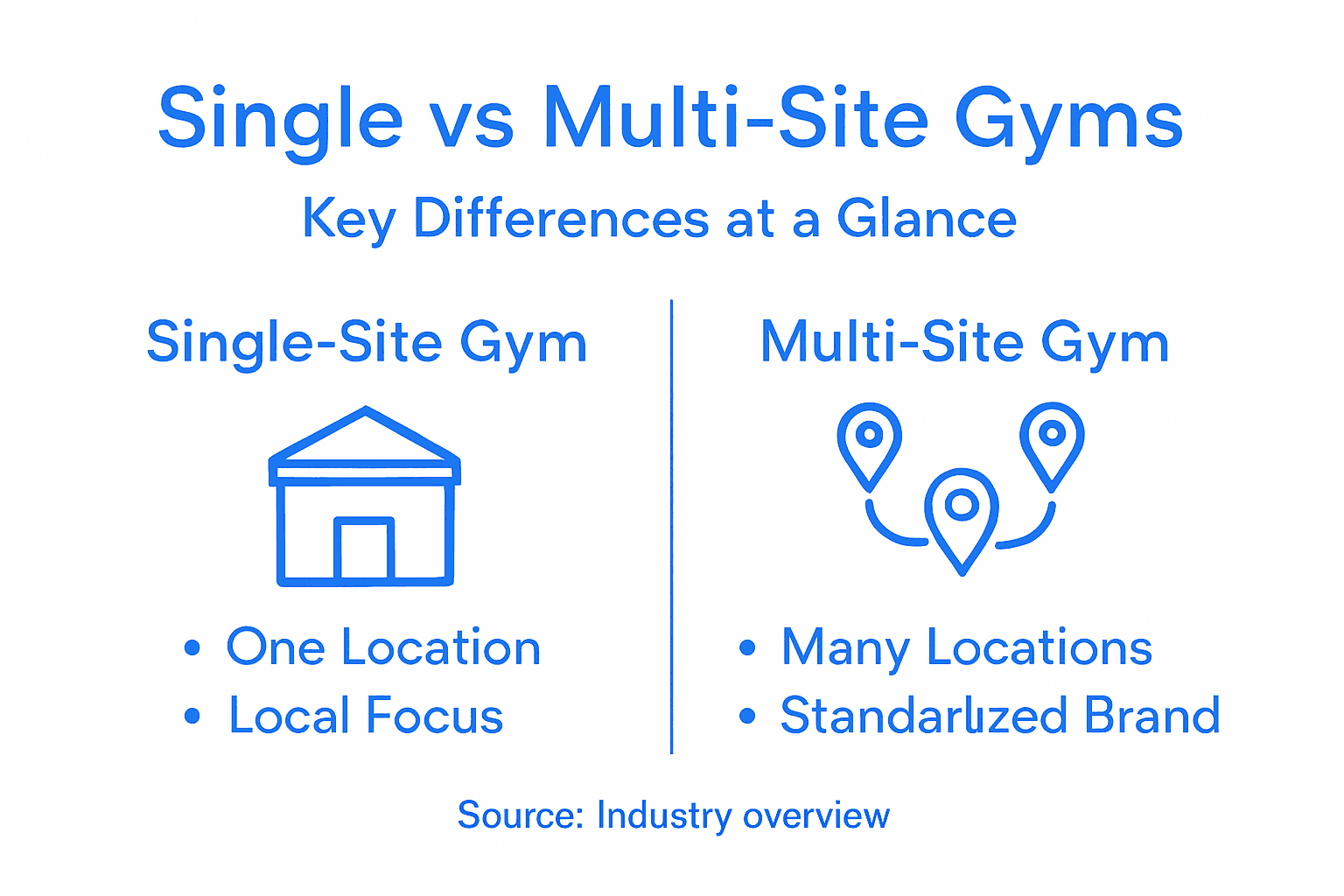
This table highlights how single-site and multi-site gyms differ strategically:
| Aspect | Single-Site Gym | Multi-Site Gym |
|---|---|---|
| Geographic Focus | Local community | Multiple regions |
| Resource Use | Individual management | Centralized coordination |
| Member Benefits | Limited flexibility | Network-wide access |
| Growth Potential | Slower, organic expansion | Rapid, scalable growth |
Pro tip: Evaluate your gym's expansion potential by analyzing member demographics, technological infrastructure, and scalability of your current operational model.
Unlock Seamless Multi-Location Gym Management with Finegym.io
Managing multiple gym locations brings unique challenges like centralized member management, unified billing, and real-time data synchronization. The article highlights how multi-location gyms require integrated technology platforms and centralized control to deliver consistent, high-quality experiences that members expect. If you're facing the complexities of coordinating scheduling, memberships, and operations across diverse sites, you are not alone.
At Finegym.io, we understand the critical need for scalable and unified management solutions designed specifically for multi-location health clubs and fitness networks. Our all-in-one SaaS platform offers streamlined tools for membership management, automated billing, and centralized scheduling that empower gym owners to maintain operational efficiency while improving member engagement. With features like QR code check-ins, marketing automation, and robust staff management, Finegym.io transforms multi-site challenges into growth opportunities.
Ready to elevate your multi-location gym operations with a technology partner built to simplify every facet of your business? Explore how Finegym.io can enhance your member experience and drive scalable growth today. Start your journey now at Finegym.io or learn more about Multi-Location Gym Management and Fitness Subscription Models. Take the next step toward a more connected and powerful gym network.
Frequently Asked Questions
What is a multi-location gym?
A multi-location gym is a fitness business that operates multiple facilities in different geographic areas, offering standardized services, membership options, and a consistent brand experience across all locations.
What are the key features of multi-location gyms?
Key features include centralized management systems, consistent brand identity, standardized equipment and training programs, unified membership protocols, and integrated technology platforms for scheduling and member tracking.
How do membership models work in multi-location gyms?
Membership models in multi-location gyms include comprehensive multi-site memberships for unlimited access, tiered access memberships with varying levels, and flexible hybrid memberships that combine in-person and digital fitness options.
What challenges do multi-location gyms face regarding management and technology?
Multi-location gyms encounter challenges such as data synchronization across locations, managing operational complexity, and ensuring security and compliance for member data while maintaining efficient technological integration.