

Most gyms let you temporarily freeze your membership, but the exact rules vary by club and membership type. Typical freeze windows run from about one month to several months, most plans charge a small administrative or recurring fee, and a freeze pauses facility access while suspending or reducing your dues rather than canceling your contract outright.
TL;DR:
- Most gyms limit freeze periods to a few months, often requiring a 14-day notice and charging a small fee, with medical or military cases sometimes fee-exempt.
- Eligibility varies by membership type, and documentation like doctor’s notes or deployment orders can speed approval, especially for long-term freezes.
- Freezing a fixed-term contract typically extends its end date by the freeze duration, while month-to-month plans simply skip billing without affecting commitment length.
- Standardized freeze policies that clearly specify notice, duration, fees, and documentation reduce disputes and improve member retention.
- Automated management tools help enforce policy consistency, automatically pause billing, send confirmations, and eliminate manual tracking errors.
Table of Contents
- What Does a Membership Freeze Policy Actually Cover?
- How Do You Request a Membership Freeze Step by Step?
- How Do Freezes Affect Fees, Billing, and Prorating?
- Who Qualifies for a Freeze, and What Documentation Is Required?
- Do Freezes Change Your Contract's Commitment Period?
- What Should an Admin-Ready Freeze Policy Include?
- Why Standardized Freeze Rules Cut Membership Churn
- How Finegym Handles Freezes, Billing Holds, and Reactivations
- Where to Check Exact Freeze Wording
- Sources
What Does a Membership Freeze Policy Actually Cover?
A freeze checklist saves you a phone call and a week of waiting. Before you submit a request, confirm these five things.
- Membership type and eligibility. Family, corporate, and student memberships often carry different freeze rules than individual plans, and some entry-level tiers don't qualify at all.
- Your next billing date and notice window. Many clubs, City Fitness among them, require 14 days' notice before your bill date so the freeze lines up cleanly with your payment cycle.
- The fee model. Some plans charge a flat one-time fee, others bill a smaller recurring freeze fee, and a few waive fees entirely for medical cases.
- Documentation on hand. A physician's note or military orders speed up approval; without them, requests often stall in review.
- Freeze versus cancellation. If you're unsure you'll return, compare the freeze fee against the cost of canceling and rejoining later, since rejoining sometimes means paying a new enrollment fee.
How Do You Request a Membership Freeze Step by Step?
The process is straightforward once you know what a club actually needs from you. Here's the sequence that avoids the most common rejection reasons.
- Check your contract for the maximum freeze length. Ranges vary widely. Life Time caps suspensions at four months per calendar year, while LA Fitness offers a paid-in-full freeze option lasting up to six months.
- Map the freeze against your billing date. Starting mid-cycle can trigger a partial charge, so confirm whether your club aligns freeze start and end dates to your bill date.
- Submit a complete request. Include your name, member ID, requested start and end dates, and the reason. Some operators, like MyGym, process freezes online only and don't accept verbal requests at the front desk.
- Attach documentation and confirm receipt. A scanned letter or PDF order attached to your online submission is far more reliable than handing paperwork to a staff member who may not log it.
- Track your billing and reactivation date. Watch your bank or card statement for the next cycle to verify the freeze took effect, and mark your calendar for the reactivation date so you're not caught off guard by a resumed charge.
Pro Tip: Screenshot or save a PDF of your freeze confirmation email the day you receive it. If billing disputes come up three months later, that timestamp is your best evidence the request went through on time.
Administrators should mirror this same sequence internally: log the request date, the approved dates, and the fee applied, so front-desk staff and billing systems stay in sync.
How Do Freezes Affect Fees, Billing, and Prorating?
Freeze fees generally fall into three buckets: a flat one-time administrative charge, a small recurring reduced fee, or no fee at all for qualifying medical or military cases. LA Fitness illustrates the range well, with a $10 monthly suspension fee for month-to-month plans, a flat fee for a paid-in-full freeze lasting up to several months, and a bi-weekly suspension option around $5. City Fitness uses a similar bi-weekly structure, charging roughly $5 per bi-weekly period while a freeze is active.
Life Time doesn't drop members to zero access during a suspension. It converts them to a $15/month digital membership, keeping app and streaming content available even though the club itself is off limits.
Annual fees often survive a freeze even when monthly dues don't. Read your contract for that clause specifically, because it's the detail most members miss. Paid-in-full memberships typically get their expiration date pushed back by the freeze length, while month-to-month plans simply skip billing during the frozen period. Reactivating mid-cycle can trigger a prorated charge for the partial month, a detail LA Fitness flags explicitly for members unfreezing outside a normal billing date.
Who Qualifies for a Freeze, and What Documentation Is Required?
Clubs generally recognize three qualifying categories, each with its own paperwork expectations.
- Medical reasons (injury, surgery, pregnancy) usually require a physician's letter stating the condition and expected duration, and clubs may ask for updated documentation if the freeze extends past 90 days.
- Military deployment or transfer typically calls for a copy of deployment or transfer orders, which 24 Hour Fitness requests in writing before granting these freezes.
- Relocation or extended travel often needs an employer letter or proof of a new address, and some clubs cap this category at a shorter window than medical freezes.
Long-term situations, like extended disability, sometimes qualify for renewable freeze periods rather than a single fixed window. Ask your club whether it re-verifies documentation on a rolling basis. Members in poor standing on their account, meaning past-due balances, generally don't qualify for a freeze until the balance is resolved.
Do Freezes Change Your Contract's Commitment Period?
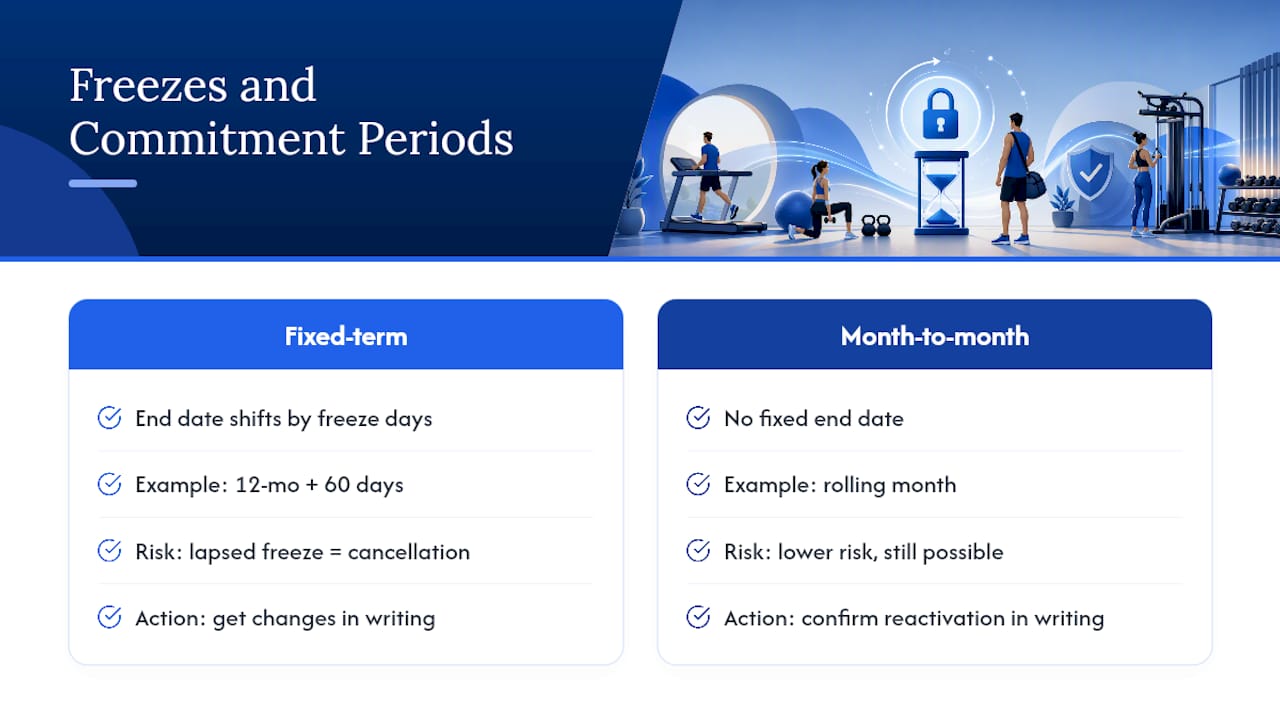
Freezing a fixed-term contract usually pushes its end date back by the same number of days you were frozen. A 12-month agreement frozen for 60 days typically becomes a 12-month agreement that now ends 60 days later, not a shorter commitment. 24 Hour Fitness applies this extension model as standard practice for members in good standing.
Month-to-month memberships don't carry this complication since there's no fixed end date to push. But if you fail to reactivate on schedule or don't request an extension in writing, some clubs treat the lapsed freeze as an implied cancellation, which can trigger early-termination fees on a fixed-term deal. Always get term changes confirmed in writing, not just verbally at the front desk.
What Should an Admin-Ready Freeze Policy Include?
A policy that's actually enforceable needs to answer four questions in plain language: who qualifies, how much notice is required, how long a freeze can last, and what it costs. A workable template reads something like this:
"Members in good standing may request one freeze per 12-month period, up to 90 days, with 14 days' notice before the next billing date. A $10 monthly administrative fee applies during the freeze. Medical and military freezes require written documentation and are fee-exempt."
Operationally, admins need a consistent way to execute that language:
- Log every freeze request with start date, end date, and documentation status.
- Pause or adjust billing the moment approval is confirmed, not after the next invoice runs.
- Send an automated confirmation email with the exact reactivation date.
- Schedule a reactivation reminder a few days before billing resumes.
Pro Tip: Configurable freeze rules in your membership-management platform mean staff never have to remember the fee schedule by heart. The system enforces it the same way every time.
Why Standardized Freeze Rules Cut Membership Churn
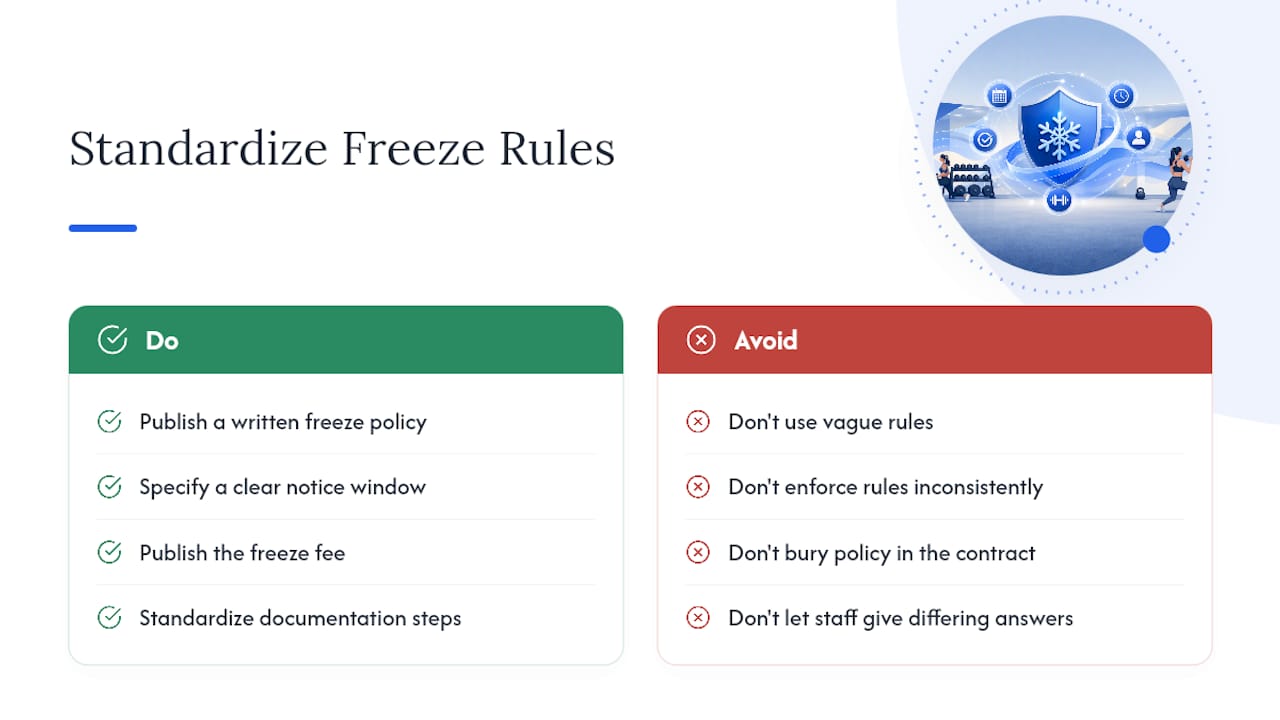
Members who freeze instead of canceling almost always come back, but only if the process felt fair the first time. Vague or inconsistently enforced freeze rules push people toward outright cancellation because they don't trust the club to handle the paperwork correctly. A written policy with a clear notice window, a published fee, and a consistent documentation standard removes that doubt.
Standardization also protects staff. When two members get different answers to the same freeze question from two different employees, that inconsistency becomes a billing dispute waiting to happen. A copy-ready policy document, distributed to every front-desk and membership team member, closes that gap before it opens. Clubs that treat freeze policy as a real operational document, not an afterthought buried in a membership contract, see fewer disputes and better retention when frozen members return.
— Vedad
How Finegym Handles Freezes, Billing Holds, and Reactivations
Manually tracking freeze dates in a spreadsheet works until you have more than a handful of members frozen at once, and then it falls apart fast. Finegym's membership-management tools let administrators set freeze rules once, including maximum duration, fee structure, and required documentation, then apply them consistently across every membership type without re-checking the policy each time.

Billing holds sync automatically with approved freeze dates, so dues pause the moment a request is confirmed instead of after the next invoice already ran. Automated confirmation emails and reactivation reminders, built on the same notification system that handles class reminders, mean members always know their exact reactivation date without a staff member chasing them down. Pair that with prorated billing tools for mid-cycle reactivations, and the fee disputes that come from manual tracking largely disappear. If you're rebuilding your freeze policy from scratch, a demo of the full platform will show you how the workflow runs end to end, from request to reactivation.
Where to Check Exact Freeze Wording
Policy language varies enough that it's worth reading a real example before drafting your own. University of Cincinnati Campus Rec shows a simple, low-friction online request flow. VASA Fitness demonstrates typical fee disclosure and maximum-duration phrasing worth borrowing for your own policy document.
Sources
- How do I suspend my membership? — Life Time
- Freeze or Cancel Gym Membership | City Fitness
- Member Policies | 24 Hour Fitness