

Gyms collect a staggering amount of sensitive member data, from payment details to health records and personal identification. Fitness businesses are prime targets for cybercriminals precisely because of this data goldmine. Yet many gym owners underestimate their vulnerability, assuming they're too small to attract hackers. The reality is far more sobering: data breaches in the fitness industry are increasing, exposing member information and triggering massive financial and reputational consequences. This guide reveals why data security must be your top priority and how to implement protection strategies that safeguard your members and your business.
Table of Contents
- Why Gyms Are Prime Targets For Cyberattacks
- Understanding Compliance: PCI DSS, HIPAA, GDPR, And CCPA
- Best Practices For Securing Gym Member Data
- The Cost Of Neglecting Data Security In Gyms
- Explore Finegym's Secure Gym Management Solutions
- Is HIPAA Compliance Required For All Gyms?
- What Are The Most Common Cyber Threats Gyms Face?
- How Can Gyms Ensure PCI DSS Compliance?
- What Immediate Steps Should A Gym Take After A Data Breach?
Key takeaways
| Point | Details |
|---|---|
| Gyms are attractive targets | Fitness facilities store sensitive member data including payment information, health records, and personal identification, making them prime targets for cybercriminals. |
| Compliance is mandatory | Non-compliance with PCI DSS can result in fines from $5,000 to $100,000 monthly, while GDPR and CCPA violations carry severe penalties. |
| Breaches are costly | The average data breach costs $4.88 million, including financial losses, legal fees, and reputational damage that drives members away. |
| Prevention is essential | Implementing multi-factor authentication, encryption, staff training, and regular security audits protects member data and business integrity. |
Why gyms are prime targets for cyberattacks
Your gym collects far more sensitive data than you might realize. Member profiles contain photos, addresses, emergency contacts, and birthdates. Payment systems store credit card numbers and bank account details. Health assessments document medical conditions, injuries, and fitness goals. Some facilities even maintain copies of government-issued IDs for verification purposes. This comprehensive data collection creates a treasure trove for cybercriminals seeking to commit identity theft, financial fraud, or sell information on the dark web.
Cyberattacks targeting gyms typically involve phishing schemes where staff members receive fraudulent emails requesting login credentials. Ransomware attacks encrypt your entire member database until you pay a hefty ransom. Credential stuffing exploits reused passwords to gain unauthorized access. Point-of-sale malware captures payment card data during transactions. These aren't theoretical threats. Recent incidents have exposed hundreds of thousands of gym member records, revealing how vulnerable the fitness industry has become.
The financial impact is staggering. Data breaches now cost an average of $4.88 million, covering forensic investigations, legal fees, regulatory fines, and member notification expenses. Smaller gyms face particularly devastating consequences because a single breach can consume their entire annual profit margin. Beyond direct costs, you'll lose members who no longer trust you with their information. Competitors will capitalize on your security failure in their marketing.
Pro Tip: Implement secure access control for 24-hour fitness facilities to reduce unauthorized physical and digital access points that hackers exploit.
Many gym owners mistakenly believe they're too small or insignificant to attract cybercriminals. This dangerous assumption leaves them exposed. Hackers specifically target small businesses because they typically lack robust security infrastructure. Your gym isn't just a service provider anymore. You're a data custodian responsible for protecting sensitive member information against increasingly sophisticated threats.
Understanding compliance: PCI DSS, HIPAA, GDPR, and CCPA
Navigating data security regulations feels overwhelming, but understanding your compliance obligations protects you from catastrophic fines and legal battles. The Payment Card Industry Data Security Standard (PCI DSS) applies to every gym that processes credit card payments. This includes requirements for secure networks, encrypted cardholder data, access controls, and regular security testing. Only 27.9% of organizations are fully compliant with PCI DSS, exposing the majority to significant risks. Non-compliance triggers fines ranging from $5,000 to $100,000 monthly until you resolve violations.
HIPAA compliance confuses many gym operators. Most gyms are not covered entities under HIPAA and don't need to comply unless they provide healthcare services like physical therapy or work with health plans as business associates. Standard fitness training and wellness programs fall outside HIPAA's scope. However, if your facility offers medical services, employs healthcare providers, or handles protected health information for insurance purposes, HIPAA requirements become mandatory.
GDPR affects gyms with European members, while CCPA applies to California residents. Both regulations grant individuals rights over their personal data, including access, deletion, and opt-out provisions. Non-compliance with GDPR and CCPA leads to hefty fines and legal repercussions. GDPR violations can reach 4% of annual global revenue or €20 million, whichever is higher. CCPA penalties start at $2,500 per violation and increase to $7,500 for intentional violations.
| Regulation | Applies When | Key Requirements | Penalties |
|---|---|---|---|
| PCI DSS | Processing credit cards | Secure networks, encryption, access controls, testing | $5,000 to $100,000 monthly |
| HIPAA | Providing healthcare services | Privacy rules, security safeguards, breach notification | Up to $50,000 per violation |
| GDPR | European member data | Consent, data rights, breach notification within 72 hours | Up to 4% annual revenue |
| CCPA | California resident data | Disclosure, deletion rights, opt-out mechanisms | $2,500 to $7,500 per violation |
Pro Tip: Outsourcing payment processing to third-party providers doesn't eliminate your PCI DSS compliance responsibility. You remain liable for securing cardholder data throughout the entire transaction process.
Understanding these regulations helps you implement appropriate safeguards and avoid costly violations. Review legal and compliance considerations for fitness software to ensure your systems meet regulatory standards.
Best practices for securing gym member data
Protecting member data requires a multi-layered security approach that addresses both technical vulnerabilities and human factors. Start by conducting regular security audits that identify weaknesses in your systems before hackers exploit them. Vulnerability assessments examine your network infrastructure, software applications, and data storage methods. Third-party security firms provide objective evaluations and actionable recommendations. Schedule these audits quarterly rather than annually to stay ahead of emerging threats.

Implementing robust security measures across all systems handling customer data creates your first line of defense. Multi-factor authentication requires staff to verify their identity through multiple methods before accessing sensitive information. Conditional access policies act as an intelligent bouncer, allowing only authorized staff to access systems under the right conditions. These policies can restrict access based on location, device type, or time of day, preventing unauthorized entry even if credentials are compromised.
Staff education forms a critical security component because employees often represent your weakest link. Train team members to recognize phishing emails, create strong passwords, and handle member data appropriately. Conduct simulated phishing exercises to test their awareness. Establish clear protocols for reporting suspicious activity. Make security training part of your onboarding process and provide refresher courses quarterly.
Encryption protects data both at rest and in transit. Encrypt member databases so stolen files become unreadable without decryption keys. Use secure protocols like HTTPS and TLS for all data transmissions between your systems and member devices. This prevents hackers from intercepting sensitive information during payment processing or account access.
- Deploy comprehensive antivirus and anti-malware software across all devices and update it automatically.
- Establish custom business policies for gyms that define data handling procedures and access permissions.
- Maintain current software versions and apply security patches immediately when vendors release them.
- Implement automated backup systems that store encrypted copies offsite for disaster recovery.
- Restrict administrative privileges to essential personnel only and monitor their activities.
- Conduct background checks on employees who handle sensitive member information.
- Review and update your incident response plan annually to ensure rapid breach containment.
Vendor management deserves special attention because third-party providers can introduce security vulnerabilities. Evaluate the security practices of software vendors, payment processors, and cloud service providers before partnering with them. Require vendors to demonstrate compliance with relevant regulations and maintain adequate cybersecurity insurance. Include security requirements in your contracts and conduct periodic vendor assessments.
Pro Tip: Review creating effective policies for fitness businesses to establish comprehensive data security protocols that protect member information and ensure staff accountability.
The cost of neglecting data security in gyms
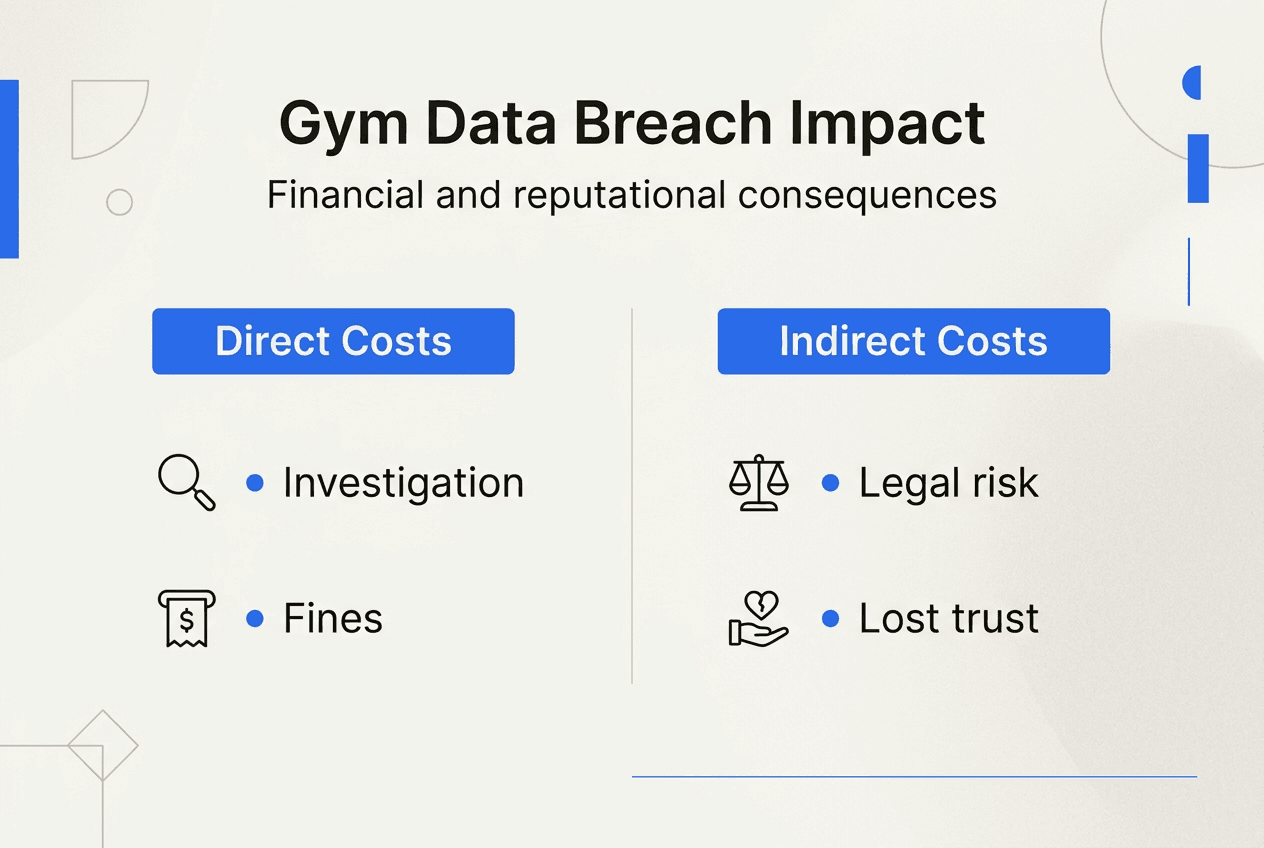
The financial devastation from data breaches extends far beyond immediate response costs. Average breach costs reached $4.88 million in 2024 and continue rising as cybercriminals become more sophisticated. This figure includes forensic investigations to determine breach scope, legal counsel fees, regulatory fines, member notification expenses, credit monitoring services, and public relations efforts to salvage your reputation. Smaller gyms typically can't absorb these costs without severe financial strain or closure.
| Cost Category | Estimated Impact | Timeline |
|---|---|---|
| Forensic investigation | $50,000 to $200,000 | Immediate |
| Legal fees and settlements | $100,000 to $500,000 | 6 to 24 months |
| Regulatory fines | $5,000 to $100,000 monthly | Ongoing until compliance |
| Member notification | $10 to $50 per affected member | Within 30 to 60 days |
| Credit monitoring services | $15 to $25 per member annually | 1 to 2 years |
| Reputational damage | 20% to 40% member loss | Long term |
PCI DSS violations result in fines from $5,000 to $100,000 per month until you achieve compliance. Payment card brands may also increase your transaction fees or terminate your ability to process cards entirely. Imagine losing your primary payment method while simultaneously paying mounting fines. This scenario forces many gyms into bankruptcy.
Legal risks multiply when you fail to comply with breach notification laws. Lack of timely breach notification leads to legal issues under regulations like CCPA, which requires notification within specific timeframes. Class action lawsuits from affected members add another layer of financial exposure. Even if you ultimately prevail in court, legal defense costs drain resources you could invest in growing your business.
Reputational harm proves hardest to quantify but often inflicts the most lasting damage. Members lose trust when their personal information is compromised. They share negative experiences on social media, review sites, and within their networks. Prospective members choose competitors with better security track records. Rebuilding trust takes years and requires consistent demonstration of improved security practices.
Pro Tip: Calculate your potential breach costs based on your member count and compare them to preventive security investments. You'll quickly realize that comprehensive security measures cost a fraction of breach response expenses.
Investing in robust security infrastructure, staff training, and compliance programs represents sound financial planning. The relatively modest upfront costs pale in comparison to the catastrophic expenses of a data breach. Review legal and compliance considerations for fitness software to understand how proper systems protect both your members and your bottom line.
Explore Finegym's secure gym management solutions
Protecting member data while streamlining operations requires purpose-built software designed with security at its core. Finegym offers comprehensive gym management software solutions that integrate secure payment processing, encrypted data storage, and customizable access controls. Our platform helps you maintain PCI DSS compliance through secure payment processing software that protects cardholder data throughout every transaction.

Establish robust data protection protocols with custom business policies for gyms that define exactly who can access sensitive information and under what circumstances. Finegym's security features include automated backups, encryption standards, and audit trails that document every data access event. These capabilities help you demonstrate compliance during regulatory reviews while giving members confidence that their information remains protected.
Is HIPAA compliance required for all gyms?
HIPAA applies only when your gym provides healthcare services, employs healthcare providers like physical therapists, or handles protected health information as a business associate for covered entities. Standard fitness training, personal training sessions, and wellness programs don't trigger HIPAA requirements. However, if you offer medical services, work with health insurance plans, or maintain medical records beyond basic fitness assessments, compliance becomes mandatory. Consult with legal counsel to determine your specific obligations. Learn more about data-driven fitness business management that balances member privacy with operational insights.
What are the most common cyber threats gyms face?
Phishing attacks targeting staff members represent the most prevalent threat, tricking employees into revealing login credentials or downloading malware. Ransomware encrypts your member database and demands payment for decryption keys. Credential stuffing exploits members who reuse passwords across multiple sites. Point-of-sale malware captures payment card information during transactions. Insider threats from disgruntled employees can also compromise data security. Understanding these threats helps you implement appropriate defenses. Explore how cloud-based fitness management reduces certain vulnerabilities while introducing new security considerations.
How can gyms ensure PCI DSS compliance?
Implement secure payment processing systems that encrypt cardholder data and restrict access to authorized personnel only. Conduct quarterly vulnerability scans and annual penetration testing to identify security weaknesses. Maintain detailed documentation of your security policies, procedures, and compliance efforts. Train staff on PCI DSS requirements and data handling protocols. Remember that outsourcing payment processing doesn't eliminate your compliance responsibility. You remain accountable for protecting cardholder data throughout the entire transaction lifecycle. Review legal and compliance considerations to ensure your systems meet all regulatory standards.
What immediate steps should a gym take after a data breach?
Contain the breach immediately by disconnecting affected systems from your network to prevent further data exposure. Notify affected members promptly as required by applicable laws, typically within 30 to 72 hours depending on jurisdiction. Engage cybersecurity experts to conduct a comprehensive forensic investigation determining breach scope and entry points. Consult legal counsel experienced in data breach response to navigate notification requirements and potential liability. Implement enhanced security measures to prevent recurrence, including password resets, access control updates, and system patches. Document every action taken for regulatory compliance and potential legal proceedings.