

Gym membership tiers usually fall into three practical buckets: entry/basic, mid-level, and premium. The rule for choosing among them is simple: pick the cheapest tier that actually covers the clubs and classes you use. Two features deserve extra scrutiny before you sign anything.
- Entry/basic: single-club equipment access, no classes, minimal extras
- Mid-level: classes included, regional access, guest passes
- Premium: multi-club or nationwide access, recovery amenities, priority booking
- Watch closely: multi-club access (often overpriced if you never travel) and freeze/cancellation terms (they decide how much you lose if life gets in the way)
Key Takeaways
The tier worth paying for is the cheapest one that fully covers your actual visit frequency, class use, and location needs, not the one with the longest amenity list.
| Point | Details |
|---|---|
| Match tier to habits | Choose the cheapest level that covers your real visit frequency and locations, not aspirational use. |
| Multi-club access costs more | Only pay for regional or nationwide access if you actually train across multiple locations. |
| Fees hide in the fine print | Enrollment, annual, and auto-pay terms can shift the real monthly cost well past the advertised rate. |
| Class packs expire | Check rollover and expiry rules before assuming unused credits carry no cost. |
| Operators shape value with systems | Finegym's automated billing and freeze tools reduce the friction that erodes trust in tiered pricing. |
Table of Contents
- How Gyms Structure Membership Levels
- What's Actually Inside Each Fitness Package Option
- The Real Cost Behind Advertised Gym Pricing Plans
- Class-Based or Access-Based: Which Wins for You?
- How to Pick the Right Tier: A Practical Checklist
- Why Operators Build Tiers This Way, and What It Means for You
- Common Add-Ons That Go Beyond the Standard Tiers
- How Discounts and Promotions Move the Price You Actually Pay
- A Publisher's Note on Picking a Tier
- Finegym: Run Tier Programs Members Actually Trust
- Sources
How Gyms Structure Membership Levels
Most operators build gym membership levels around three variables: where you can work out, what's included beyond equipment, and how long you're committed to stay.
- Access-based tiers control geography. A home-club tier limits you to one location; a regional tier opens a metro area; a national tier, like Planet Fitness's PF Black Card, unlocks any club in the chain. This matters most if you travel for work or split time between two cities.
- Amenity-based tiers stack on extras. EōS Fitness sells three tiers, Will Do, Will Crush, and Will Power, where the jump between them adds pools, saunas, and expanded club access rather than more workout time.
- Class-based tiers price around volume. Orangetheory runs Basic (4 classes a month), Elite (8), and Premier (unlimited), plus class packs for occasional users.
- Term/commitment models layer on top of any of the above, trading a longer contract for a lower rate.
Names like "Gold," "Peak," or "Black Card" don't map to a fixed feature set industrywide. Always check what a specific tier unlocks at the location you'd actually join.
What's Actually Inside Each Fitness Package Option
Marketing copy loves vague words like "premium." Here's what that usually translates to in real fitness package options.
- Entry/basic: equipment floor, single-club access, locker use, sometimes a basic app
- Mid-level: group classes, regional or multi-state access, occasional guest passes, expanded app content
- Premium: nationwide or all-club access, recovery tools like massage chairs or cold plunges, priority class booking, discounts with retail or wellness partners
Crunch Fitness illustrates the trade-off well: its Base tier is single-club equipment access, while Peak and Peak Results add classes and multi-club privileges, at prices that shift noticeably by location. One common catch: some tiers trade guest passes for class inclusion, so you rarely get both at the entry price.
Pro Tip: Ask specifically whether guest passes are unlimited or capped monthly. "Guest privileges" on a brochure can mean two visits a year or two a week, and staff won't always volunteer the difference unless you ask directly.
The Real Cost Behind Advertised Gym Pricing Plans
Advertised gym pricing plans rarely match what hits your card. The same tier name can cost meaningfully more in a dense metro market than in a suburban location, since real estate and local demand drive base rates as much as the feature list does.
Watch for these add-ons before you compare a listed price against a competitor's:
- Enrollment or processing fees charged once at sign-up
- Annual fees billed automatically around your join date
- Local sales tax on top of the membership rate
- Per-class fees for add-on formats not covered by your tier
- Equipment or towel-service charges at some clubs
Auto-pay and longer-term commitments typically unlock the lowest advertised rate; month-to-month plans usually cost more per month and skip most discounts. To compare fairly, divide your total monthly cost, including fees averaged over the year, by how many times you'll realistically show up. A $40 monthly membership used twice a week runs about $5 a visit; used once a month, it's $40 a visit. Finegym's breakdown of hidden fees in fitness subscriptions walks through this math with more detail.
Class-Based or Access-Based: Which Wins for You?
The math here comes down to how often you actually show up.
- Unlimited classes pay off around three sessions a week or more. Below that, you're subsidizing empty slots on your own membership card.
- Class packs and credits work for occasional users, but check expiry windows and rollover rules first. Orangetheory's class-pack system can leave unused credits on the table if you don't track them.
- Multi-club access earns its premium only if your routine actually spans locations, whether that's a work commute, travel, or a second home.
A quick example: 8 classes a month at around $99 puts the per-class cost in the low double digits. Unlimited plans become more cost-effective only if your visits exceed approximately three times per week.
How to Pick the Right Tier: A Practical Checklist
Run through this before you sign, not after.
- How many days a week will you realistically train?
- Do you need more than one location, or just one?
- Will you use group classes, or just the floor?
- Do you want guest privileges, and how often?
- What's your real monthly budget, including fees?
- What are the freeze and cancellation terms?
Ask staff directly: "What's your freeze policy if I travel?" "Is there an early-termination fee?" "Are classes included or extra?" "What's the enrollment and annual fee, exactly?" Get answers in writing, or check the guest policy details online before you visit.
Red flags: fees the staff can't explain clearly, pressure to sign before you've seen the contract, or freeze terms that only exist verbally.
Worked example: you train three times a week and skip classes entirely. Entry-level covers you fine, since mid-level's class access adds cost you won't use.
Pro Tip: Bring up cancellation terms before you ask about price. Staff scripts are built to sell the rate first; asking about the exit early tends to get you a straighter answer.
Why Operators Build Tiers This Way, and What It Means for You
Gyms tier memberships for a business reason: it segments revenue, smooths facility usage across peak and off-peak hours, and creates a natural upsell path as members get more invested. That's not a bad thing for members, as long as the rules are transparent.
The mechanics behind good tier design usually come down to systems, not just pricing sheets:
- Automated billing that flags failed payments before they become disputes
- Freeze workflows members can trigger without a phone call
- Class scheduling that shows real-time availability by tier
- QR check-ins that enforce access rules automatically at the door
Tiering works best when the friction sits on the operator's side, not the member's. A member should never have to guess whether their freeze request went through or whether their guest pass expired.
Finegym's membership management tools and access control and check-in features exist to make those rules enforceable without a staff member manually tracking exceptions.
Common Add-Ons That Go Beyond the Standard Tiers
Most gyms sell extras that sit outside the core tier structure entirely. Personal training packages are the most common: a set number of one-on-one sessions billed separately, often at a discount if bundled with a higher membership tier. Nutrition coaching and body-composition scans follow a similar model, priced per session or per package rather than folded into monthly dues.
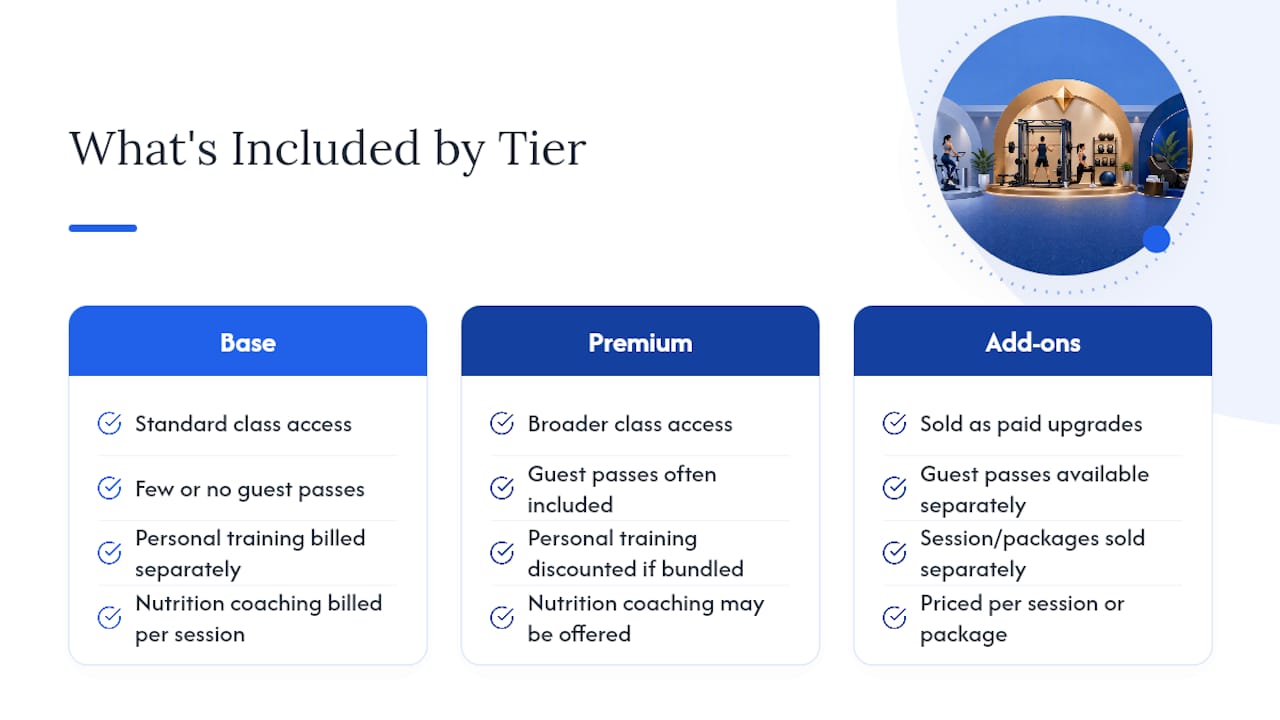
Recovery add-ons have grown fast: infrared saunas, cryotherapy, massage chairs, and compression therapy often carry their own access fee even inside clubs that include them for premium members. Some clubs sell "recovery lounge" access as a standalone upgrade for members who don't want to jump a full tier just for that one perk.
Specialty class add-ons matter too. Reformer Pilates, hot yoga, or boxing programs frequently sit outside standard class credits, billed as drop-in fees or their own small-format membership.
Family and household add-ons are common at multi-purpose clubs: adding a spouse or child at a discounted rate rather than paying two full memberships. Locker rental, towel service, and parking are smaller but real recurring charges worth checking before you assume your monthly rate is the whole bill.
The pattern across all of these: the base tier rarely includes everything a gym offers. Ask what's bundled and what's billed separately before comparing two gyms on sticker price alone.
How Discounts and Promotions Move the Price You Actually Pay
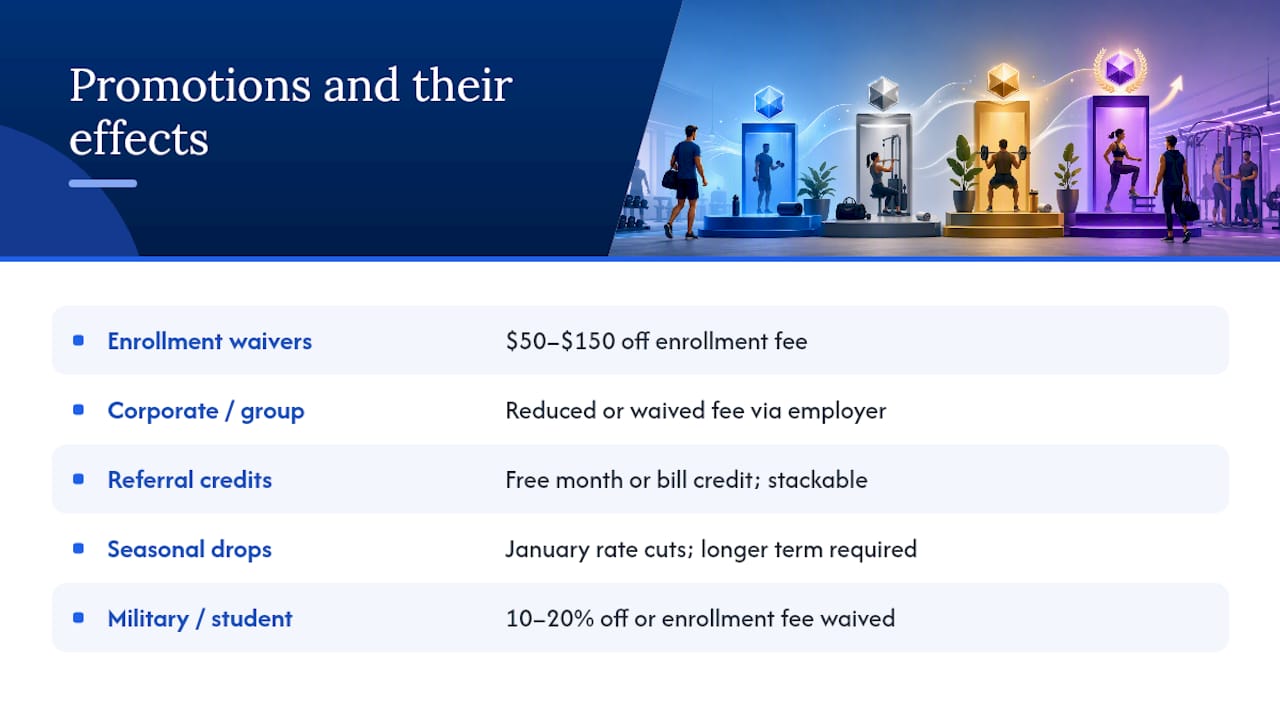
Promotional pricing changes gym membership tiers more than most people realize. Enrollment-fee waivers are the most common promotion, usually tied to a specific sign-up window like New Year's or back-to-school season, and they can be worth $50 to $150 depending on the club.
Corporate and group discounts are widespread but rarely advertised on the main pricing page. Many employers negotiate a reduced rate or waived enrollment fee for employees, sometimes through a wellness benefit program. It's worth asking your HR department before you assume the public rate is your only option.
Referral credits, where an existing member gets a free month or bill credit for bringing in a new signup, show up at nearly every chain and are usually stackable with other promotions. Seasonal rate drops, particularly around January, can temporarily undercut the standard price on mid-level and premium tiers to capture New Year's resolution demand, though the lower rate often locks you into a longer commitment term.
Military, student, and first-responder discounts are common but inconsistent; some clubs cut 10 to 20 percent off the standard rate, others only waive the enrollment fee. None of these promotions are guaranteed to last past the sign-up window, so confirm in writing whether a promotional rate is permanent or reverts after a set period.
A Publisher's Note on Picking a Tier
If you're a member, match the tier to your real habits, not your aspirational ones. If you're an operator, write your freeze and billing rules down and automate them; ambiguity is what turns a fair policy into a complaint. Finegym's membership management tools are built for exactly that gap.
— Vedad
Finegym: Run Tier Programs Members Actually Trust
Finegym gives operators a way to run tiered pricing without the manual chaos that usually comes with it, automated billing that catches failed payments early, freeze workflows members can trigger themselves, real-time class scheduling by tier, and QR check-ins that enforce access rules at the door.
If you manage a gym, CrossFit box, or multi-location studio and your tier rules live in someone's memory instead of your system, that's the exact friction Finegym's gym management software is built to remove. You can also start with the free gym management plan to test billing and freeze automation before committing to anything larger. Request a demo and see how your specific tier structure maps into the platform.
Sources
- Join Orangetheory Fitness & Explore Our Gym Membership Options
- EōS FITNESS MEMBERSHIPS
- How Much Does a Crunch Fitness Membership Cost? - NerdWallet
- Gym Memberships | Starting at $15 | Planet Fitness